A company’s structure—the way in which it is organized—can have a major impact on the way it performs. There are several models of corporate structure typically used in the business world, and they continue to evolve. The first consideration is whether power should be centralized at the top, with decisionmaking in the hands of a few key senior employees, or decentralized, with more power in the hands of staff, and with fewer people to go through for approval.
78% of groups reach solutions to simple tasks faster in centralized structures
100% of groups reach solutions to complex tasks faster in decentralized structures
Choosing a structure
Most start-ups have a centralized structure. More complex structures either evolve or are designed as the company grows, depending on the nature and size of the business, the complexity of the work, any requirement for instant expertise, and the geographical location of parts of the business.
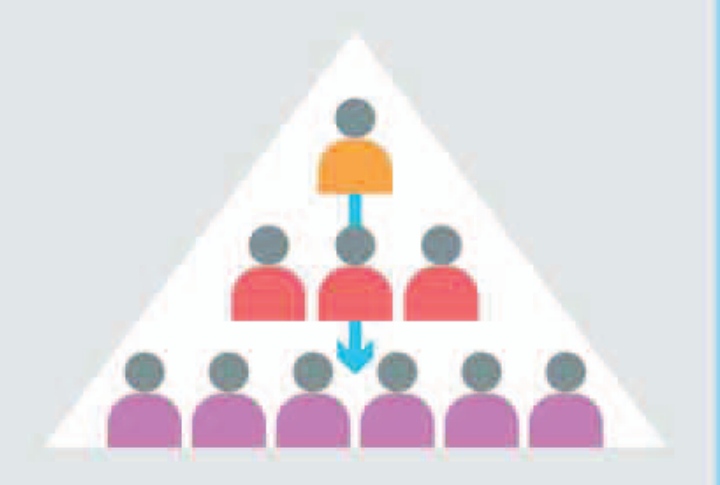
Centralized
Power rests in the hands of a few people, with a long chain of command.
❯ Power at the top
❯ Rigid
❯ Conventional
❯ Inflexible
❯ Slow response to change
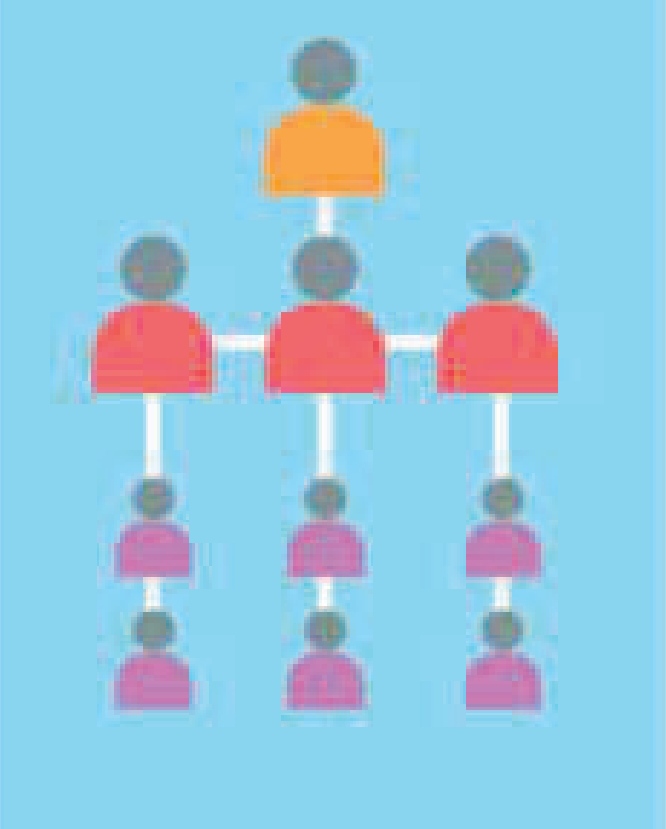
Functional
Good for strict control and formal relationships, as in the military.
CEO COORDINATES
Divisional
Suits companies with many global offices or product lines.
CEO COORDINATES AND EACH DIVISION RESPONSIBLE FOR GENERATING PROFIT
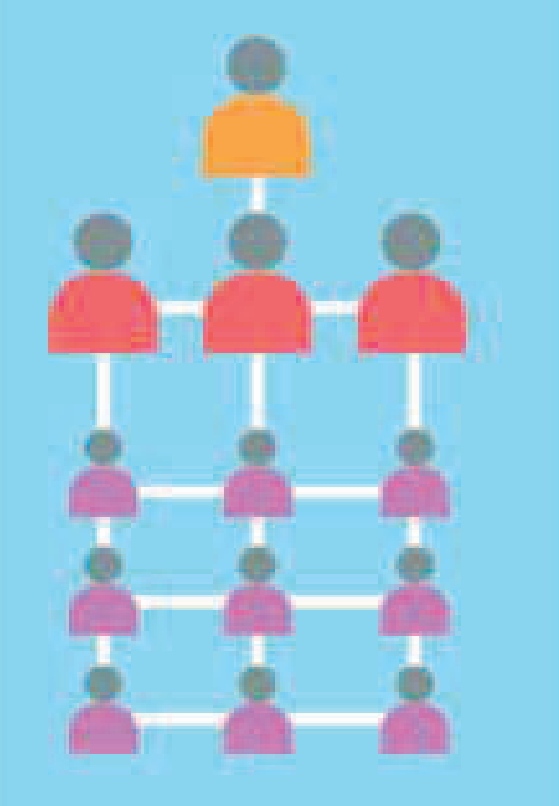
Matrix
Good for large corporations with complex projects in different locations.
DIVISIONAL AND FUNCTIONAL MANAGERS COORDINATE
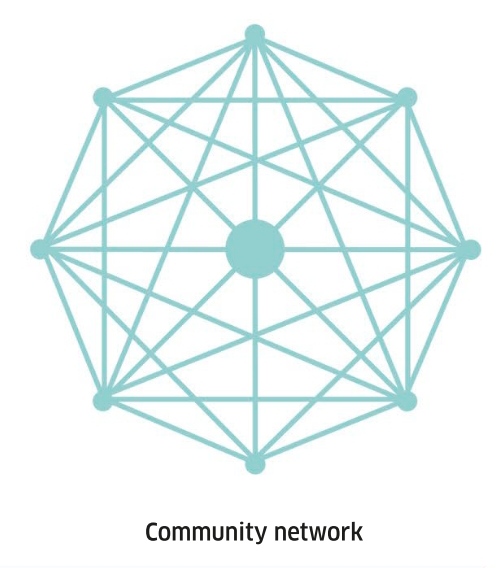
Network
Suits creative and technology companies in which everyone is online.
CORE COMPANY COLLABORATES WITH VIRTUAL COMMUNITY
Team-based
For companies that rely on innovation and are customer focused
STAFF SELFCOORDINATE
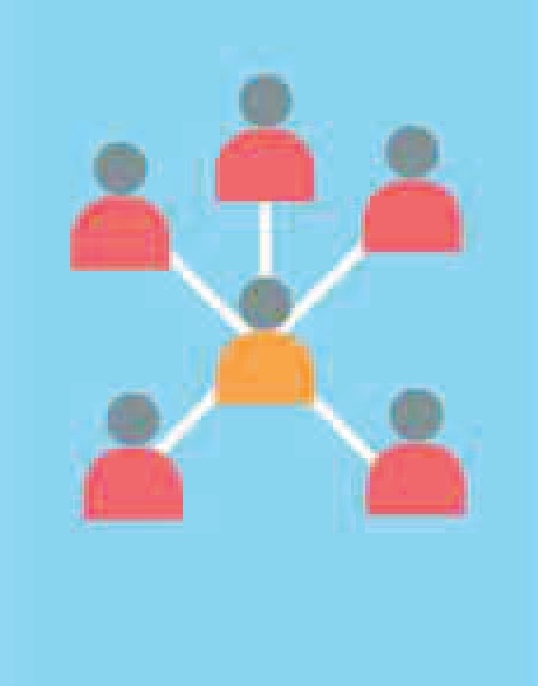
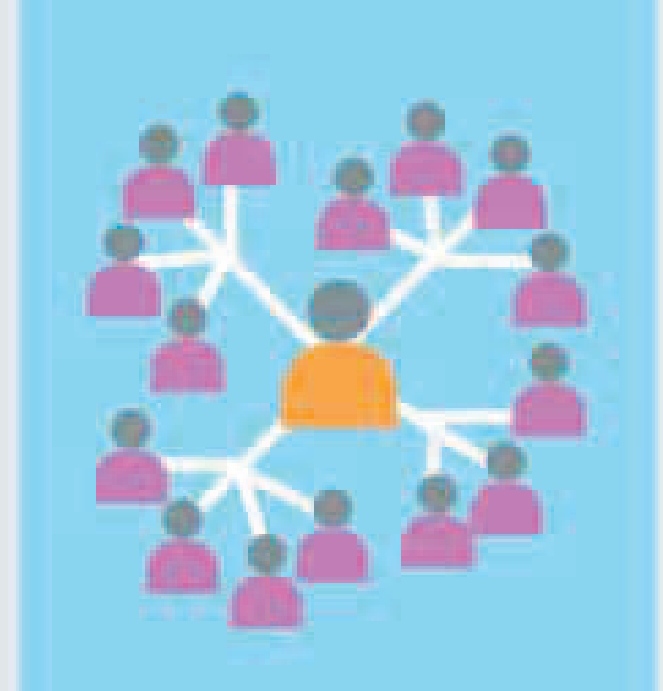
Decentralized
Power is spread through the company, and staff make their own decisions
❯ Power shared
❯ Organic
❯ Experimental
❯ Flexible
❯ Fast response to change
WARNING
When change is needed
Signs that a structure is not working include low morale and high staff turnover, no new products being developed, and profit suddenly accelerating or decelerating. Tools to amend poor structure include:
❯ Business process reengineering (BPR) Analyzing and redesigning the workflow within a company
❯ Altering the reporting line In a traditional solid-line reporting relationship, one line manager oversees goals and performance. It can be beneficial to switch to the weaker chain of a dotted-line reporting relationship, in which a manager sets some but not all the objectives.
Every organization has a particular workplace environment, consciously or unconsciously shaped by the personalities, values, and behavior of the people leading it and working in it.
How it works
The organizational culture of every business is different, reflecting the ethos of the company, its workplace habits, and the image the company projects. It is also tied to the type of work that has to be done. In a high-stakes financial trading company, the pace and pressure of the work makes the atmosphere of the corporate environment crackle, whereas in a company relying on creativity for its products, the mood is likely to be more relaxed. The type of incentives offered to management and employees may also affect the workplace, resulting in either a competitive or a collaborative culture, or a mix of both.
NEED TO KNOW
❯ Control systems Used by managers to set standards and measure performance
❯ Leverage Power to influence a person or situation
❯ Paradigm Value system of goals, mission, and beliefs
Types of corporate cultures
Management experts have tried to explain how organizational cultures work. Charles Handy, a former professor at the London Business School, describes them in terms of four major types: power, task, role, and person.
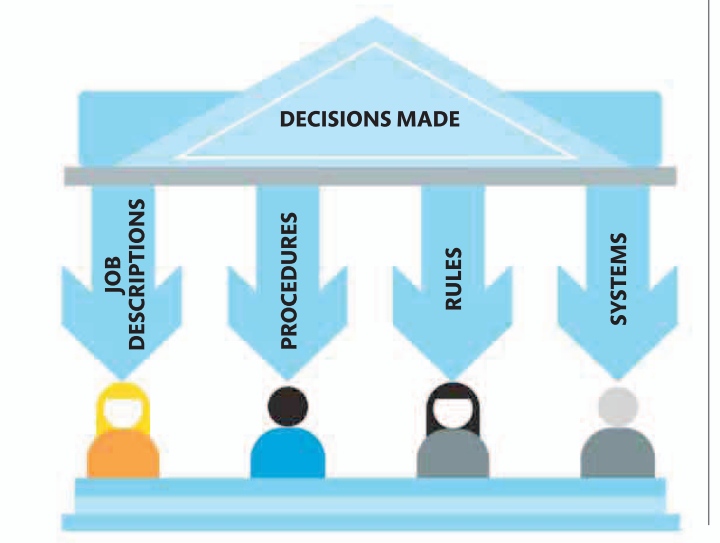
Role culture
Where a company is based on the structural support of specialized roles. Each role is crucial and will persist even if the person occupying it leaves. Procedures and systems are strictly followed, as in a government department.
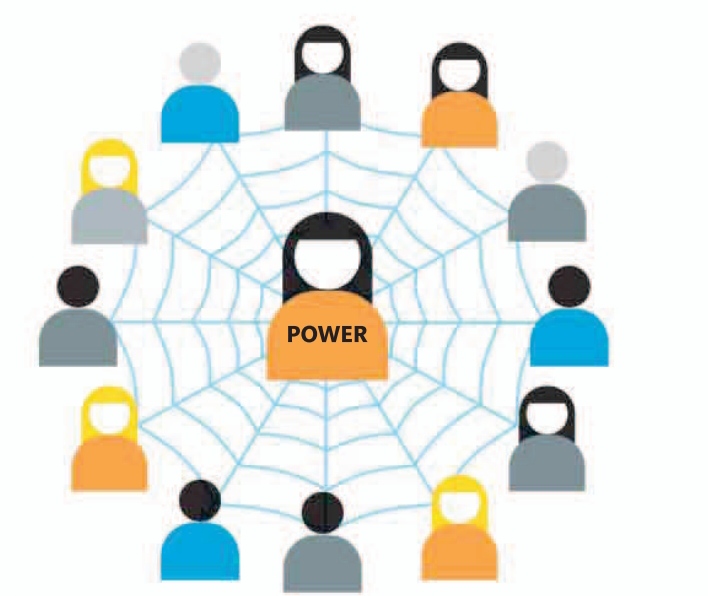
Power culture
Driven by a powerful individual at the center of the organization, who is relied on for decision-making and the company’s successes. Those closest to the center have most influence. Typical of a family-owned business.
Task culture
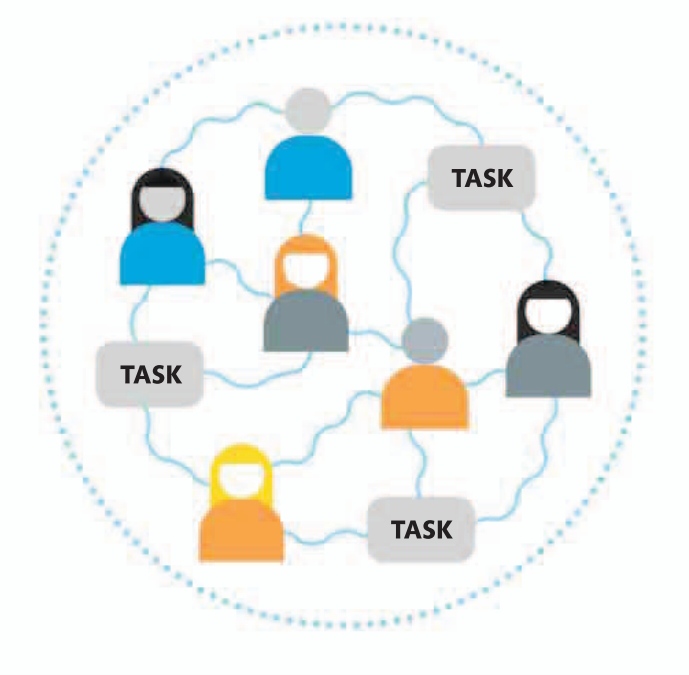
Project-oriented work where a project’s completion is the motivating force. Relies on teamwork and individuals’ expertise, but results are more important than personal objectives. Found in technology companies, for example
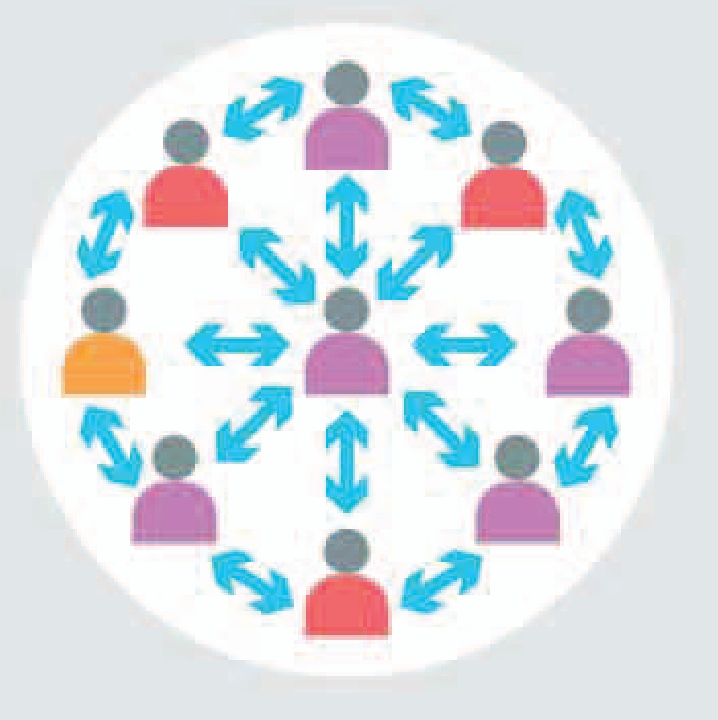
Person culture
Company power and influence is shared among individuals who work semi-autonomously. Individuals count for more than the company, which is made up of people with similar specialist training, such as in an architects’ practice.
WHAT SHAPES CORPORATE CULTURE?
Many factors reinforce a culture. To bring about change, the workforce needs to be inspired by different motivations, values, and types of role models.
Organization size Big business, or small company
Company structure Strict hierarchy, or power shared among many people
Founding values Includes origination myths and stories
Leaders Their personality and behavior
Symbols Titles, dress codes, interior aesthetic
Control systems Rewards, incentives, performance assessment
86% of senior managers in global organizations agree that organizational culture is critical to success
Every organization has a particular workplace environment, consciously or unconsciously shaped by the personalities, values, and behavior of the people leading it and working in it.
How it works
The organizational culture of every business is different, reflecting the ethos of the company, its workplace habits, and the image the company projects. It is also tied to the type of work that has to be done. In a high-stakes financial trading company, the pace and pressure of the work makes the atmosphere of the corporate environment crackle, whereas in a company relying on creativity for its products, the mood is likely to be more relaxed. The type of incentives offered to management and employees may also affect the workplace, resulting in either a competitive or a collaborative culture, or a mix of both.
NEED TO KNOW
❯ Control systems Used by managers to set standards and measure performance
❯ Leverage Power to influence a person or situation
❯ Paradigm Value system of goals, mission, and beliefs
Types of corporate cultures
Management experts have tried to explain how organizational cultures work. Charles Handy, a former professor at the London Business School, describes them in terms of four major types: power, task, role, and person.
Role culture
Where a company is based on the structural support of specialized roles. Each role is crucial and will persist even if the person occupying it leaves. Procedures and systems are strictly followed, as in a government department.
Power culture
Driven by a powerful individual at the center of the organization, who is relied on for decision-making and the company’s successes. Those closest to the center have most influence. Typical of a family-owned business.
Task culture
Project-oriented work where a project’s completion is the motivating force. Relies on teamwork and individuals’ expertise, but results are more important than personal objectives. Found in technology companies, for example
Person culture
Company power and influence is shared among individuals who work semi-autonomously. Individuals count for more than the company, which is made up of people with similar specialist training, such as in an architects’ practice.
WHAT SHAPES CORPORATE CULTURE?
Many factors reinforce a culture. To bring about change, the workforce needs to be inspired by different motivations, values, and types of role models.
Organization size Big business, or small company
Company structure Strict hierarchy, or power shared among many people
Founding values Includes origination myths and stories
Leaders Their personality and behavior
Symbols Titles, dress codes, interior aesthetic
Control systems Rewards, incentives, performance assessment
86% of senior managers in global organizations agree that organizational culture is critical to success
As we progress through our lives, we can learn from experiences in work, at home, and in our communities. Development is continuous and keeps us motivated and focused on, “what’s next?”
The most reliable path to success is to assume that learning is not a process that you finish, but a way to approach every situation you encounter. There are always opportunities to seek out new situations in which to learn and develop. With the help of a “growth mindset” (see p.26), you can always stay vitally and rewardingly engaged.
Seeking out knowledge
Do we ever reach a point where we “know enough”? Certainly we can acquire enough skills to meet a particular challenge, but there are far-ranging benefits to continuing our learning:
■ Learning makes us more confident and resilient.
The experience of meeting challenges and using our intelligence to overcome them boosts our sense that we can cope with difficult situations
■ Learners are better able to cope with change.
Mastering new concepts accustoms us to encountering unfamiliar and perhaps challenging beliefs. The more we come to terms with unknown ways of thinking, the less daunting the unknown becomes.
Learning enriches our experiences.
Life becomes more interesting as we learn and develop. The more we can approach the world as students, the more we are likely to thrive in it.
■ Learning makes us more well rounded.
A 2015 study published in Adult Education Quarterly found that the best measure of lifelong learning was “human capital”—the understanding we can gain by educating ourselves. “Social capital,” or the extent to which we build on connections with others to help us develop, was also helpful, especially for those with less formal education. But the greater their “human capital,” the better the subjects of the research were able to make effective use of their skills in a variety of situations.
■ Learning preserves our well-being as we age.
Studies confirm that older people who embark on education enjoy higher levels of health and happiness, and the connections and insight they foster enrich the community as a whole.
Learning to learn
It may sound like a narrow topic, but learning itself can be a skill to develop. In 2006, the European Parliament and Council listed this as one of several “key competences” we can improve throughout our lives. Here is the complete list:
■ Communication in our mother tongue
■ Communication in foreign languages ■ Mathematical, scientific, and technical competence ■ Digital and computer competence ■ Learning to learn
■ Social and civic competence
■ A sense of initiative and entrepreneurship
■ Cultural awareness and expression.
If you need a general recipe for success, one of the best things you could do is follow this curriculum.
THE LEARNER IN SOCIETY
How should we understand our learning in the widest context? Danish Professor of Lifelong Learning Knud Illeris argues that we learn in three dimensions: through our thoughts (cognition), our feelings (emotion), and our place in the world (environment). This creates balance:
✔ COGNITION: our personal abilities and understanding
✔ EMOTION: how we achieve psychological balance
✔ ENVIRONMENT: how we positively integrate into the world and culture around us.
REACHING FOR MEANING
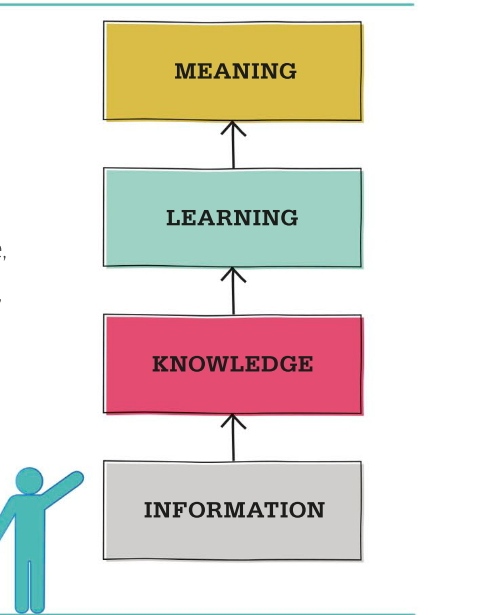
According to Portuguese psychologist and education expert Roberto Carneiro, learning is a process that grows more complex—and more fulfilling—as we develop. We begin with approaching basic information, and progress from there to knowledge, which gives us a grasp of the facts. Then, we approach genuine “learning,” in which we refine our understanding of the knowledge we’ve gained. Finally, we reach a sense of meaning, in which the application, value, and worth of all we’ve learned starts to become clear.
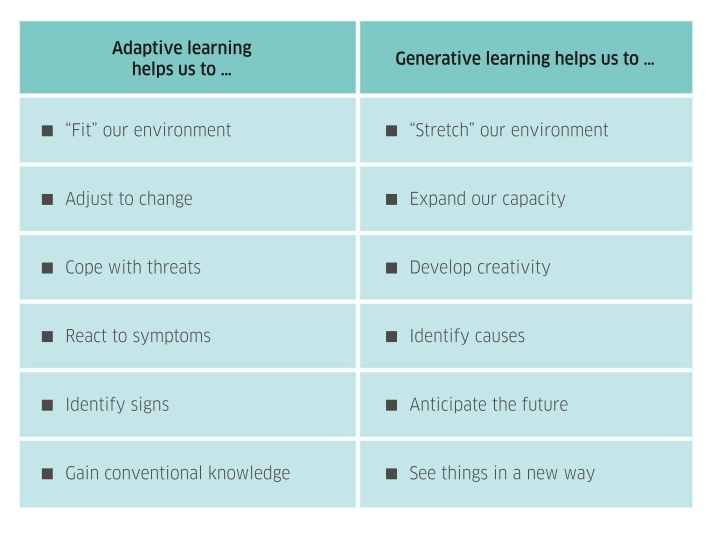
TO ADAPT OR GENERATE?
Thinking of learning as a way of gaining information is useful but limited.Professor Roberto Carneiro proposes a distinction between “adaptive” and “generative” learning. Adaptive learning helps us to manage within our environment; generative learning helps us to change our environment. To be successful, we need to cultivate both types of learning.
Success involves coping well with challenges and crises, but also relishing good things when you find them. That way, when life does get difficult, you can benefit from a well-rounded outlook based on positivity and optimism
A positive mindset is a long-term investment that prepares you for life’s challenges. Research has found that when we experience good moods, this tends to broaden our outlook and allow us to respond to situations— including bad ones—more flexibly than usual. If we can cultivate this positive mindset, it’s likely to help us build maturity of character. If you want to get through life with a robust attitude, don’t push yourself to be “tougher,” but instead open yourself to the full range of life’s experiences (good, bad, and challenging). Here are some approaches you may find useful in your journey.
SAVOR THE GOOD MOMENTS
In the Journal of Happiness Studies, psychologists Michele Tugade and Barbara Fredrickson point out that if we have something good to report, we commonly call friends and family, wanting to tell as many people as possible. This is partly about maintaining social connections, but it’s also about prolonging the happy mood: sharing the good news keeps the pleasure fresh in our minds. We can prolong the mood at any time, by looking forward to a positive experience, enjoying it while it lasts, and then relishing the memory afterward. All are ways of “capitalizing” on something pleasant—which is to say, getting as much value out of it as we can.
ENJOY ALL YOU CAN
Psychology distinguishes between two kinds of well-being:
■ Hedonic well-being.From the Greek hēdonē, meaning “pleasure.” This describes subjective, in-themoment experiences that we find enjoyable.
■ Eudaimonic well-being.From the Greek eu, meaning “good” and daimōn, meaning “spirit.” This describes long-term activities that allow us to grow, have positive relationships with other people, and feel good about ourselves.
It’s not only life’s challenges that foster our resilience; it’s also our experiences of life at its best. So make enough room for enjoyment in your life.
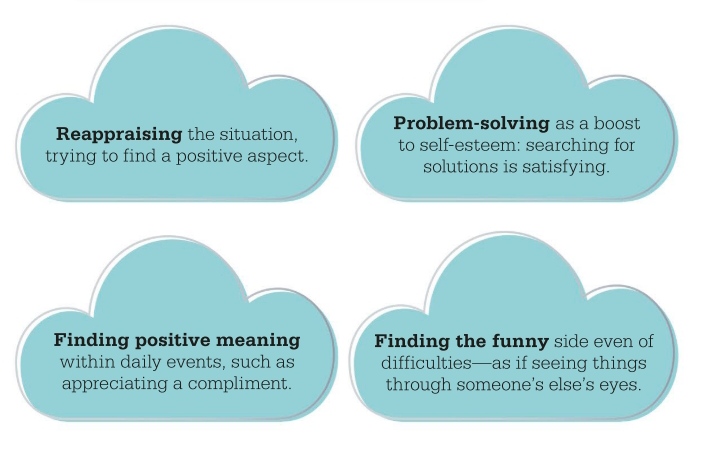
FIND THE SILVER LINING
We can’t prevent the bad moments, but we can learn to experience at least some positive emotions within them. According to a 2000 US study, useful approaches for turning negative to positive are:
Don’t wait for a big problem to arise before you put these coping methods into effect. Instead, see them as faculties you can exercise at any time so that you’ll be strong and ready for whatever life brings you.
KEEP A BALANCED PERSPECTIVE
While a positive attitude is undoubtedly good for success, in some circustances this needs qualification. As psychologists Robert Cummins and Mark Wooden remark in the Journal of Happiness Studies, “the extremes of optimism are […] maladaptive”— which means too much can be as unhelpful as too little. Too little optimism makes us discouraged and fearful, but an excess can make us impulsive in situations where caution would serve us better. Balance is the key to success: being optimistic but also realistic.
CHOOSE YOUR AFFIRMATIONS WISELY
worse after repeating generalized, nonspecific positive affirmations. It seems they didn’t feel that these statements were true, and having to articulate them only served as a reminder that these were painful subjects. If you decide to use affirmations to lift your spirits, choose statements that you feel describe positive attributes about your talents and what is important to you, such as, “I am excellent at attending to details and planning.”
When your life is focused on planning for success, it can be easy to treat leisure time as a low priority. In fact, though, you may find it easier to attain your goals if you plan your free time equally well.
Our time is valuable. Yet when it comes to enjoying our recreation time, we can find it slipping away. It’s understandable that we may feel reluctant to plan our downtime— with all the pressures of life, we don’t want to turn fun into yet more work—but a bit of forethought can mean the difference between time lost and time relished.
The universal goal
The desire to enjoy our leisure time spans nations and generations. Research conducted by the World Health Organization in 2008 found that an enjoyment of leisure time, especially when it produces “flow” experiences (see pp.166–167), improves people’s quality of life in a range of countries around the world. Meanwhile, a 2006 Brazilian study found that a structured outdoor adventure program markedly improved the quality of life of citizens aged between 60 and 80. Whatever our age or place of origin, we need free time—but it’s more “freeing” when it’s at least moderately planned.
Making it worthwhile
When we’re tired and overwhelmed, we often long for more time to relax. Sometimes, though, quality is better than quantity. A 2010 study published in the Journal of Happiness Studies documented the lives of 403 students over the course of a month. It found that simply having more free time didn’t necessarily lead to an improvement in the students’ well-being. What mattered was how well they used their free time.
Those who did benefit from their free time had a proactive approach to it. They tended to:
■ Engage in physical activities
■ Engage in social activities, with both friends and family
■ Engage in specific leisure activities, such as excursions and hobbies
WHAT FILLS YOUR TIME?
Psychotherapist and business coach Lynn Grodzki states that our time can be divided into three basic categories
■ Work time. Activities that bring us either joy or money.
■ Spirit time. Meaningful activities that rejuvenate our souls.
■ Buffer time. Time spent on practical and psychological “inessentials” that can eat into the two other, more important categories.
How much of your time is being spent on buffer activities? Could you fill it with something more effective?
TYPES OF LEISURE ACTIVITY
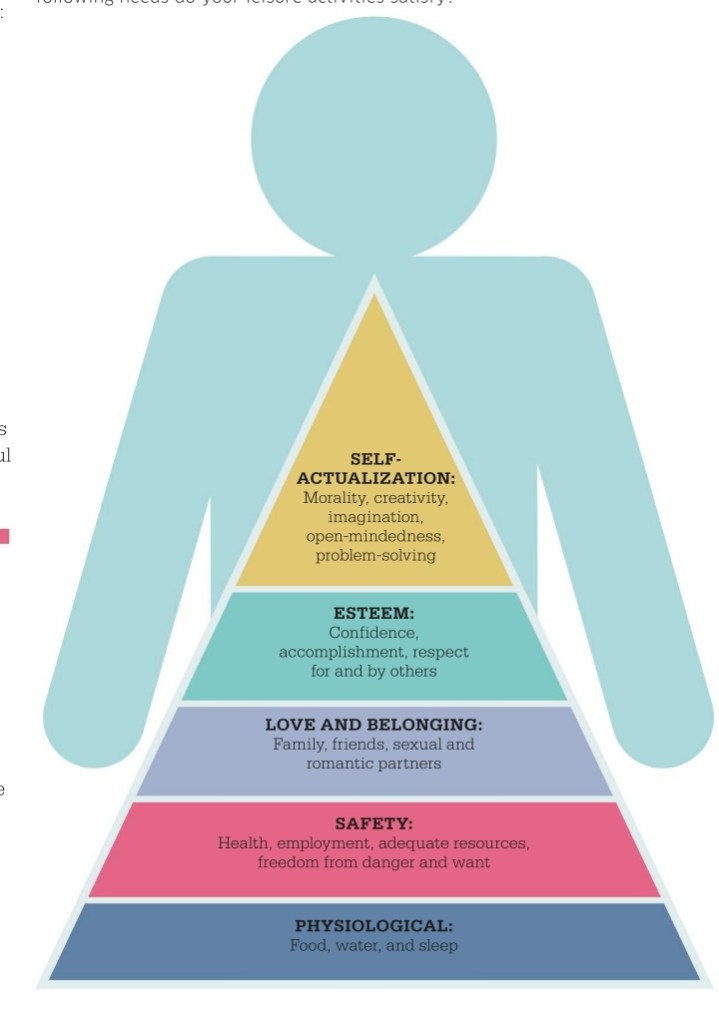
What do we get out of leisure? Working from Maslow’s “hierarchy of needs” (see “Our deepest needs,” right), psychologists Mounir Ragheb and Jacob Beard identified six types of activity that give us satisfaction
1.Psychological.Look for activities that reward you on an emotional or cognitive level
2.Educational.Find activities that improve your knowledge and understanding.
3.Social.Involve your friends and family in your leisure activities.
4.Relaxation.Seek out peaceful and unchallenging activities.
5.Physiological.Enjoy pleasant physical activities.
6.Aesthetic.Engage in activities in which you can enjoy beautiful places and things.
OUR DEEPEST NEEDS
In 1943, American psychologist Abraham Maslow first advanced his theory of the “hierarchy of needs”—the idea that we meet our most basic needs first, and then seek to meet “higher” needs, which help us achieve our full potential. Maslow based his theory on his study of outstanding individuals, such as physicist Albert Einstein and abolitionist hero Frederick Douglass, believing that such people represented the healthiest in human psychology. Leisure activities tend to represent the upper tiers of the hierarchy. Which of the following needs do your leisure activities satisfy?
■ Set specific goals, such as, “I want to improve my fitness”
■ Schedule activities in advance.
If we assume that our leisure time will take care of itself, we are more likely to end up feeling bored and unsatisfied. This can raise our stress levels, as the sense that time is slipping away is more likely to make us feel anxious than rested. Research suggests we thrive most when we see “time off” as a period for doing things that matter to us, rather than just a spell when we’re not working.
Burnout doesn’t happen overnight, but if you’ve been pushing yourself for too long you may not realize you’re heading for trouble until it’s too late. Learn to recognize the signs and take steps to look after yourself.
We all have days when we’re tired, but burnout is more serious. Burnout occurs when chronic stress overwhelms you to the point where everything in your life starts to suffer. Your efforts need to be sustainable over the long term, and protecting yourself is much more effective than waiting until you are spent to take action
The telltale signs
To know when it’s time to give yourself a change or a rest, watch out for these problems:
■ Lots of minor health complaints. Your immune system weakens when you’re exhausted, and this means you’re more susceptible to bugs and illnesses. You may also develop stress-related symptoms such as headaches, palpitations, dizziness, chest pains, and stomach problems—in which case, see a doctor.
■ Chronic tiredness.If you’re tired after a big effort, that’s one thing, but if you’re tired all the time—especially if you feel too tired to get simple, everyday things done—you may be suffering from burnout.
■ Trouble sleeping.If you’re chronically stressed, you’re in a state of constant arousal, which means it can be hard to shut off and relax at the end of the day
■ Impaired memory and concentration.Too much pressure pushes your body into a state of “fight or flight.” In the short term this can help by diverting all our cognitive resources to a single problem, but we’re not designed to live like this over an extended period. If you’re developing tunnel vision or feeling confused, you may need a proper rest.
■ Diminished job performance.Compare your current performance to how you were doing a year or two ago. Burnout tends to reveal itself in a slow but steady decline.
■ Interpersonal problems.Are you having more disagreements and quarrels than usual? Or are you feeling detached from others?
■ Poor self-care.Are you forgetting to eat, or living on junk food? Are you going without exercise or sleep?
■ Dark emotions.Anger, depression, anxiety, cynicism, and numbness indicate that you may be reaching your limit.
Preemptive measures
If you notice any of the warning signs, follow these steps to get yourself back on an even keel:
■ Say “no” where you can.Some things may be nonnegotiable, but don’t take on any more than you absolutely have to
■ Forget perfectionism. Your aim is to be “good enough,” not perfect
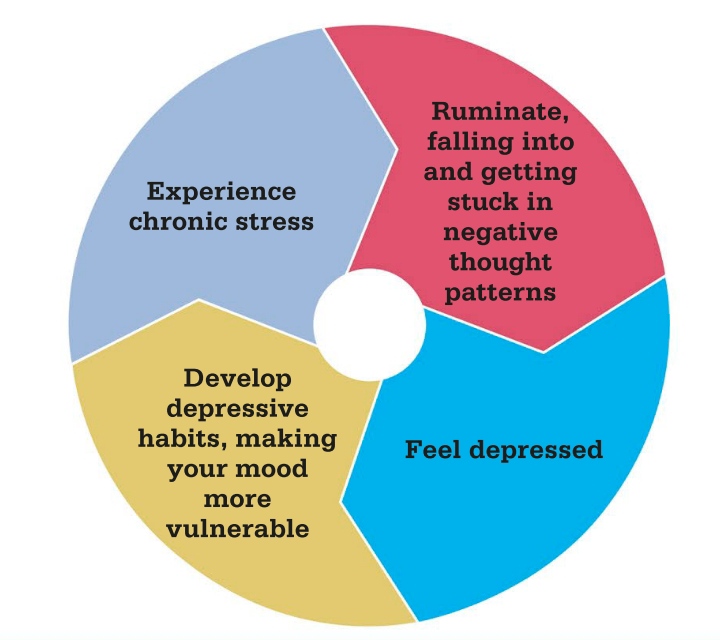
■ Don’t ruminate .Rumination is when we lapse into a spiral of brooding (see “The ruminative cycle,” right): remind yourself of the positives or distract yourself with something else to break the pattern.
■ Know when to get out.Potential causes of burnout are situations of unfairness, insufficient reward, unsupportive communities, and lack of control. Sometimes the solution is to change your environment.
■ Take care of yourself.You have to eat, drink, sleep, and get some exercise: neglecting your physical well-being is a false economy.
■ Have a place to be vulnerable,preferably with other people who are going through the same problems as you.
■ Live your values.A big cause of burnout is a disconnect between what you believe in and what you’re working toward. Find ways to do things that align with your principles. Put your own well-being first: it helps no one if you run yourself into the ground. It’s more efficient to function at a level you can comfortably sustain over the long term—this is a key component of achieving and maintaining enduring success.
THE RUMINATIVE CYCLE
Reflecting and planning can be helpful, but beware of the “ruminative cycle,” shown below, in which dwelling on negative thoughts can become self-reinforcing. If you find yourself getting mired in worries, resentments, or bad memories, remember that the solution involves breaking a habit. When the problem is overthinking bad feelings, you can’t think your way to a solution—it’s better to go and do something completely different. Listen to music, read a book, cook a meal—whatever it takes to get your mind running along pleasanter lines. It may take some effort at first, but persevere, and you may find your mood lifts.
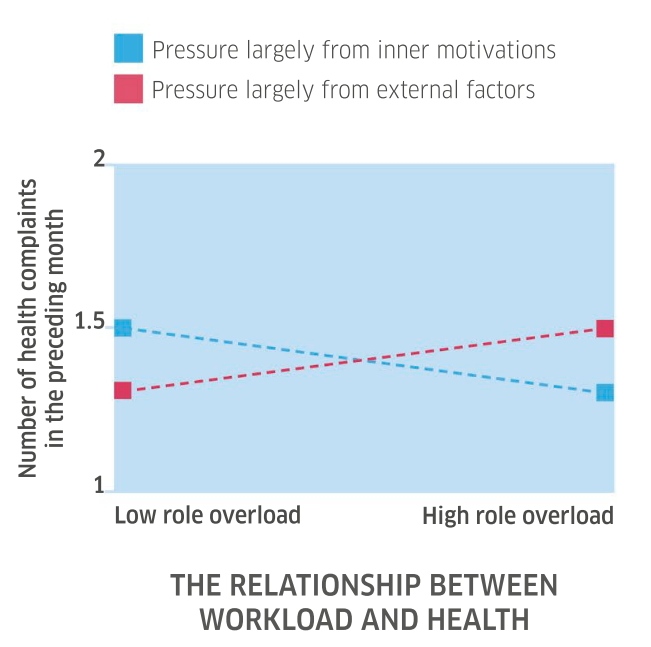
OPTIMUM WORKLOADS
The type of control we have over our work can have an impact on our health. A 2010 Australian–Canadian study found that people who are self-motivated and have a high level of control become less prone to illness as their workload increases. Try to identify your own optimum workload: it may seem counterintuitive, but an increased workload may improve your health.
Nobody likes the idea of falling short, but in order to keep moving forward, we need to be able to learn from our mistakes. This means being able to accept failure instead of fleeing from the discomfort it causes.
Learning from our mistakes can be critical for our success. A 2015 US study, for example, found that serial entrepreneurs were not only more likely to change industries if a venture failed, but were more likely to fail in the new industry too, not least because they were new to it, lacked expertise, and assumed that what did work in the old field should work in the new. It’s easy to get stuck in a pattern of doing things automatically, but what really helps us develop is being able to step back and identify what we can do differently in the future based on the mistakes we made in the past
Seeing straight
Humans are prone to a particularly awkward cognitive error: we see what we expect to see rather than what’s actually there. “Schema theory” argues that this can even include what’s right in front of us, from minor mistakes such as putting the cereal box in the fridge because we were thinking about the cupboard, to fatal mistakes such as a nurse attaching a patient to the wrong drip because of nerves or the pressure of the job. The less reflective we are, the more we fail— and we need to be able to learn the right lessons from our failures
Defensive thinking
If we’re intelligent, surely we should be good at learning from mistakes? In fact, according to business specialist Chris Argyris, smart people often lack this skill. The problem is one of mental habits. High achievers usually succeed at what they attempt. As a result, they don’t experience failure on a regular basis and so don’t have much practice at learning from it. Many of us are problem-oriented: if something is wrong, our instinct is to fix it as quickly as possible and move on. This may feel efficient, but it doesn’t help us examine the causes, which could include the need to revise our own approach (see “Learning loops,” above). When we fail to get the result we want, we tend to go into defensive reasoning. We tried, it didn’t work, and we don’t want it to be our fault, so we redirect our energy into proving that it wasn’t. This is a sure way to shut down our problem-solving abilities.
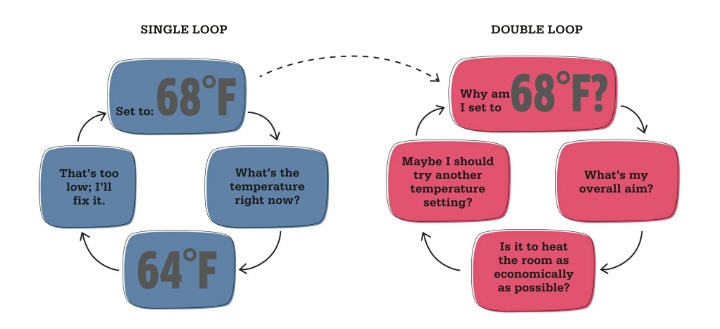
LEARNING LOOPS
Business theorist Chris Argyris points to two different ways of learning from mistakes, the single and double loop. A single loop can be efficient if you’re pursuing a specific goal, but if you want to broaden your mental scope, it’s better to add another loop to your thinking that looks at the bigger picture as well—not just whether you did a particular task “by the book,” but also examining the nature of the task itself. Argyris uses the example of seeing yourself as a thermostat set to 68°F (20°C), and imagines that it could be programmed to add in another level of calculation.
Changing habits
While we like to think of ourselves as consistent, Argyris argues that our principles tend to be undermined by a pattern of thinking that aims to:
■ Keep us in control
■ Maximize “winning” and minimize “losing”
■ Suppress negative feelings
■ Be “rational,” which, in practice, means evaluating our behavior on our own terms.
At their core, all of these elements are about avoiding anxiety and shame, and they don’t help us to improve. To learn from setbacks, we need to embrace vulnerability (see p.109) and crosscheck our actions and assumptions to make sure we’re not denying ourselves an important learning opportunity. We all make mistakes: the key to success is to accept them when they happen, understand what caused them and, if necessary, modify our approach. If we can do this, the mistakes themselves may matter much less.
Creativity can be defined as the ability to reimagine existing elements in a new way. If you are inventive, you can solve problems in a unique way and find new channels to achieve your goals.
Are you an artist, a scientist, or a combination of the two? According to research, it doesn’t make much difference: creativity is creativity, whatever end it serves. A 2001 American study even found that the works of Albert Einstein and Pablo Picasso were based on similar elements, such as a strong sense of aesthetics and an interest in how spaces are experienced by different observers. You may not think of yourself as a naturally creative person, but evidence suggests that how you think about the situation makes all the difference. Using this framework, think of creativity as a mental state that everyone can access. Use the seven methods below to stimulate your imagination and curiosity
1.IDENTIFY THE PROBLEM:
When you’re faced with a new challenge or problem, start by spending time in mindful observation, identifying, defining, and redefining the issue. Keep your mind as open as possible: it’s easy to get used to the status quo, especially with modern life being so fast-paced and full of distractions. Instead, try to be alert to how things are and how they might be improved—and be prepared to see the big picture and consider why they are the way they are. Resist simple or familiar explanations and probe as deeply as you can to develop your understanding.
2.ABSORB YOURSELF:
Groundwork and immersion are crucial Don’t become fixated on the idea of a sudden epiphany. There’s nothing uncreative about preparation: many of the best “inspirations” are actually the result of long and serious involvement in a field of work. The more you know, the better your ideas will be, so do your research and familiarize yourself with your subject.
3 PRACTICE GENERATING IDEAS:
Your neural networks are designed to run along familiar paths—your brain saves energy that way. We tend to have established categories and rules in our head, but these can be a barrier to innovation. We also have an awkward tendency to play it safe the more stress we’re under: research shows that volunteers pressured to be creative and given an example will, on 9 out of 10 occasions, “create” something that’s a close copy of the example. The best protection against this is practice: think of new ideas regularly in low-pressure situations where it really doesn’t matter if they’re useless. That way, you can strengthen your creative muscles in a comfortable environment, and build your confidence in the fact that you can create new options and alternatives. We’re creatures of habit, so make a habit of thinking outside the box.
4.CROSS-POLLINATE IDEA:
Combining ideas and opinions is something that comes naturally to us: you may have heard someone say that a situation or concept is like, “such-and-such meets suchand-such.” When seeking new solutions, put different concepts and solutions together and see whether they generate any chemistry. If they do, pursue this path and see where it takes you.
5.LET IT INCUBATE:
When you have an idea you don’t have to leap into action and develop it right away. You might wish to seize the moment, of course, but the creative process also runs on rest periods , so letting an idea ferment for a while can often improve it. Allow your subconscious some time to enrich things
6.EVALUATE AND SELECT:
Being creative involves vetting your ideas.Which ideas have a good benefit-to-risk ratio? Which ones feel worth the energy it will take to carry them out? Which best reflect your values and aspirations? Good support and a chance to discuss your plans in a safe environment can be particularly useful at this point.
7.TEST AND IMPLEMENT:
There’s no point testing the plot of an unwritten novel or the rough sketch of a new kind of engine, because your idea has to be at least at the first draft or prototype stage before anyone can have an informed opinion about it. However, once you have something tangible to show for your work, test it as soon as you can. Every creative endeavor involves uncertainty and the chance of failure, and discovering and correcting mistakes early on is much better for your confidence than detecting a flaw when you’re a long way down the line. Try it out while it’s still not polished—it’s a good way to get around performance anxiety because at this point, no one expects perfection.
The most exciting phrase to hear in science, the one that heralds new discoveries, is not “Eureka” but “That’s funny [curious]…”
Isaac Asimov Author and biochemist
Balance your mental space
Brain scans show that there are two major neurological states associated with creativity:
1.A relaxed, quiescent state similar to dreaming. This is when you are feeling inspired and ideas are starting to form.
2.An energetic, active state in which you elaborate on the idea you’ve “dreamed up” and put it into practice. Studies show that highly creative people are good at switching between these two states. Forcing yourself to create is likely to deny you the calm moments when the inspiration can incubate. Don’t strain yourself: rest periods are part of the creative process.
Forget the “lone genius”
There may be times when you need periods of peace and quiet to work on your ideas, but getting others’ ideas and perspectives can accelerate the creative process in ways you never imagined. The idea of the solitary intellectual pioneer is something of a myth. Numerous studies confirm that creativity is influenced by our social and cultural context, and even some of the greatest minds in history, including Albert Einstein and Charles Darwin, were working with collaborative teams when they made their breakthroughs. History may credit the lead scientist or artist, but this isn’t to say that they weren’t part of a professional community. Contact with other minds keeps us challenged and supported, and that’s good for creativity.
Stay curious
Happiness researcher Todd Kashdan defines curiosity as a willingness to seek out new experiences and to be at ease with the ambiguous and the unpredictable. Keeping an open mind means we’re always able to learn from new experiences as they come along, and tolerating uncertainty means we’re more persistent when it’s not clear how things will turn out. The Romantic poet John Keats described “what quality went to form a Man of Achievement” as “Negative Capability, that is when a man is capable of being in uncertainties, mysteries, doubts, without any irritable reaching after fact and reason.” Don’t be afraid of uncertainty: it can be the root of great work.
Be confident and persistent
The price of creativity is that sometimes things fail. According to research from the Howard Hughes Medical Institute, scientists given full creative freedom published twice In 1985, consultants Steve Grossman and Katherine Catlin developed a Black hat: you are the voice of caution, judgment, and criticism. game to stimulate creativity, called “Superheroes.” Everyone pretends to be—and might even dress up as— superheroes such as Superman and Wonder Woman. They then describe their special powers and characters, and approach the problem in those roles. The sense of empowerment and silliness can result in surprising solutions.
IN EVERY FIELD…
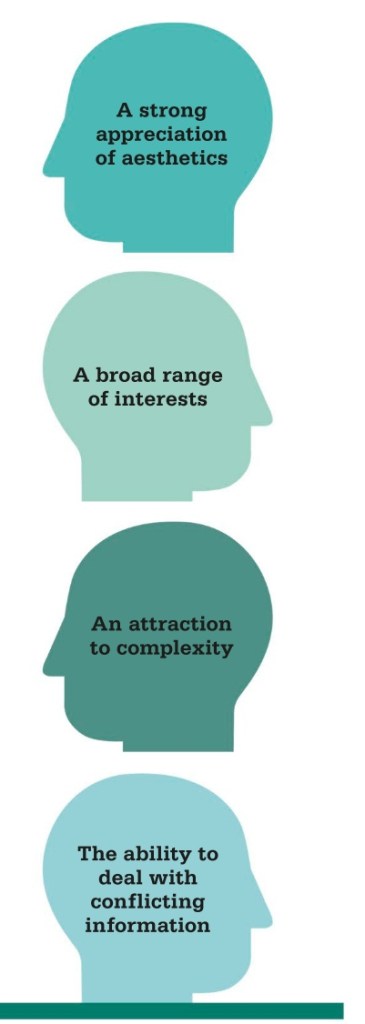
According to a 1981 study published in the Annual Review of Psychology journal, creative people in every domain share the following personality traits, which you may wish to cultivate in yourself:
Genius means little more than the faculty of An attraction to complexity perceiving in an unhabitual way.
Positive relationships are good for our emotional health, but there’s more to it than that. A dynamic network is also one of the center points of a productive community. This is social capital, and you can help create it.
The concept of “social capital” was first coined by author Lyda Judson Hanifan in 1916. The term refers to the fact that connections within the broader community enrich life both for the individual member and for the group as a whole. The idea enjoyed a revival in the popular consciousness when American academic Robert D. Putnam published his 2000 book Bowling Alone: The Collapse and Revival of American Community, and has since been taken up by promoters as influential as Bill Clinton, George W. Bush, and the World Bank.
Working together
World Bank social scientist Michael Woolcock describes three kinds of social capital:
1.Bonding.this means ties between people in similar situations, such as family, close friends, and neighbors.
2.Bridging.this is similar to the concept of “weak ties” connections between people who are fairly alike but not especially intimate, such as casual friends and ex-colleagues.
3.Linking.This is based on connecting people who are in different situations and do not know each other: reaching out to, and sharing resources with, other communities. The most productive scenario is a healthy mix of all three. Bonding social capital is supportive and reciprocal, and studies find that it is often the source of the most reliable support. On its own, however, it can lend itself to insularity and “us-versus-them” thinking. Bridging social capital allows us to fill gaps in our resources as long as we make good use of them—that is, we seek and exchange information and resources instead of simply “schmoozing” for schmoozing’s sake. Linking social capital keeps us vital by bringing us into contact with new ideas and encouraging us to be generous and see the bigger picture. Combining all three allows us to have both solid support and a sense of ourselves as part of the wider human family. Building success means establishing a foundation of social capital that is both solid and diverse.
Beyond networking
Staying active in your social circles is a good way to develop social capital, but the best way to sustain it is to develop a reputation as being trustworthy . A community depends on the good faith of its members, so the more you can show yourself a dependable participant, the greater the rewards for everyone, including you.
Social capital… is not simply the sum of the institutions which underpin society—it is also the glue that holds them together.
The World Bank, 1998
CREATING VALUE TOGETHER
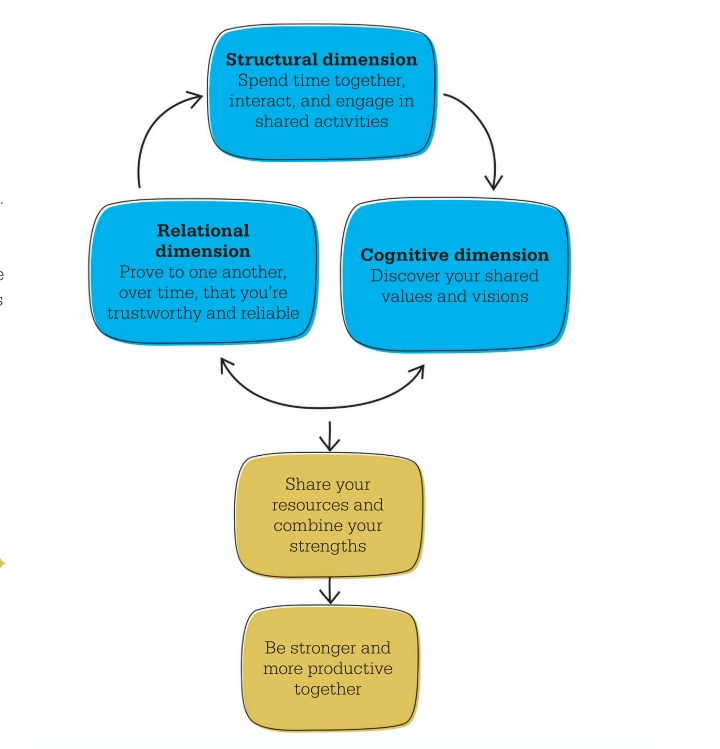
A 1988 study published in the Academy of Management Journal suggests we view the creation of social capital as the result of several factors. To establish good ties with people you need an established arrangement that supports this, such as regular meetings, activities, or communication (the “structural dimension”). You also need to appeal to what you share beyond these circumstances, by finding the values you have in common: even if you’re very different, there will be underlying principles you all hold (the “cognitive dimension”). By spending time together and working over shared ideals, you each have an opportunity to establish yourselves as someone to be trusted (the “relational dimension”). From there, you’ve built the social capital to create outcomes that are greater than the sum of their parts. Use this diagram to help you foster social capital
The effort you put into networking will pay dividends. Think of it as building a community of people you can rely on, learn from, and share ideas with over time. The key is to foster relationships with a wide range of people.
The ties within our communities can be a strong support to us. But when it comes to networking, do you prefer to align yourself with people based on your feelings toward them, or an assessment of what they can do for you? A 2008 American study found that some people are “affect-based”—that is, they’re led by their feelings and are bonded to others by empathy, rapport, and self-disclosure. On the other hand, “cognition-led” thinkers are guided by rational calculation and prefer people who offer them tangible benefits, such as career guidance and task-specific advice. The researchers concluded that some people value friendliness more than practical help, while for others it is the reverse. When getting along with your colleagues and friends, it’s useful to know which is which.
The strength of weak ties
“Weak ties” refers to the connections we have with people with whom we are on good terms but don’t see often—such as friends of friends, people we meet at conferences, and old colleagues. Such contacts are still worth cultivating: sociologist Mark Granovetter, researching randomly selected professionals, discovered that the majority had found their job through people they saw only rarely. Granovetter deduced that such connections don’t overlap our social circles much, and so they can introduce us to new people and opportunities: those who may not seem to have much influence on your prospects now may make the most difference in the future.
CLOSE-KNIT OR DISTANT
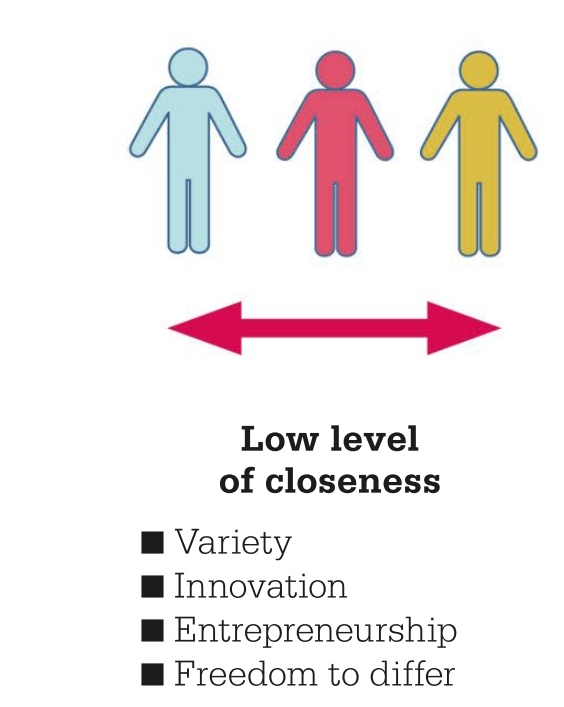
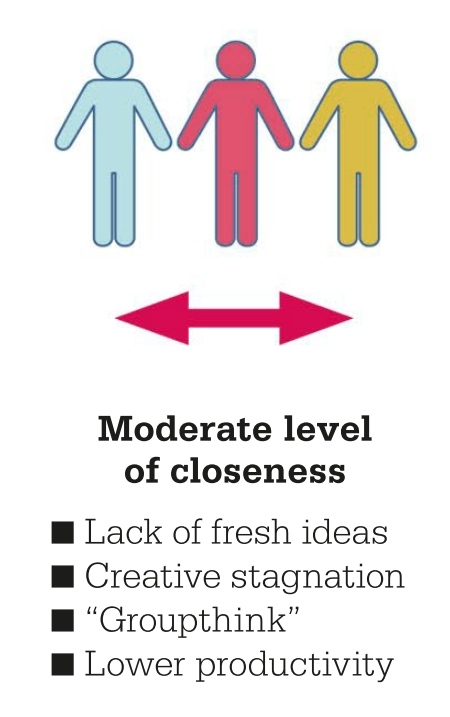
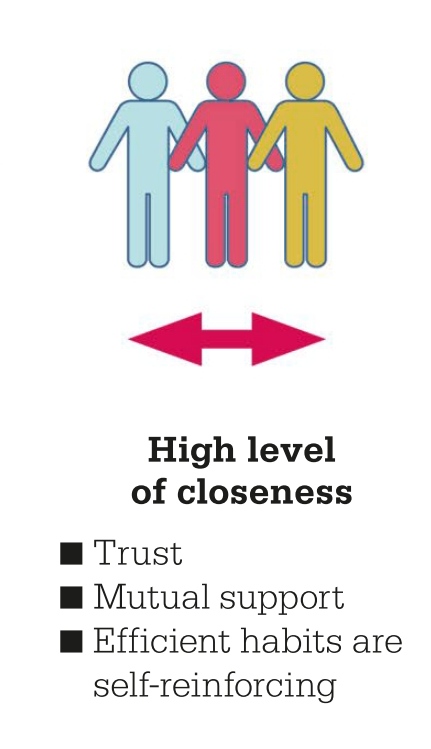
A 2004 Italian and American study analyzed group dynamics in the Italian television industry—a field that calls for both creative and technical expertise— to examine which sorts of teams were the most effective. They found that when it came to completing tasks, groups with a moderate level of closeness were the least productive, as they were interconnected enough to be insular, but not close enough for the members to have a profound mutual understanding.
HOW TO NETWORK
American management consultant and entrepreneur Ken Morse offers these eight tips for successful networking at an event:
1 .Do your research:If information is available about who will be present, read it, and see if you know anyone in your network who could help you make a connection to these people.
2.Perfect a short speech.This is your “elevator pitch”: be able to say what you can offer people in one or two sentences.
3.Show up early:This is an opportunity to meet the host.
4.Act with confidence:Take the initiative by introducing yourself to others
5.Hang around by the food:Blocking the bar will irritate people, but food boosts people’s mood and makes them friendlier.
6.Approach speakers before their talk:Afterwards people will be clustering around them and it will be hard to get their attention.
7.Ask for introductions.you know someone with credibility being presented by them makes you look credible too.
8.Focus on other people:Ask questions. People enjoy sharing their opinions and perspectives, so listen closely, and make space for conversations to flourish.
CONNECTING OTHERS
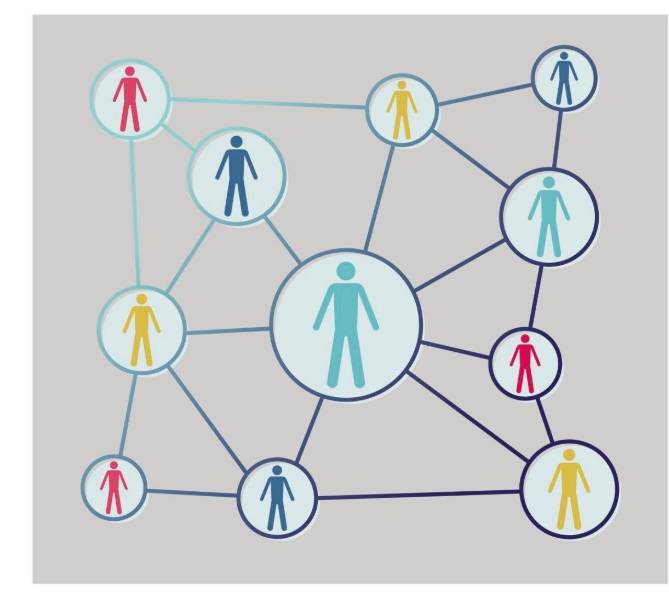
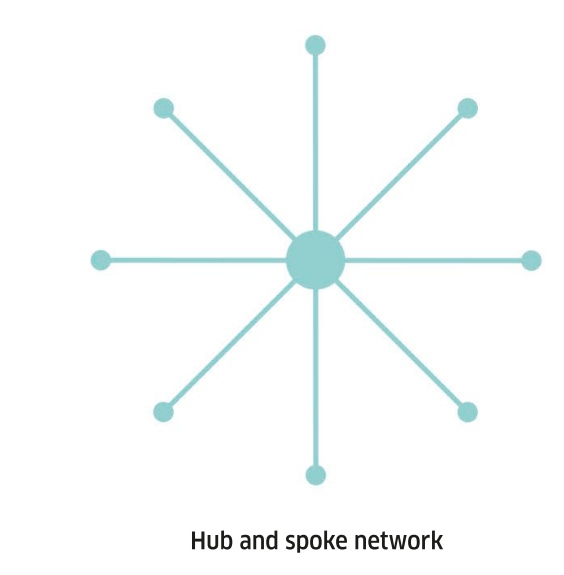
Silicon Valley entrepreneur Adam Rifkin argues that most of us think of our network as a series of spokes, like a bicycle wheel, with ourselves in the center. Instead, we should conceive of ourselves as part of a community: connecting people to each other still places us in the center of that community, even if we aren’t particularly connected to each individual. This broadens the depth and size of our network, and by empowering others, we benefit in the long run too.
Achieving our goals often involves choosing between competing priorities. When we decide to give something up, how do we deal with the feelings of discomfort this can cause?
Have you ever held onto an item of clothing that no longer fits, or a bond that’s fallen in value? You know you’d like to have more space in your wardrobe or a better investment, but somehow the pain of losing what you have, even if it’s not useful, seems to outweigh the clear benefits. This is what psychologists call loss aversion
The endowment effect
In 1990, economist Richard Thaler joined psychologist Daniel Kahneman and behavioral economist Jack L. Knetsch in an experiment. Half of the study’s participants were given coffee cups, and the other half only shown them. The two groups were then asked how much they would be prepared to either sell or buy the cups for respectively. The “owners” wanted about twice as much for their cups as the viewers were willing to pay. This is the endowment effect: simply owning something, even briefly, makes us put a higher value on it. It seems we dislike giving things up simply because it’s a sacrifice, even if we wouldn’t otherwise value the thing we’re giving up very highly
Ownership and self-image
Why do we sometimes act in an irrational way? In a 2013 study by American psychologists Sara Loughran Dommer and Vanitha Swaminathan, one group of volunteers was asked to describe a “social self-threat” situation, such as a romantic rejection, while a second group was asked to describe an average day. Both groups were then given a relatively worthless item—a ballpoint pen—before being asked to part with it. The study found that people were less willing to give up the pen after they experienced social self-threat situations. When we own something, we start to incorporate it into our sense of who we are—and the more threatened we feel, the less willing we are to forfeit even unimportant things. If you need to give something up, try to bolster your sense of identity first. Remind yourself that selfworth doesn’t depend on particular possessions or relationships—it’s inherent, and the more confidence you have in yourself, the easier it can be to let things go.
LOSS AVERSION
A knowledge of loss aversion can be useful when you are seeking to influence others. When making pitches, marketing psychologists propose the following approaches.
■ Suggest your audience already possesses something desirable, and that your product will stop them from losing it. (For example, “You could lose hundreds of clients if you don’t…”)
■ Encourage them to imagine themselves owning or using your product. (“Picture yourself sitting behind the wheel…”)
■ Let them “own” your product for a limited time, such as a free sample or a trial period. That way, not buying it once the trial ends would mean giving it up
WEIGHING THE CHOICES
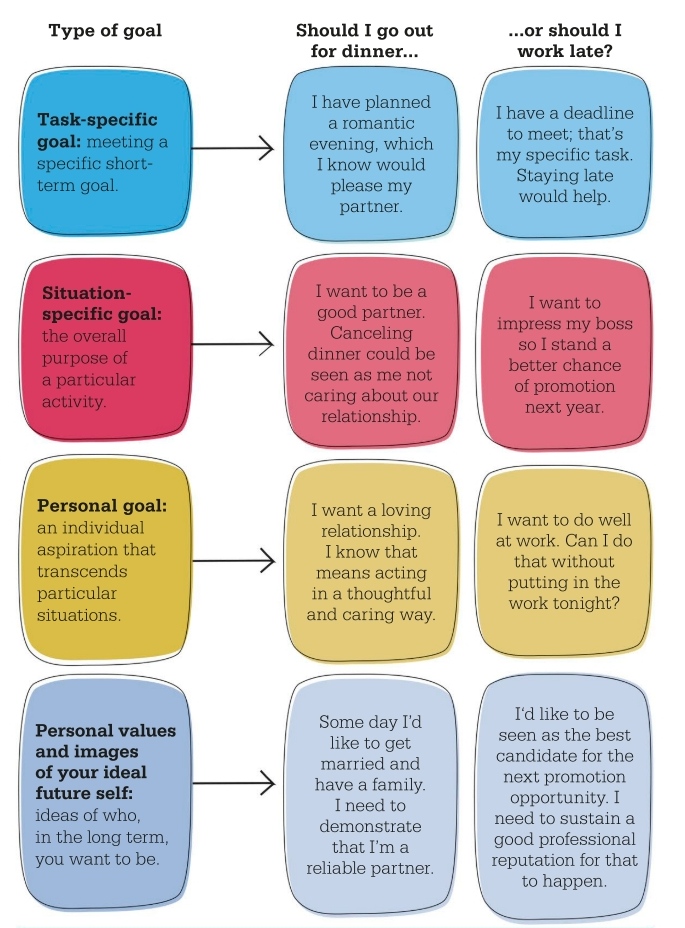
When you have to decide what to give up, it can be useful to think in terms of different types of goals. A 1997 study published in the Journal of Personality and Social Psychology suggests weighing four different types of goals when trying to make a decision. Suppose you’re trying to decide whether to cancel date night with your partner in order to get some extra work done. Assessing the situation in the context of the following types of goals may help you settle whether, in this instance, your partner or your work should take priority.
For a task to be truly satisfying, we need to be able to enjoy the work for its own sake, instead of just taking pleasure in the end results. For that to happen, we need to become fully absorbed in what we do
Flow is an important part of any kind of success. It’s a word that’s often used in positive psychology (see pp.48–51) and it describes a state of complete engagement with a task, to the point that you lose track of time and want to continue working on the task as long as possible. If you’ve ever forgotten to eat lunch because you were so absorbed in finishing an essay, or hit a sweet spot on the running track where you were aware of nothing but the rhythm of your feet, you’ve experienced a “flow” state. These experiences are intrinsically rewarding: we enjoy them whether or not they bring us any other benefits. A task that allows us to be in a state of flow brings us clarity and feelings of accomplishment, whether it’s great or small
How do we find flow?
A key to creating flow states is to find tasks that let us feel what Robert J. Vallerand, Professor of Psychology at the Université du Québec à Montréal, calls “harmonious passion.” This comes when we engage with tasks that we feel are a part of us, as opposed to what Vallerand terms “obsessive passion,” which happens when we fear we will suffer or be punished if we don’t complete a task that we don’t really identify with. Suppose you teach mathematics, and you not only find your work interesting but consider it central to who you are. In this situation, you’re not just someone who teaches. In your self-concept (who you believe yourself to be), a very important part of your personal definition is that you are “a teacher.” Under the right circumstances (see “Harmonious passion,” opposite), tasks that you enjoy and that fully engage your attention when teaching, will usually lead to a state of flow. The same is true no matter what our vocation: flow comes from tasks that we are passionate about and that align with our values and identity.
Conscious control
Of course, sometimes we need to do everyday tasks that aren’t central to our identity. In these situations, we’re required to use “attention” as opposed to “absorption” (see “Quality or quantity?,” opposite). A 2011 international study for the Journal of Management Studies found that, perhaps predictably, workers who felt a harmonious passion for their jobs were more likely to become absorbed in them, and also found it easier to pay attention. The unexpected news, however, was that people who didn’t feel this harmonious passion were nevertheless capable of both absorption and attention—they just needed to approach their jobs in a flexible way so that they could still create a flow state for themselves. This might involve taking ownership of a task, or fostering an interest in it. When it comes to managing your focus—whether it’s a project that you’re passionate about or just a mundane task—it’s useful to have some self-knowledge. What’s at the core of your identity? What are your values and real interests? The more you can approach a task in this spirit, the better chance you’ll have of becoming absorbed in it—and the more rewarding the experience will ultimately become.
AN ENGAGING CHALLENGE
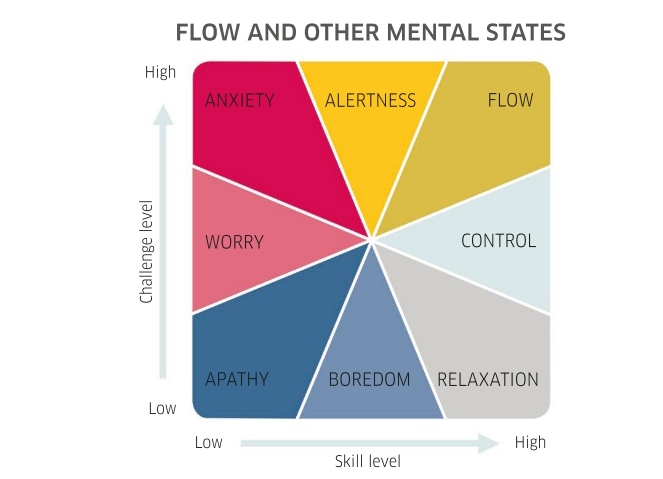
The concept of flow was first proposed by Hungarian psychologist Mihaly Csikszentmihalyi. According to Csikszentmihalyi, we achieve this state of contented immersion when we meet a task that’s reasonably difficult—not beyond our capability, but something that stretches us and demands our full concentration. In the graph below, flow is shown as one of a number of mental states that can result from attempting a task, depending on how challenging the task is and how skilled we are.
HARMONIOUS PASSION
Psychologist Robert J. Vallerand observes that feeling a harmonious passion for a task—that is, our interest in it is deep enough to be part of our identity—can greatly improve our performance. If we feel we’re doing something that reflects our feelings and values, it adds another layer of engagement, because it involves us on a deeper level.
QUALITY OR QUANTITY?
Psychologist N. P. Rothbard identifies two factors that are crucial to cognitive engagement
1—Attention:the quantity of our focus. It is concerned with the amount of effort we put into keeping our minds on a task.
■ Is under our conscious control.
■ Is finite, and wanes when we grow tired.
2—Absorption:the quality of our focus. It is concerned with how intensely immersed we are in a task.
■ Arises spontaneously from the right mix of circumstances.
■ Is self-rewarding; we may get tired, but can still stay focused and may not notice time passing

















 Vnotes Education