1957 Soviet Union 1958 🇺🇸 USA 1962 🇬🇧 UK 1962 🇨🇦 Canada 1964 🇮🇹 Italy 1965 🇫🇷 France 1967 🇦🇺 Australia 1969 🇩🇪 Germany 1970 🇯🇵 Japan 1970 🇨🇳 China 1974 🇳🇱 Netherlands 1974 🇪🇸 Spain 1975 🇮🇳 India 1976 🇮🇩 Indonesia 1978 🇨🇿…
Monitoring the marketplace and making sense of the vast quantities of data available has become a priority for businesses; the data is crucial for digital marketing, which is taking on increasingly sophisticated forms. Most businesses have a system in place for managing information—and the most successful ones use data not only to monitor day-to-day performance at every level, but to predict future outcomes and plan accordingly.
External
Outside the business, data flows in from production, supply chain, sales outlets, partners, and customers.
Production
SupplyChain
Sales outlets
Legal system The legal system ensures the use of data adheres to privacy and other laws.
Partner
Customer
Internal
Operations
Finance
Human Resources
Marketing and IT The marketing and IT departments are at the center of information management. They are responsible for collecting and analyzing data, and then reporting their findings to executives.
Analysis
Forecast
Executives
TRANSFORMING DATA INTO DECISIONS
With relevant data easily accessible a business can identify its strengths and weaknesses in order to improve its processes and operations, as well as its customer relationships.
Source raw data Gather customer data.
Store information Store data via data warehousing.
Access knowledge Retrieve data with business intelligence tool.
Gain insight Examine data using business analytics.
Make decisions Plan and budget for future outcome.
7% of organizations employ a chief digital officer
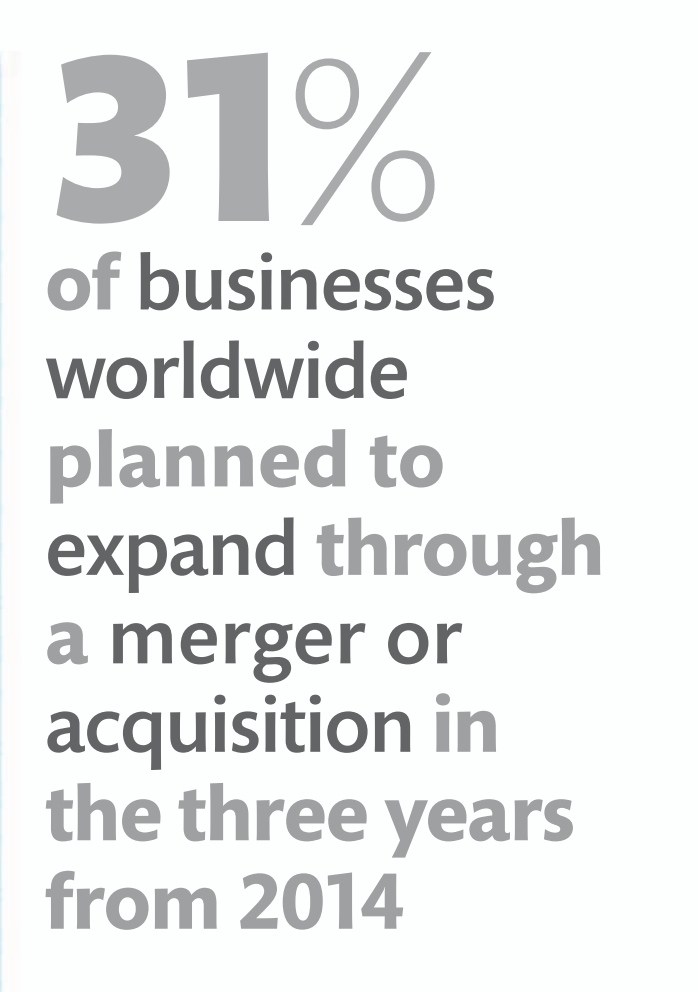
Companies that want to expand through a merger or acquisition may decide on a strategy of either horizontal or vertical integration, combining businesses involved in similar or dissimilar activities.
How it works
Companies can choose from several strategies when they merge or are part of an acquisition. Two of the most common are horizontal and vertical integration. Horizontal deals are always done between competitors that produce similar types of products, such as cars or mobile phones, and often share—or compete for—the same suppliers and clients. As a result of merger or acquisition, the newly formed company can make cost savings in production, distribution, sales, and marketing. Vertical deals are usually between businesses involved in the same industry but at different stages—for example, a computer maker and a component manufacturer. These deals can be upstream (toward the market) or downstream (in the direction of operations and production).
Integration models in practice
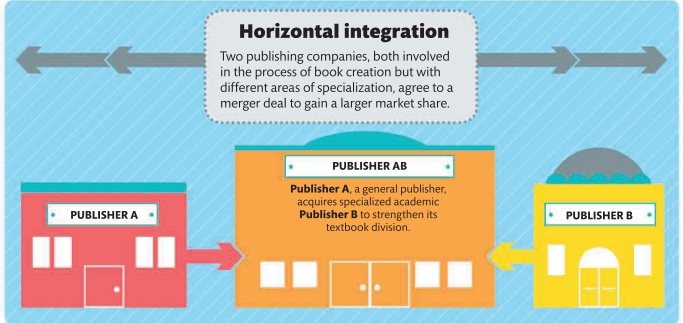
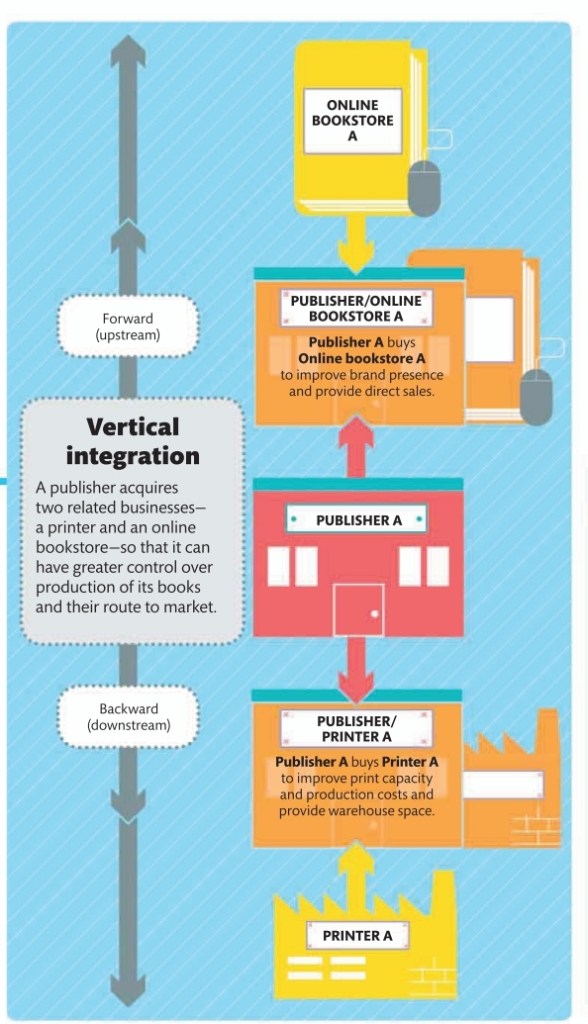
In these hypothetical examples, a cluster of printers, publishers, and bookstores merge or acquire each other in horizontal or vertical deals that aim to strengthen their market position, take advantage of economies of scale, and exploit synergy.
Horizontal integration
Two publishing companies, both involved in the process of book creation but with different areas of specialization, agree to a merger deal to gain a larger market share.
PUBLISHER AB
Publisher A, a general publisher, acquires specialized academic Publisher B to strengthen its textbook division.
PUBLISHER A
PUBLISHER B
Vertical integration
A publisher acquires two related businesses— a printer and an online bookstore—so that it can have greater control over production of its books and their route to market.
MERGER AND ACQUISITION TYPES
Conglomerate Combining two companies with nothing in common: for example, in 1985, tobacco-producer Philip Morris purchased General Foods, a new line of business unconnected to legal wrangles around smoking.
Market extension Combining two companies that sell the same products but in different markets: for example, in 1996, the Union Pacific Railroad Company acquired the Southern Pacific Rail Corporation to link railroads in adjacent US regions.
Product extension Combining two companies that sell different but related products in the same market: for example, in 2014, Microsoft bought Nokia’s mobile-phone unit to address flagging PC sales and its weakness in the mobile device market.
A phobia is a type of anxiety disorder. Specific phobias manifest themselves when a person anticipates contact with, or is exposed to, the object, situation, or event they fear.
What are they?
Specific, simple phobias (as opposed to the complex ones, agoraphobia and claustrophobia, pp.50–51) are the most common psychological disorders in children and adults. A phobia is much more than fear and arises when a person develops an exaggerated or unrealistic sense of danger about a situation or an object. The fear may not make any sense, but the individual feels powerless to stop it. Anticipated or actual exposure (even to an image) can cause extreme anxiety or a panic attack. Symptoms include rapid heart rate, breathing difficulties, and a feeling of being out of control. A combination of genetics; brain chemistry; and other biological, psychological, and environmental factors can give rise to a phobia. It can often be traced back to a frightening event or stressful situation a person either witnessed or was involved in during early childhood. A child can also “learn” a phobia through seeing other family members demonstrate phobic behavior. Specific phobias often develop during childhood or adolescence and may become less severe with age. They can also be associated with other psychological conditions such as depression , obsessive compulsive disorder , and post-traumatic stress disorder .
How are they diagnosed?
Many affected individuals are fully aware of their phobia, so a formal diagnosis is not necessary and they do not need treatment—avoiding the object of their fear is enough to control the problem. However, in some people habitual avoidance of a feared object can also maintain or worsen the phobia, and seriously impact aspects of their lives. A GP can refer them to a specialist with expertise in behavioral therapy.
Types of specific phobia
There is a wide variety of objects or situations that can trigger a phobia. Specific, so-called “simple,” phobias fall into five groups: blood-injectioninjury, natural environment, situational, animal, and “other” types. With the exception of the first type, specific phobias are two to three times more common in females than males.
ANIMAL This group of phobias includes insects, snakes, mice, cats, dogs, and birds, among other animals. It could be rooted in a genetic predisposition for survival from animals that were a threat to human ancestors.
SNAKES
SPIDERS
RATS
BLOOD-INJECTION-INJURY
A unique group of phobias in which the sight of blood or needles causes a vasovagal reaction—a reflex action that slows down the heart rate, reducing blood flow to the brain—that can result in fainting. Unlike all other phobias, this is as common in males as it is in females.
NEEDLES
BLOOD
SITUATIONAL
These are a group of phobias of being in a specific situation, which can range from visiting the dentist’s office to stepping into an old elevator, flying, driving over a bridge or through a tunnel, or getting into a car.
FLYING
BRIDGES
NATURAL ENVIRONMENT
A person with a phobia from this group has an irrational fear of a natural event, which they often associate with imagery of potentially catastrophic outcomes. Examples of this type of phobia include storms; deep water; germs; and fear of heights, such as being near a cliff edge.
WATER
HEIGHTS
LIGHTNING
SPECIFIC PHOBIAS are very treatable with gradual, guided exposure to the feared object or situation.
OTHER PHOBIAS
Thousands of people are tormented by an array of phobias, including fear of vomiting; a specific color, for example, anything that is yellow or red (including foodstuffs); the number 13; the sight of a belly button or toes; sudden loud noises; costumed characters, such as clowns; trees; or contact with cut flowers.
TREES
CLOWNS
TREATMENT
❯ Cognitive behavioral therapy to overcome a phobia using a system of graded steps to work toward the goal of confronting the feared object or situation without fear; anxiety management techniques to master each step.
❯ Mindfulness to raise tolerance of anxiety and of thoughts or images associated with the distress.
❯ Anti-anxiety medication or antidepressants alongside therapy if the phobia is impairing day-to-day living.
8.7% of adult Americans are affected by a specific phobia
Success doesn’t necessarily mean acquiring great wealth, but lack of financial resources may make you feel like an underachiever. Money can be an emotional subject, so how do you cultivate a healthy attitude?
Ever since psychologist Sigmund Freud defined the need to hoard wealth as a sign of an “anal-retentive” personality, psychologists have been studying our relationship with money. How can you get a balanced view of this difficult subject?
What does it mean?
Is money a source of stress, a moral pitfall, or a valid symbol for one of life’s winners? In the 1990s, Taiwanese psychologist Thomas Li-Ping Tang developed what he called the “Money Ethic Scale” (MES), which is a good way to judge how we value money. Tang found that people who ranked money highly as a sign of achievement tended to experience less life satisfaction, and also that people working to a modest budget tended to be more content. Hence, the evidence suggests that treating money as a practicality rather than as a measure of your worth may make you happier. He also found that people who value money highly aren’t necessarily richer than those who don’t, so giving money low priority probably won’t end up impoverishing you!
What can it buy you?
What do you see as the main purpose of money? A useful three-point scale was devised by American psychologists Kent Yamauchi and Donald Templer, alongside a questionnaire you can use for self-testing (see “Test your money focus,” opposite). These writers posit that our relationship with money can be measured by the following three factors:
Power and prestige. Using money to obtain influence over and/or impress other people.
Security. Using money to protect ourselves against various types of fear or want.
Retention. Saving for the sake of saving itself, sometimes to the point of parsimony or even obsessiveness.
They note that security and retention can overlap. Both, for example, can be apparent in a desire for “time retention,” which is when we’re motivated to be prepared for a rainy day. And both
He is rich or poor according to what he is, not according to what he has.
Henry Ward Beecher American social reformer
can be a sign of distrust, such as when we worry about someone cheating or overcharging us.
Money as opportunity
The sense of our being poised to embark on some new project or other experience can be very satisfying—especially when we’re conscious of having enough money to pursue a chosen plan. Issues, however, may arise when we aren’t yet ready to commit to— and spend money on—a particular course of action. Perhaps we haven’t made up our minds between alternatives. Having to spend cash may heighten the importance of certainty. Or even if we have decided, our sense of cutting off an alternative future for ourselves, for which the money could equally well have been used, can result in paralysis: unable to commit, we do nothing. In such situations, it’s good to reassess your relationship with money. If you believe it should be a tool, what’s the point of a tool you don’t use?
Money magnifies
All this illustrates how money can magnify our psychological issues. It can make relationship problems much harder to deal with—just think of money’s role in many celebrity divorces. And having no spare cash can further lower an already low sense of self-esteem. The message from all this is: don’t allow money to have symbolic force unless you want it to. And by extension, don’t mistake a wealthy lifestyle for happiness. True wealth lies elsewhere.
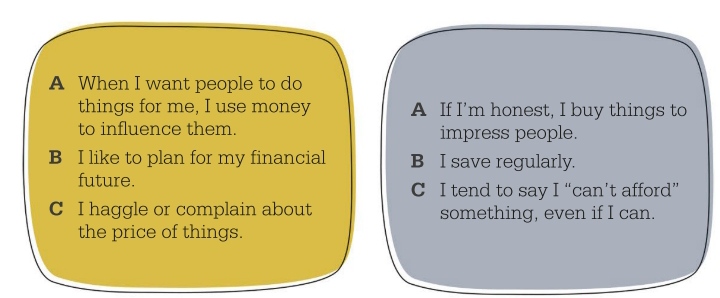
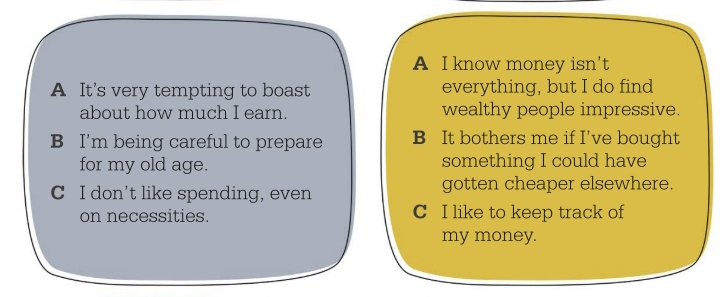
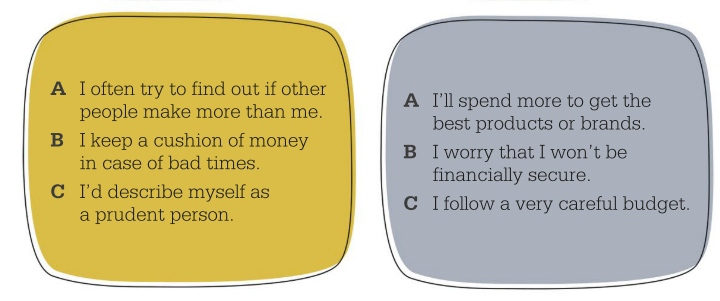
Mostly A: Power and prestige are motivators for you. Action: Avoid obsessive ambition. Be sure not to neglect love and friendship.
Mostly B: You’re motivated by security. Action: Check that you’re not neglecting opportunities. Challenge yourself. Mostly C: You have a tendency toward “retention,” or hoarding. Action: Make sure your behavior doesn’t turn to meanness. Give generously.
TEST YOUR MONEY FOCUS
Research on attitudes about money by American psychologists Kent Yamauchi and Donald Templer was based on asking participants to answer a revealing questionnaire. Use the same questions for your own self-assessment. Which of the three statements in each bubble resonates most with you? Use the concluding summary for self-assessment, and work on the action points given.
From your earliest days as a leader, you will need to build relationships with your team and a range of stakeholders throughout the organization. The ability to understand and influence people is a key skill, and thinking of relationships in terms of “stories” gives you some tools to analyze and control your interactions.
Telling stories
We each carry in our heads our own stories—the narratives we have constructed over the years to make sense of our collected experiences, emotions, habits, and thoughts. These stories bias our perspective in all new situations and may push us toward embracing the future or—conversely—constrain our actions. Relationships are built by exchanging these stories with other people we meet. As we tell our stories, we disclose more about ourselves, our backgrounds, roles, and beliefs—and create new, emergent stories. Just as individuals have their own stories, so do organizations; these stories encompass the history and values of that organization and describe how they get things done.
Relationships are built by exchanging stories. Just as individuals have their own stories, so do organizations
Listening to stories
By listening analytically to a person’s story, you may be able to understand why they want to work with you and what their motivations are likely to be. Stories also point to ways of negotiating successfully with individuals or companies, and even indicate whether a joint venture may succeed. Leaders who fail to take full account of a person’s or an organization’s past thoughts, culture, actions, and aspirations—as well as what they observe in the present moment—can find themselves facing a culture clash they had not anticipated.
Do the stories convey a strong moral code, judgments, or beliefs?
Do the stories place the individual in a particular role—hero, participant, or victim, for example?
Do the stories make or break connections between things?
Are the stories mostly set in the past, present, or future?
Do the stories claim particular skills for the individual?
Do the stories express themselves in protective jargon?
LISTEN TO THE SUBTEXT
Listen for recurrent patterns in peoples’ stories. What do they tell you about the way they relate to others, their modes of thinking, biases, and barriers?
Case study
MERGING CULTURES
A merger between an international company (A) and a smaller, but dynamic national company (B) was jeopardized when rumors emerged that the merger would be accompanied by redundancies in B. The directors of both companies
Some companies arrange their staff into divisions devoted to a specific product or market. Each division is a self-sufficient team employing the personnel for the various functions within it.
How it works
Under the overall control of a CEO or president, several divisions work alongside one another to design, research, produce, and sell a particular product, or to service a specific market. Each division runs its own specialized functions, such as operations and production, sales and marketing, and finance. A company may arrange its divisions according to the types of product it makes, the regions in which it operates, or the customers to whom it sells. Large companies may adopt hybrid structures—by product and geography, for example.
Division by geography
For businesses with products that need to be adapted to local markets, an organization can be structured according to each of the regional markets it serves. These may be domestic or international. Print technology and services company Xerox has successfully adopted this structure (see case study, right)
CEO
North America The company’s main market
Europe The second-largest region for sales Developing markets
Developing markets All other markets
Global services Additional division consulting across regions
Division by product
Businesses selling different types of products may pick a structure by which each division handles one category. Fast-food chain McDonald’s has been organized by product division.
CEO
FAST-FOOD PRODUCTS Burgers and fries
RESTAURANT SUPPLIES Tableware
BEVERAGES Unbranded drinks mixes
Division by customer type
Businesses with distinct customer markets may be organized by customer division. For example, the financial institution Bank of America Merrill Lynch caters to individuals, small businesses, and corporate and institutional clients.
CEO
CONSUMER Typically the original market
BUSINESS Products adapted or favorably priced
INSTITUTIONAL Large-scale provision to a single client
DIVISIONAL: PROS AND CONS
Pros
❯ If one division fails, there is no threat to the rest of the business
❯ Can respond quickly to changes in the market
❯ Focused on customer needs
❯ Performance of each division clearly measurable
Cons
❯ Duplicating resources—for example, each division employing finance personnel
❯ Lack of expertise-sharing between divisions
❯ Career path for staff restricted
Heightened sense of competition among divisions
CASE STUDY
Printer technology and services company Xerox has restructured several times to align the business with the main markets that buy its products. In 1992, Xerox’s highprofile change from a functional to a new divisional structure, with nine self-contained divisions each serving a particular customer type, hit the headlines. This also allowed the company to focus on its core business—digital publishing, color copying, and printing. Dividing the company by market location is another strategy Xerox has used successfully. In 2006, each division was organized once again, geographically, to ensure that those making the decisions were closest to the customers in each market
As we progress through our lives, we can learn from experiences in work, at home, and in our communities. Development is continuous and keeps us motivated and focused on, “what’s next?”
The most reliable path to success is to assume that learning is not a process that you finish, but a way to approach every situation you encounter. There are always opportunities to seek out new situations in which to learn and develop. With the help of a “growth mindset” (see p.26), you can always stay vitally and rewardingly engaged.
Seeking out knowledge
Do we ever reach a point where we “know enough”? Certainly we can acquire enough skills to meet a particular challenge, but there are far-ranging benefits to continuing our learning:
■ Learning makes us more confident and resilient.
The experience of meeting challenges and using our intelligence to overcome them boosts our sense that we can cope with difficult situations
■ Learners are better able to cope with change.
Mastering new concepts accustoms us to encountering unfamiliar and perhaps challenging beliefs. The more we come to terms with unknown ways of thinking, the less daunting the unknown becomes.
Learning enriches our experiences.
Life becomes more interesting as we learn and develop. The more we can approach the world as students, the more we are likely to thrive in it.
■ Learning makes us more well rounded.
A 2015 study published in Adult Education Quarterly found that the best measure of lifelong learning was “human capital”—the understanding we can gain by educating ourselves. “Social capital,” or the extent to which we build on connections with others to help us develop, was also helpful, especially for those with less formal education. But the greater their “human capital,” the better the subjects of the research were able to make effective use of their skills in a variety of situations.
■ Learning preserves our well-being as we age.
Studies confirm that older people who embark on education enjoy higher levels of health and happiness, and the connections and insight they foster enrich the community as a whole.
Learning to learn
It may sound like a narrow topic, but learning itself can be a skill to develop. In 2006, the European Parliament and Council listed this as one of several “key competences” we can improve throughout our lives. Here is the complete list:
■ Communication in our mother tongue
■ Communication in foreign languages ■ Mathematical, scientific, and technical competence ■ Digital and computer competence ■ Learning to learn
■ Social and civic competence
■ A sense of initiative and entrepreneurship
■ Cultural awareness and expression.
If you need a general recipe for success, one of the best things you could do is follow this curriculum.
THE LEARNER IN SOCIETY
How should we understand our learning in the widest context? Danish Professor of Lifelong Learning Knud Illeris argues that we learn in three dimensions: through our thoughts (cognition), our feelings (emotion), and our place in the world (environment). This creates balance:
✔ COGNITION: our personal abilities and understanding
✔ EMOTION: how we achieve psychological balance
✔ ENVIRONMENT: how we positively integrate into the world and culture around us.
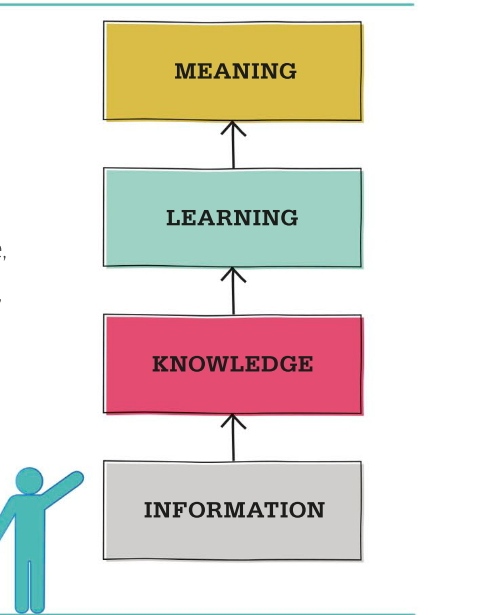
REACHING FOR MEANING
According to Portuguese psychologist and education expert Roberto Carneiro, learning is a process that grows more complex—and more fulfilling—as we develop. We begin with approaching basic information, and progress from there to knowledge, which gives us a grasp of the facts. Then, we approach genuine “learning,” in which we refine our understanding of the knowledge we’ve gained. Finally, we reach a sense of meaning, in which the application, value, and worth of all we’ve learned starts to become clear.
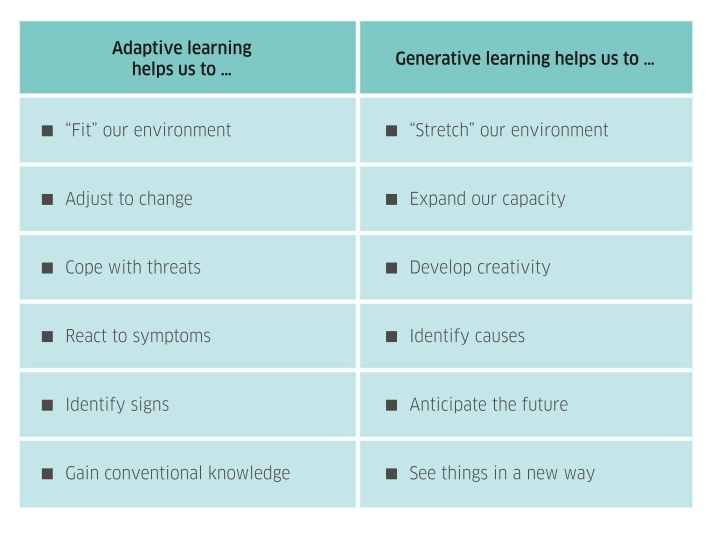
TO ADAPT OR GENERATE?
Thinking of learning as a way of gaining information is useful but limited.Professor Roberto Carneiro proposes a distinction between “adaptive” and “generative” learning. Adaptive learning helps us to manage within our environment; generative learning helps us to change our environment. To be successful, we need to cultivate both types of learning.
Nobody likes the idea of falling short, but in order to keep moving forward, we need to be able to learn from our mistakes. This means being able to accept failure instead of fleeing from the discomfort it causes.
Learning from our mistakes can be critical for our success. A 2015 US study, for example, found that serial entrepreneurs were not only more likely to change industries if a venture failed, but were more likely to fail in the new industry too, not least because they were new to it, lacked expertise, and assumed that what did work in the old field should work in the new. It’s easy to get stuck in a pattern of doing things automatically, but what really helps us develop is being able to step back and identify what we can do differently in the future based on the mistakes we made in the past
Seeing straight
Humans are prone to a particularly awkward cognitive error: we see what we expect to see rather than what’s actually there. “Schema theory” argues that this can even include what’s right in front of us, from minor mistakes such as putting the cereal box in the fridge because we were thinking about the cupboard, to fatal mistakes such as a nurse attaching a patient to the wrong drip because of nerves or the pressure of the job. The less reflective we are, the more we fail— and we need to be able to learn the right lessons from our failures
Defensive thinking
If we’re intelligent, surely we should be good at learning from mistakes? In fact, according to business specialist Chris Argyris, smart people often lack this skill. The problem is one of mental habits. High achievers usually succeed at what they attempt. As a result, they don’t experience failure on a regular basis and so don’t have much practice at learning from it. Many of us are problem-oriented: if something is wrong, our instinct is to fix it as quickly as possible and move on. This may feel efficient, but it doesn’t help us examine the causes, which could include the need to revise our own approach (see “Learning loops,” above). When we fail to get the result we want, we tend to go into defensive reasoning. We tried, it didn’t work, and we don’t want it to be our fault, so we redirect our energy into proving that it wasn’t. This is a sure way to shut down our problem-solving abilities.
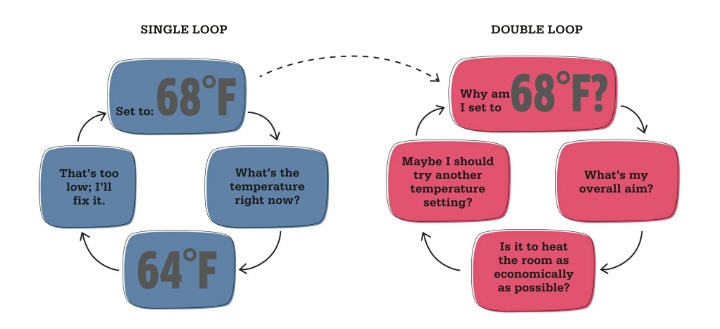
LEARNING LOOPS
Business theorist Chris Argyris points to two different ways of learning from mistakes, the single and double loop. A single loop can be efficient if you’re pursuing a specific goal, but if you want to broaden your mental scope, it’s better to add another loop to your thinking that looks at the bigger picture as well—not just whether you did a particular task “by the book,” but also examining the nature of the task itself. Argyris uses the example of seeing yourself as a thermostat set to 68°F (20°C), and imagines that it could be programmed to add in another level of calculation.
Changing habits
While we like to think of ourselves as consistent, Argyris argues that our principles tend to be undermined by a pattern of thinking that aims to:
■ Keep us in control
■ Maximize “winning” and minimize “losing”
■ Suppress negative feelings
■ Be “rational,” which, in practice, means evaluating our behavior on our own terms.
At their core, all of these elements are about avoiding anxiety and shame, and they don’t help us to improve. To learn from setbacks, we need to embrace vulnerability (see p.109) and crosscheck our actions and assumptions to make sure we’re not denying ourselves an important learning opportunity. We all make mistakes: the key to success is to accept them when they happen, understand what caused them and, if necessary, modify our approach. If we can do this, the mistakes themselves may matter much less.
Any strategy for success involves pruning: to focus on what you’re doing, you have to decide what you won’t be doing. When setting your priorities, don’t overlook the less obvious consequences of your decisions.
I WILL NOT FOLLOW WHERE THE PATH MAY LEAD, BUT I WILL GO WHERE THERE IS NO PATH, AND I WILL LEAVE A TRAIL
MURIEL STRODE, POET AND AUTHOR
Sometimes it can be difficult to know which priorities to focus on, and what the end result of our actions might be. Asking yourself specific questions can help focus your mind on what’s important to you.
Avoiding pitfalls
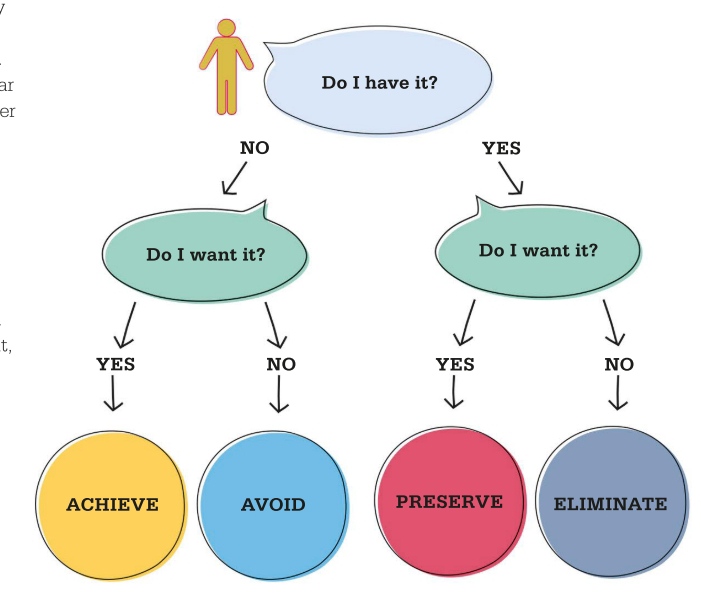
American management consultant Fred Nickols, with input from his colleague Ray Forbes, has developed a set of questions you can ask yourself whenever you are trying to determine your objectives
■ What are you trying to achieve? ■ What are you trying to preserve? ■ What are you trying to avoid?
■ What are you trying to eliminate?
The aim of these questions is to highlight the sometimes-complex interaction among our decisions, actions, and outcomes (see “Achieve, preserve, avoid, or eliminate?,” opposite). The point is that you need to make choices to maintain an overall balance in your accomplishments by preserving what you have that you value, achieving in new areas, and avoiding any negative results. You may have more goals than you think, and if you can factor in the “negative” goals as well as the positive ones, you’re less likely to miss something important and end up short of where you started. When clarifying your goals, be clear about what you want—and consider the things you don’t want to risk.
Maintaining momentum
If you have big plans and are starting from a less than ideal position, you’re going to have to put in a lot of time and effort. There may be moments when you really don’t feel like it: at that point, it may be time to double-check your priorities. As Stuart Biddle, Professor of Active Living and Public Health at Victoria University in Australia, puts it, “Not having time is not a reality in most cases.” If we have time to watch TV or take a break, that’s time that we can, if we choose, decide to dedicate to a bigger project. The key here, as psychologist Carol Dweck explains, is to have a “growth mindset” rather than a “fixed mindset” (see “Fixed or growing?,” opposite). Instead of being perfectionists who think we either can or can’t do something, it helps to see learning as a process that continues throughout our lives. That relieves some of the pressure. You don’t need to drive yourself to exhaustion; ACHIEVE, PRESERVE, AVOID, OR ELIMINATE? Performance improvement expert Fred Nickols devised a set of questions to help establish and clarify priorities: sometimes “success” may be more about preserving, avoiding, or eliminating aspects of your life than it is about achieving something. Think about your different goals, and ask yourself these questions to see if your answers reveal any issues you may need to consider further: 27 Do I have it? NO YES Do I want it? Do I want it? YES NO YES NO ACHIEVE AVOID PRESERVE ELIMINATE but when time is a limited resource, it’s good to ask yourself whether you’re really losing motivation, or if you’re just tired. We need to keep our spirits up as we push for success, and we also need to be aware that not jeopardizing what we already have can matter as much as gaining new things. The clearer you are on your priorities, the better off you’ll be.
ACHIEVE, PRESERVE, AVOID, OR ELIMINATE?
Performance improvement expert Fred Nickols devised a set of questions to help establish and clarify priorities: sometimes “success” may be more about preserving, avoiding, or eliminating aspects of your life than it is about achieving something. Think about your different goals, and ask yourself these questions to see if your answers reveal any issues you may need to consider further:
There are no solutions; there are only trade-offs
Thomas Sowell Economist, social theorist, and political philosopher











 Vnotes Education