
Behavioral psychology analyzes and treats people on the basis that their behavior is learned by interacting with the world and that the influence of the subconscious is irrelevant.
What is it?
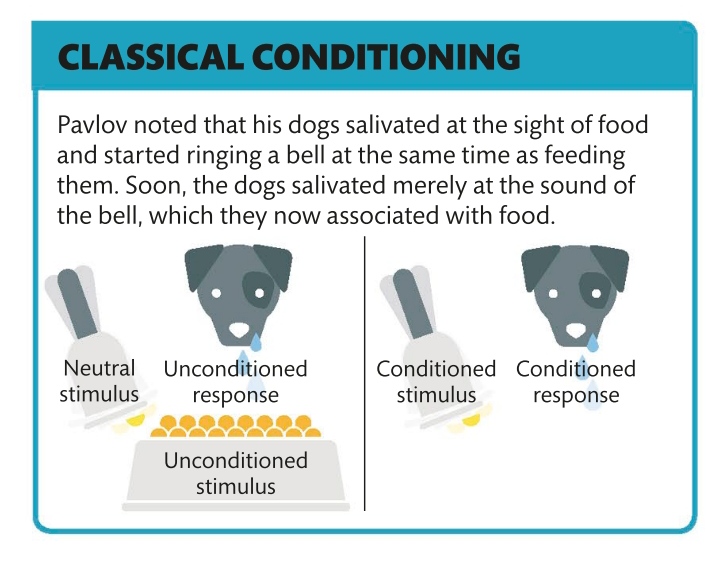
The starting point for behavioral psychology is a focus on only observable human behavior, leaving out thought and emotion. This approach rests on three main assumptions. First, people learn their behavior from the world around them, and not from innate or inherited factors. Second, because psychology is a science, measurable data from controlled experiments and observation should support its theories. Third, all behavior is the result of a stimulus that triggers a particular response. Once the behavioral psychologist has identified a person’s stimulus-response association, they can predict it, a method known as classical conditioning (below). In therapy , the therapist uses this prediction to help the client change their behavior.
Evaluation
The strength of the behaviorist approach—that it can be scientifically proven, unlike Freud’s psychoanalytic approach , for example—has also been seen as its weakness. Many of the behavioral experiments were carried out on rats and dogs, and humanists (min particular rejected the assumption that people in the world acted in the same way as animals in laboratory conditions. Behavioral psychology also
takes little account of free will or biological factors such as testosterone and other hormones, reducing human experience to a set of conditioned behaviors.
OPERANT CONDITIONING
This method for inducing behavior change, in this case training a dog, involves positive or negative actions on the part of the owner to reinforce or punish the dog’s behavior.
❯ Positive reinforcement Giving a reward encourages good behavior. For example, the dog receives a treat for sitting on command. It quickly learns that repeating that behavior will earn it another treat.
❯ Negative reinforcement The owner removes something bad to encourage good behavior. The lead goes slack when the dog walks close to its owner. The dog learns to walk to heel without pulling and so avoid the choking sensation.
❯ Positive punishment The owner does something unpleasant to discourage bad behavior. When the dog pulls ahead on the lead, its collar feels uncomfortably tight around its throat.
❯ Negative punishment Taking away something that the dog enjoys is used to discourage undesired behaviors. For example, the owner turns their back on the dog to deprive it of attention if it jumps up. The dog learns not to jump up.
Themes of behaviorism
John Watson developed behavioral psychology in 1913. His theory agreed with the early 20th-century trend toward data-backed science rather than concentrating on the subjective workings of the mind, and the behaviorist approach was influential for decades. Later psychologists interpreted behavioral theory along more flexible lines, but objective evidence remains a cornerstone of research.
METHODOLOGICAL BEHAVIORISM
Watson’s theory became known as methodological behaviorism because of its focus on scientific methods:

- ❯ He viewed psychology as a science, its goals being the prediction and control of behavior.
- ❯ It is the most extreme theory of behaviorism because it rules out any influence from a person’s DNA or internal mental state.
Neutral stimulus
Unconditioned response
Unconditioned stimulus
Conditioned stimulus
Conditioned response
EXTERNAL - ❯ It assumes that when people are born their minds are a blank slate and they learn all their behavior from the people and things around them (classical conditioning, left). For example, a baby smiles back when their mother smiles, or cries if their mother raises her voice.
RADICAL BEHAVIORISM
In the 1930s B. F. Skinner developed radical behaviorism, which allowed for the influence of biology on behavior:
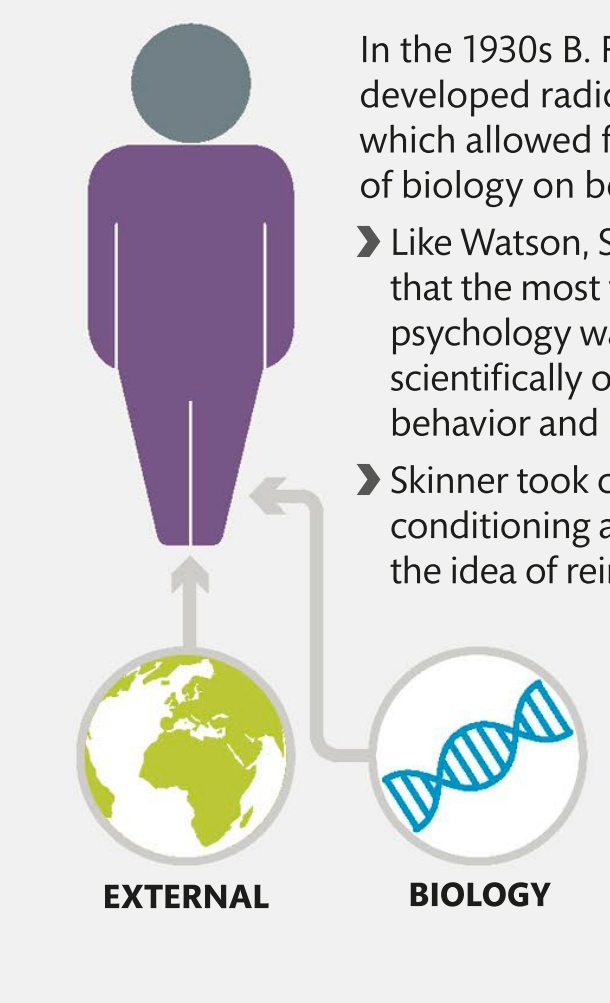
- ❯ Like Watson, Skinner believed that the most valid approach to psychology was one based on scientifically observing human behavior and its triggers.
- ❯ Skinner took classical conditioning a step forward with the idea of reinforcement— behavior that is reinforced by a reward is more likely to be repeated (operant conditioning, above).
PSYCHOLOGICAL BEHAVIORISM
Conceived by Arthur W. Staats, psychological behaviorism gained dominance over four decades. It informs current practice in psychology, especially in education:
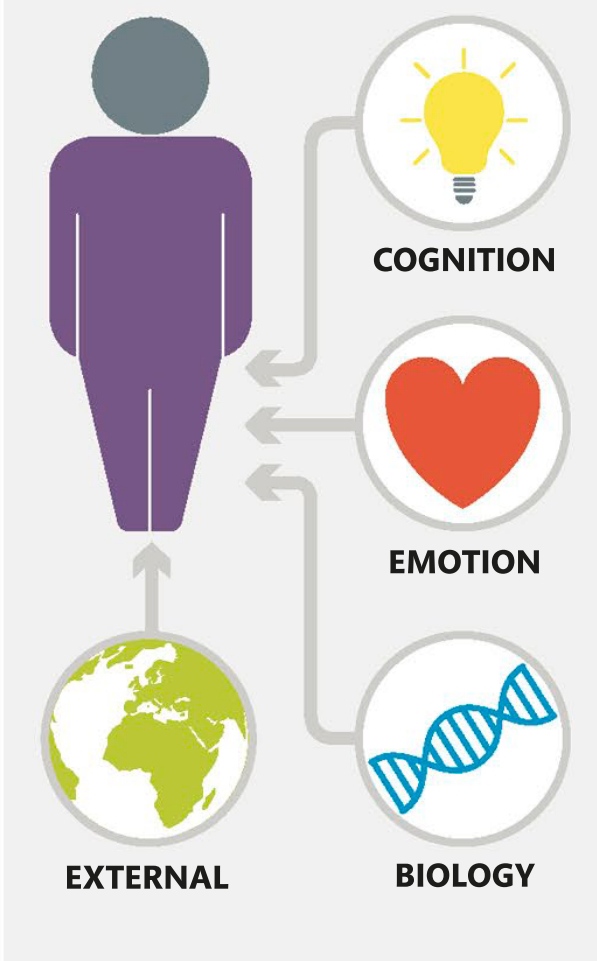
- ❯ A person’s personality is shaped by learned behaviors, genetics, their emotional state, how their brain processes information, and the world around them.
- ❯ Staats researched the importance of parenting in child development
- ❯ He showed that early linguistic and cognitive training resulted in advanced language development and higher performance in intelligence tests when children were older.
 Vnotes Education