
A branch of psychology that considers the mind to be like a complex computer, the cognitive approach analyzes the way people process information and how that dictates their behavior and emotions.
What is it?
When the computer arrived in offices in the late 1950s, it sparked comparisons between artificial information processing and the operation of the human mind. Psychologists reasoned that in the same way that a computer accepts data, codes it for storage, and retrieves it, the human mind takes in information, changes it to make sense of it, stores it, and recalls it when needed. This computer analogy came to be the foundation for cognitive psychology. The theories behind cognitive
psychology can apply to virtually every aspect of daily life. Examples include the brain receiving and processing sensory information to make a judgment (such as recognizing that a carton of milk has soured from its bad smell); reasoning with logic to reach a decision (such as whether to buy an expensive shirt that may last longer than a cheap one); or learning how to play a musical instrument, which requires the brain to make new connections and store new memories.
Evaluation
Although cognitive psychology emphasizes internal processes, it aims to be strictly scientific, relying on laboratory experiments to back up any theory. What happens in controlled experiments, however, can be difficult to apply to real-life scenarios. Similarly, the assumption that the human mind functions like a computer does not take into account realities such as people getting tired and emotional, and critics claim it treats humans as machines, reducing all behavior to a cognitive process such as committing things to memory. Critics have also pointed out that this approach ignores the roles of biology and genetics. However, cognitive psychology has proved useful for treating memory loss and selective attention disorders. It is also valuable in understanding child development, allowing educators to plan appropriate content for each age group, and to decide the best tools for delivering it. In the legal system, cognitive psychologists are regularly called on to assess eyewitness reports in order to determine whether a witness has accurately recalled a crime.
Information processing
Using evidence from controlled experiments, psychologists have built theoretical models of how the mind deals with information. According to these models, the human brain handles information in the same sequence a computer uses to handle data—from input, through transformation of the data, to retrieval.
INPUT (from environment)
A person’s sense organs detect stimuli from the external world and send messages to the brain as electrical impulses containing information. For example, if a person’s car breaks down, their brain
focuses on warning signs, such as unexpected sounds from the engine, visual cues like smoke, or the smell of burning rubber.
PROCESSING
(mediational mental event)
After receiving information via the senses, the brain must sort
through it to analyze it and decide what to do with it. Cognitive psychologists call this process
mediational because it happens between (“mediates”) the
environmental stimulus and the brain’s eventual response to that stimulus. In the case of a car breakdown, the brain might analyze the smell of burning
rubber, and connect it with an earlier memory of a similar smell.
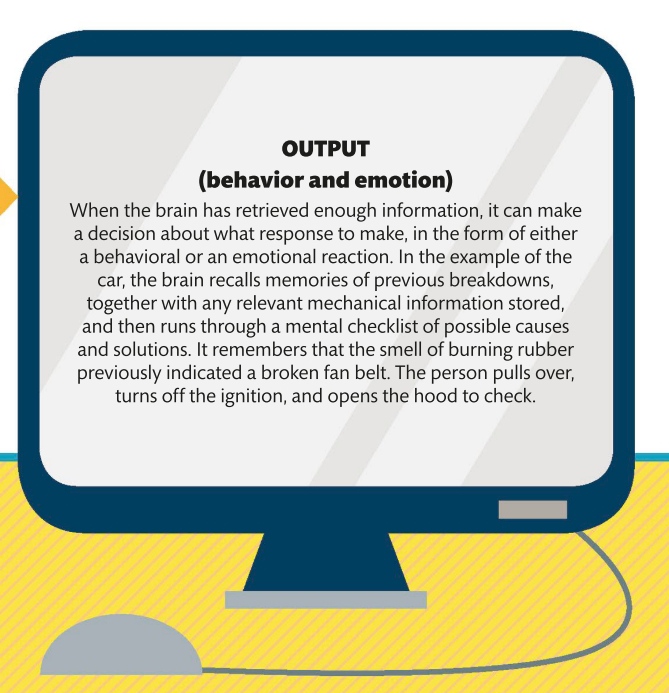
OUTPUT (behavior and emotion)
When the brain has retrieved enough information, it can make a decision about what response to make, in the form of either a behavioral or an emotional reaction. In the example of the car, the brain recalls memories of previous breakdowns, together with any relevant mechanical information stored, and then runs through a mental checklist of possible causes
and solutions. It remembers that the smell of burning rubber previously indicated a broken fan belt. The person pulls over, turns off the ignition, and opens the hood to check.
“Disconnected facts in the mind are like unlinked pages on the Web: they might as well not exist.”
Steven Pinker, Canadian cognitive psychologist
COGNITIVE BIAS
When the mind makes an error in the course of thought processing, it results in a skewed judgment or reaction, known as a cognitive bias. This may be related to memory (poor recall, for example) or lack of attention, usually because the brain is making a mental shortcut under pressure. Biases are not always bad—some are the natural outcome of having to make a quick decision for survival purposes.
Examples of bias
❯ Anchoring Placing too much importance on the first piece of information heard.
❯ Base-rate fallacy Abandoning original assumptions in favor of a new piece of information.
❯ Bandwagon effect Overriding own beliefs in order to go along with what other people are thinking or doing.
❯ Gamblers’ fallacy Mistakenly believing that if something is happening more often now, it will happen less often in the future— for example, if the roulette wheel consistently falls on black, thinking it is bound to fall on red before long.
❯ Hyperbolic discounting Choosing a smaller reward now, rather than patiently waiting for a larger reward.
❯ Neglect of probability Disregarding true probability, for example, avoiding air travel for fear of a plane crash, but fearlessly driving a car even though it is statistically far more dangerous.
❯ Status quo bias Making choices to keep a situation the same or alter it as little as possible, rather than risking change.
 Vnotes Education