
The human resources (HR) department is responsible for all policies and processes relating to the people employed by a business. To help the business achieve its goals, HR has to make sure that it employs the right people with the right skills, treats them consistently and fairly, and has a supporting framework to drive and deliver the required level of performance.
HR framework
The starting point for any decision in an organization is its business goals. HR supports the delivery of these goals by ensuring that there is a staffing strategy to support the business plan. Typically, an HR framework sets out a people strategy including the competencies of the people who best suit the organization. This is then implemented in a range of areas, from recruitment and selection to learning and development. HR professionals work closely with business leaders and line managers to design and implement HR systems that back up strategic business goals.
Business goals
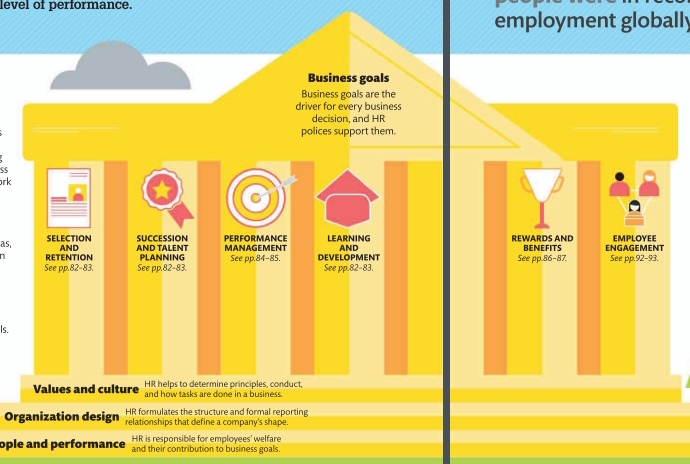
Business goals are the
driver for every business decision, and HR
polices support them.
- SELECTION AND RETENTION
- SUCCESSION AND TALENT PLANNING
- PERFORMANCE MANAGEMENT
- LEARNING AND DEVELOPMENT
- REWARDS AND BENEFITS
- EMPLOYEE
- ENGAGEMENT
Values and culture HR helps to determine principles, conduct, and how tasks are done in a business.
Organization design HR formulates the structure and formal reporting relationships that define a company’s shape.
People and performance HR is responsible for employees’ welfare and their contribution to business goals.
ESSENTIAL PEOPLE SKILLS
As well as recruiting effectively and ensuring that employees deliver, HR plays a role in nurturing essential people skills across the organization
Relating to others
❯ Some people are natural leaders, but most leaders can benefit from objective thinking about the leadership strategy they wish to follow.
❯ Even in flattened, team-based hierarchies, team leaders need to develop leadership skills to guide and support their teams.
❯ Despite the revolution in technology, people remain vital to organizations, as skills and knowledge are central to success. As a result, HR has an expanding role. One example is Google, which calls its HR function People Operations (POPS) and treats its staff as a valuable asset, offering a range of attractive perks to “find them, grow them, and keep them.”
Managing projects
❯ Project management is an essential skill for managers at all levels, whether they are running regular day-to-day activities or special projects.
Negotiating
❯ The ability to negotiate successfully is an essential skill. Awareness of strategies and styles is key to success.
 Vnotes Education