
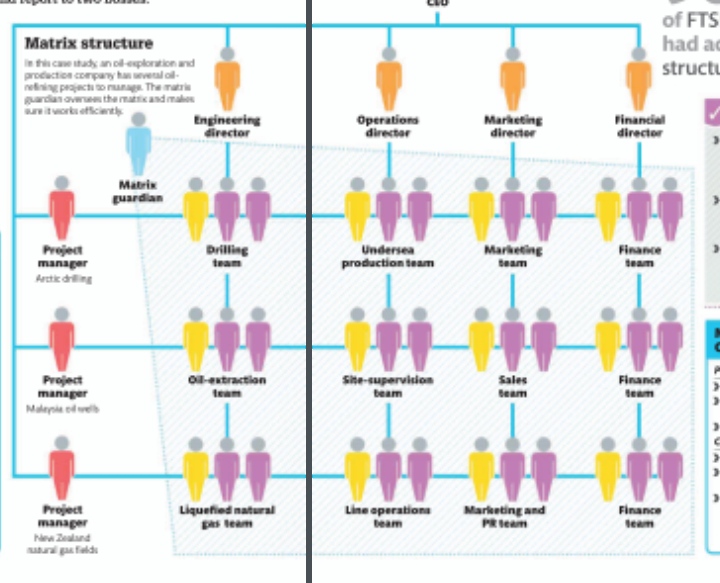
Unlike a conventional company hierarchy organized either by function or division, a matrix combines the two approaches so that staff work in both functional and divisional units, and report to two bosses.
How it works
A business that uses a matrix setup often begins with the more traditional functional structure. As the business develops, it may make sense to overlay a divisional structure to meet changes in business conditions—for example, if a company is managing several large projects for a client or expands globally and is selling its products in several regions. A matrix grid may start out as temporary—perhaps formed to manage short-term projects—and become permanent. The two chains of command in a matrix create the
grid. Staff report along a vertical line to a functional manager, such as the marketing director, and along a horizontal line to the project manager of a specific business line, brand, project, or region.
Matrix structure
In this case study, an oil-exploration and production company has several oilrefining projects to manage. The matrix guardian oversees the matrix and makes sure it works efficiently.
FOUR BIG MATRIX ORGANIZATIONS
Each of the following companies has been cited as a model of success for making the matrix structure work:
❯ Procter & Gamble (P&G) To help it innovate and respond faster to the market, the consumer-product company is segmented into baby and family care, global beauty, health and grooming, and global fabric and home care.
❯ IBM Because it needs to control many global processes, the matrix at the technology and consulting corporation is structured vertically by divisions such as sales and distribution, finance and marketing, and software, and horizontally by country and region.
❯ Cisco In 2001, the IT company reorganized to enable committees to make decisions across several different functions and divisions. The idea was to stimulate ideas throughout the organization and quickly implement solutions to problems.
❯ Starbucks The coffee-shop chain is arranged by product on one axis of the matrix and business function on the other to ensure that quality and innovation meet customers’ expectations and anticipate their desires.
MATRIX: PROS AND
Pros
- ❯ Faster decision-making
- ❯ Potential for improved productivity
- ❯ Flexible use of staff
Cons
- ❯ Expensive to set up and run
- ❯ Possible confusion as to the reporting lineLine operations team
Marketing and PR team
Finance team - ❯ More potential for interpersonal conflict as team goals may conflict
NEED TO KNOW
❯ Project management professional (PMP®)Qualification for project managers offered by global Project Management Institute
❯ Matrix guardian Senior professional appointed to oversee the matrix and make sure it works efficiently
❯ Mature matrix Matrix structure in which functional and divisional bosses have equal power
 Vnotes Education