
When a company goes public, it sells shares to investors, who become part-owners in return for capital investment. The number and type of shares bought by each investor determines the size of their ownership.
How it works
Before floating on a stock exchange, a company undergoes a valuation process to set the initial price of its shares. This process involves the directors, prospective investors, and an investment bank, which is appointed to assess the company’s value. Together, they reach a decision on the most financially viable price for the shares that will be offered on the exchange. Upon going public, a company issues ordinary shares to investors as the basic unit of ownership, commonly referred to as a stake in the business. A company may also issue shares privately, rather than publicly to investors via the stock exchange, to retain greater management control.
A share of the pie
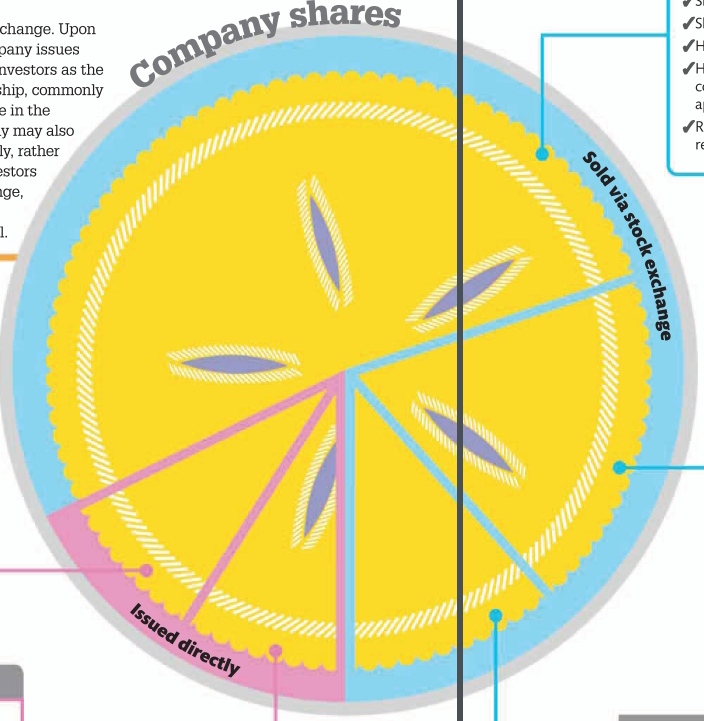
Ordinary shares, issued by all companies when they go
public, are the most common type of shares. There are also other share types, which give the company more flexibility to control rights available to different shareholder groups. Most shares are sold on the stock exchange, but non-voting and management shares are issued directly to holders. Different types of shares entitle the holder to different rights.
Company shares
Issued directly
Management shares Issued (usually given not sold) to owners and members of company management, who have:
- ✓Extra voting rights, so control of company stays in the same hands
Non-voting shares Issued to employees, who:
- ✓Receive a part of remuneration in the form of dividends
- ✗ Have no voting rights
- ✗ Receive no invitation to attend annual meeting
Solid bia stock exchange
Common stock Shareholders:
- ✓Share in the company dividends ✓Share in the company’s assets ✓Have right to attend AGM✓Have right to vote on important company matters such as appointment of directors
- ✓Receive the company’s annual report and financial statements
Preferred stock Shareholders:
- ✓Receive fixed dividend, paid ahead of any dividends paid out to ordinary shareholders✓Take priority in receiving a share of any assets left after debts are paid if company is insolvent
- ✗ Have fewer, if any, voting rights
RAISING MORE SHARE CAPITAL
After the initial sale of shares, when a company goes from private to public, the business can raise additional funds by issuing more shares. There are three main ways to do this:
❯ Rights issue entitles existing shareholders to buy additional shares from the company within a set time frame, before they are offered to other buyers.
❯ Public issue is a process by which the company issues a new allotment of shares to sell to the public on the stock market.
❯ Private placement is a practice by which the company sells its shares (or other securities) directly to private investors, usually large institutions, bypassing the stock exchange all together.
NEED TO KNOW
❯ Flipping Buying and quickly reselling IPOs for a large profit
❯ Redeemable shares Shares that may be later bought back by the issuing company for a cash sum
698% the increase in share price of IPO VA Linux Systems in one day on the New York Stock Exchange, in 1999
Establishing share value
The forces of supply and demand set the price of shares. Companies issue only a limited number of shares to the public, which can then be bought and sold on the stock exchange. Demand for those shares is determined by whether investors think the company has good future economic prospects. If investors believe that the company is primed for substantial growth, they will want to buy shares in it, which consequently drives up the share price.
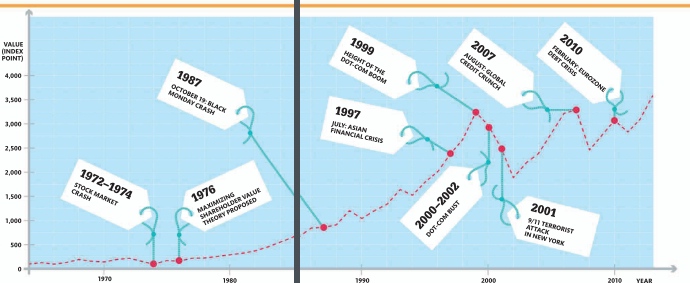
Rising value of shares
Financial market observers believe
that the emphasis on optimizing the value of shares for shareholders began in 1976, when the idea of maximizing profit for shareholders became a priority. Since then, the market has experienced a general upward trend with occasional deep dips. The graph tracks the average value of all shares on London’s FTSE from 1964 to 2013.
SPLITTING SHARES
A company occasionally carries out a “share split” to its existing shares. This increases the total number of shares, although the combined value of shares stays the same. A share split allows a company to lower the price of its shares to bring them in line with the price of competitor shares. The share split is usually a two-for-one or three-for-one increase, whereby the shareholder sees the number of their shares double or triple.
SHARE PRICE TOO HIGH A company listed on the stock exchange has seen its share price increase so that its shares now cost more than its competitors’. The high price puts off investors.
SHARES SPLIT The company decides on a share split. It halves the price of each existing $3 share, so each share is now worth $1.50.
SHARE CERTIFICATES ISSUED It issues new share certificates to holders, doubling shares held: a shareholder with 1,000 shares at $3 each now has 2,000 at $1.50 each. Total worth is still $3,000.
SHARE VALUE ALIGNED The value of shares is now similar to that of competitors. The price encourages new investors to make a purchase.
NEED TO KNOW
❯ Bear market Market that has seen decline of 20 percent over a period of 2 months or more
❯ Bull market Market where share
prices are rising and investor confidence is high
❯ Market correction Short-term decline in share prices to adjust for an overvaluation
25%
the drop in share value over four days during the Wall Street Crash of 1929
What is a dividend?
Shareholders in a company are usually entitled to a payment of cash from its profits. The company pays a dividend sum on every share it has issued, but it is up to the company’s board to decide how much profit to reinvest and pay out. Investors may look at a company’s rate of dividend payout, along with its capital growth, to gauge its financial health and decide whether to invest in it. Investors who rely on shares for income are likely to invest in companies that reliably pay out dividends. In a good economic climate, they win twice—the dividend provides income and the capital value of the shareholding increases. However, there is always a risk that the value of shares will go down, and companies only pay dividends if they have made a profit. Paying dividends is a good way
for a company to attract investors. It is essentially a reward for putting money into a company so that it can fund its existing output and develop and expand the business.
How it works
Shareholders usually receive a dividend if the company in which they hold shares has retained enough profit in that financial year to make the payment. The decision to make a payment is made by the board of directors. The dividend might be paid every quarter (four times a year), or in two parts—an interim dividend may be made partway through the year, with the final dividend paid just after the end of the financial year.
Announcing retained profits At the end of the financial year, the company announces its retained profits: the sum it intends to keep for reinvesting or paying off debts rather than pay out as dividends.
Making the decision for dividends The board of directors makes a decision on whether there is enough to warrant a dividend payment, and if so, how much. It records details of each payment in dividend vouchers.
- Keeping funds for growth The company keeps some of its profit to put back into the business. It needs to strike a balance between pleasing investors and expanding its operation.
- Making the payment Most dividends are cash dividends. Sometimes companies distribute stock dividends, issuing more shares instead of cash to shareholders.
Paying taxes Shareholders must declare dividends on their tax return and pay taxes on them.
INTEREST RATES AND DIVIDENDS
When interest rates are low, shares with high dividend payouts become extremely attractive to investors because they provide a better return than investments that yield an interest payment. This economic climate encourages companies to pay out top-rate dividends and so attract as many investors as possible, which in turn increases the share value. Conversely, when interest rates are rising, investors
may prefer to put their money into fixed-income assets, which will pay high rates as a result of the hike without the risk attached to buying shares.
HIGH INTEREST RATES Investors are attracted to pay into
fixed-income assets, such as deposit accounts.
LOW
INTEREST RATES Investors are attracted to buy shares as dividends give a good return for their money.
NEED TO KNOW
❯ Dividend yield ratio Measure of how much a company pays out in dividends relative to the price of each share
❯ Dividend per share Sum paid on each share after retained
profits have been calculated
❯ Dividend payout ratio Percentage of a company’s net income that is paid out in the form of dividends
1602
the year the Dutch East India Company became the first company to issue stocks and bonds
 Vnotes Education