
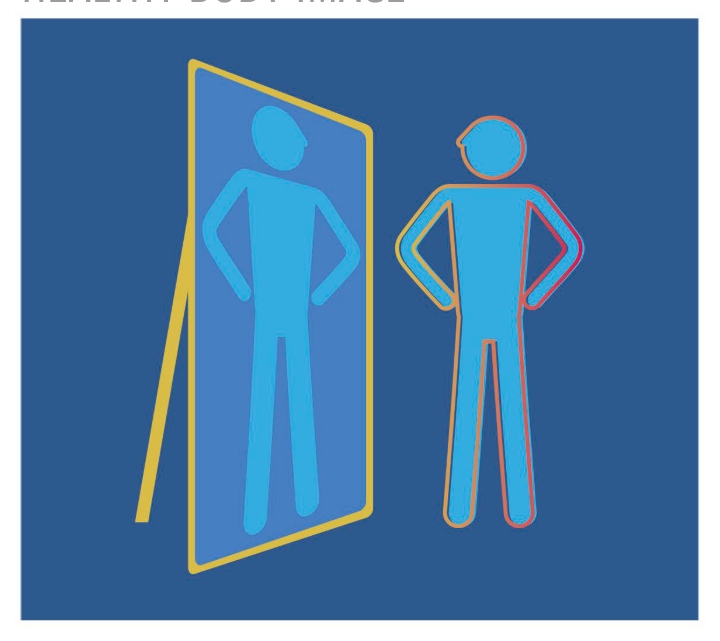
A healthy body image is one dimension of feeling successful. Being comfortable in your own skin makes for a better quality of life, and is likely to make you more attractive and impressive to others as well.
However accomplished you are, it’s hard to feel like a success if you’re not entirely happy with your physical appearance. Of course, you can exercise and be more careful about what you eat and drink, but it’s also a good idea to begin by accepting and learning to enjoy your body here and now, whatever it looks like. When we think of the body beyond mere appearance, there’s a lot it can teach us.
Positive body image
Research finds that a positive body image tends to support a variety of healthy behaviors, including:
- ■ Higher levels of psychological and social well-being
- ■ Better coping skills
- ■ Improved sex life
- ■ Intuitive eating (that is, eating appropriate quantities when hungry, rather than comfort eating or starving yourself)
If you can become more relaxed with how you feel about your body, the evidence suggests that you become better able to read its signals—and this in turn leads to more positive behaviors.
Dress for success
Getting dressed can sometimes be a fraught issue if you’re not wholly confident about how you look. The concept of “enclothed cognition” may come in handy here. A series of experiments at Northwestern University in Illinois, published in the Journal of Experimental Social Psychology in 2012, found that the clothes we wear have a symbolic meaning, and can make a difference in our level of achievement when completing a task. Preliminary research found that a white lab coat, as typically worn by scientists and doctors, is associated with being attentive and careful. In the experiment, volunteers were shown a white lab coat and given the option of putting it on or not—but first, some volunteers were told it was a doctor’s coat, while others were told that it was an artist’s coat. After making their choice, the volunteers took part in a test. Those wearing the “doctor’s coat” outperformed everyone else: the image of a doctor’s precision and intellect had heightened their concentration. (Attention levels did not increase among those whose coats had been described as belonging to an artist.) The researchers concluded that the influence of clothing depends on the symbolic meaning attached to an outfit and the act of wearing it. Certain outfits can bring out in us the positive qualities we associate with their role. When choosing our clothes, perhaps the key is to worry less about how we’ll look, and think of it more as choosing a costume for who we want to feel like.
I’ve never
wanted to look like models on the cover of magazines.
I represent the majority of
women and I’m proud of that. Adele
Singer-songwriter
Being in the world
In a society full of images of impossible physical perfection, it’s easy to feel we’re lacking. Instead of thinking of your body as an accessory, though, it’s healthier to think of it as a tool: however it looks, your body can carry you toward your goals. Confidence, dynamism, and action are more than skin deep, and these are the qualities that will help you to succeed.
LOVE YOUR BODY
Positive psychologist Kate Hefferon points out that people who feel comfortable with their bodies tend to be physically and emotionally healthier. She suggests a combined set of techniques to encourage us in the right direction:
Physical activity:Focus on how exercise and eating good food make you feel rather than how they make you look.
Media literacy:Be familiar with how
advertisers feed our insecurities in order to make us more suggestible consumers.
The beauty myth:Appreciate how
unrealistic ideals limit both men and women in today’s society.
Improved self-esteem:Work on liking and
accepting yourself as a valuable person, no matter how you look.
Israeli health psychologist Tal Shafir observes that our physical stance gives our brains feedback that can translate into emotions. Hence, assuming a downcast posture tends to make us “feel” sad, while a confident posture picks us up—so, for instance, dancing has been proven to improve mood more than hunching over an exercise bike. Shafir’s research identifies key movements that cheer us up:
Expanding the body upward and horizontally such as stretching, jumping, and arm-raising.
Lightness.Walking or moving with a spring in your step.
Repetitive movements movements—dancing is particularly good for this.
 Vnotes Education