
DETERMINING YOUR AIMS YOUR OBJECTIVES

Any strategy for success involves pruning: to focus on what you’re doing, you have to decide what you won’t be doing. When setting your priorities, don’t overlook the less obvious consequences of your decisions.
I WILL NOT FOLLOW WHERE THE PATH MAY LEAD, BUT I WILL GO WHERE THERE IS NO PATH,
MURIEL STRODE, POET AND AUTHOR
AND I WILL LEAVE A TRAIL

Sometimes it can be difficult to know which priorities to focus on, and what the end result of our actions might be. Asking yourself specific questions can help focus your mind on what’s important to you.
Avoiding pitfalls
American management consultant Fred Nickols, with input from his colleague Ray Forbes, has developed a set of questions you can ask yourself whenever you are trying to determine your objectives
- ■ What are you trying to achieve? ■ What are you trying to preserve? ■ What are you trying to avoid?
- ■ What are you trying to eliminate?
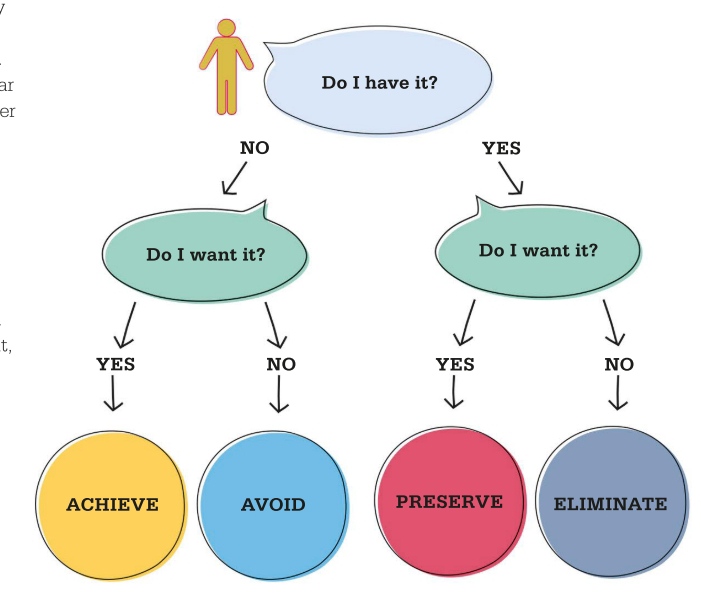
The aim of these questions is to highlight the sometimes-complex interaction among our decisions, actions, and outcomes (see “Achieve, preserve, avoid, or eliminate?,” opposite). The point is that you need to make choices to maintain an overall balance in your accomplishments by preserving what you have that you value, achieving in new areas, and avoiding any negative results. You may have more goals than you think, and if you can factor in the “negative” goals as well as the positive ones, you’re less likely to miss something important and end up short of where you started. When clarifying your goals, be clear about what you want—and consider the things you don’t want to risk.
Maintaining momentum
If you have big plans and are starting from a less than ideal position, you’re going to have to put in a lot of time and effort. There may be moments when you really don’t feel like it: at that point, it may be time to double-check your priorities.
As Stuart Biddle, Professor of Active Living and Public Health at Victoria University in Australia, puts it, “Not having time is not a reality in most cases.” If we have time to watch TV or take a break, that’s time that we can, if we choose, decide to dedicate to a bigger project. The key here, as psychologist Carol Dweck explains, is to have a “growth mindset” rather than a “fixed mindset” (see “Fixed or growing?,” opposite). Instead of being perfectionists who think we either can or can’t do something, it helps to see learning as a process that continues throughout our lives. That relieves some of the pressure. You don’t need to drive yourself to exhaustion;
ACHIEVE, PRESERVE, AVOID, OR ELIMINATE?
Performance improvement expert Fred Nickols devised a set of questions to help establish and clarify priorities: sometimes “success” may be more about preserving, avoiding, or eliminating aspects of your life than it is about achieving something. Think about your different goals, and ask yourself these questions to see if your answers reveal any issues you may need to consider further:
27 Do I have it? NO YES Do I want it? Do I want it? YES NO YES NO ACHIEVE AVOID PRESERVE ELIMINATE
but when time is a limited resource, it’s good to ask yourself whether you’re really losing motivation, or if you’re just tired. We need to keep our spirits up as we push for success, and we also need to be aware that not jeopardizing what we already have can matter as much as gaining new things. The clearer you are on your priorities, the better off you’ll be.
ACHIEVE, PRESERVE, AVOID, OR ELIMINATE?
Performance improvement expert Fred Nickols devised a set of questions to help establish and clarify priorities: sometimes “success” may be more about preserving, avoiding, or eliminating aspects of your life than it is about achieving something. Think about your different goals, and ask yourself these questions to see if your answers reveal any issues you may need to consider further:
There are
Thomas Sowell
no solutions; there are only trade-offs
Economist,
social theorist, and political philosopher
 Vnotes Education
Leave a comment