
Success involves coping well with challenges and crises, but also relishing good things when you find them. That way, when life does get difficult, you can benefit from a well-rounded outlook based on positivity and optimism
A positive mindset is a long-term investment that prepares you for life’s challenges. Research has found that when we experience good moods, this tends to broaden our outlook and allow us to respond to situations— including bad ones—more flexibly than usual. If we can cultivate this positive mindset, it’s likely to help us build maturity of character. If you want to get through life with a robust attitude, don’t push yourself to be “tougher,” but instead open yourself to the full range of life’s experiences (good, bad, and challenging). Here are some approaches you may find useful in your journey.
SAVOR THE GOOD MOMENTS
In the Journal of Happiness Studies, psychologists Michele Tugade and Barbara Fredrickson point out that if we have something good to report, we commonly call friends and family, wanting to tell as many people as possible. This is partly about maintaining social connections, but it’s also about prolonging the happy mood: sharing the good news keeps the pleasure fresh in our minds. We can prolong the mood at any time, by looking forward to a positive experience, enjoying it while it lasts, and then relishing the memory afterward. All are ways of “capitalizing” on something pleasant—which is to say, getting as much value out of it as we can.
ENJOY ALL YOU CAN
Psychology distinguishes between two kinds of well-being:
■ Hedonic well-being.From the Greek hēdonē, meaning “pleasure.” This describes subjective, in-themoment experiences that we find enjoyable.
■ Eudaimonic well-being.From the Greek eu, meaning “good” and daimōn, meaning “spirit.” This describes long-term activities that allow us to grow, have positive relationships with other people, and feel good about ourselves.
It’s not only life’s challenges that foster our resilience; it’s also our experiences of life at its best. So make enough room for enjoyment in your life.
FIND THE SILVER LINING
We can’t prevent the bad moments, but we can learn to experience at least some positive emotions within them. According to a 2000 US study, useful approaches for turning negative to positive are:
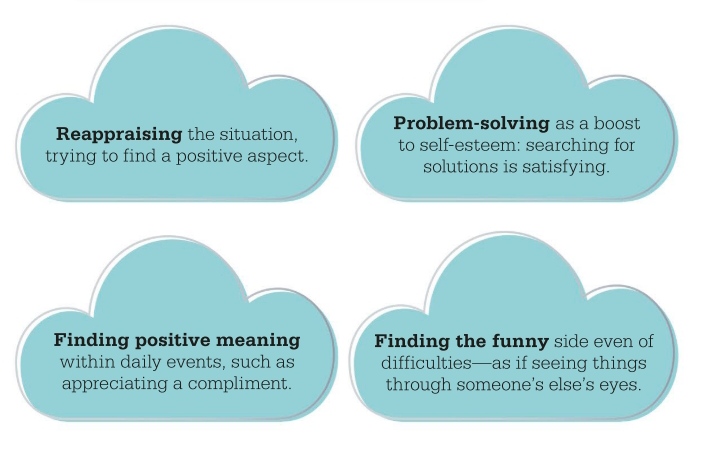
Don’t wait for a big problem to arise before you put these coping methods into effect. Instead, see them as faculties you can exercise at any time so that you’ll be strong and ready for whatever life brings you.
KEEP A BALANCED PERSPECTIVE
While a positive attitude is undoubtedly good for success, in some circustances this needs qualification. As psychologists Robert Cummins and Mark Wooden remark in the Journal of Happiness Studies, “the extremes of optimism are […] maladaptive”— which means too much can be as unhelpful as too little. Too little optimism makes us discouraged and fearful, but an excess can make us impulsive in situations where caution would serve us better. Balance is the key to success: being optimistic but also realistic.
CHOOSE YOUR AFFIRMATIONS WISELY
worse after repeating generalized, nonspecific positive affirmations. It seems they didn’t feel that these statements were true, and having to articulate them only served as a reminder that these were painful subjects. If you decide to use affirmations to lift your spirits, choose statements that you feel describe positive attributes about your talents and what is important to you, such as, “I am excellent at attending to details and planning.”
 Vnotes Education
Leave a comment