
Achieving our goals often involves choosing between competing priorities. When we decide to give something up, how do we deal with the feelings of discomfort this can cause?
Have you ever held onto an item of clothing that no longer fits, or a bond that’s
fallen in value? You know you’d like to have more space in your wardrobe or a better investment, but somehow the pain of losing what you have, even if it’s not useful, seems to outweigh the clear benefits. This is what psychologists call loss aversion
The endowment effect
In 1990, economist Richard Thaler joined psychologist Daniel Kahneman and behavioral economist Jack L. Knetsch in an experiment. Half of the study’s participants were given coffee cups, and the other half only shown them. The two groups were then asked how much they would be prepared to either sell or buy the cups for respectively. The “owners” wanted about twice as much for their cups as the viewers were willing to pay. This is the endowment effect: simply owning something, even briefly, makes us put a higher value on it. It seems we dislike giving things up simply because it’s a sacrifice, even if we wouldn’t otherwise value the thing we’re giving up very highly
Ownership and self-image
Why do we sometimes act in an irrational way? In a 2013 study by American psychologists Sara Loughran Dommer and Vanitha Swaminathan, one group of volunteers was asked to describe a “social self-threat” situation, such as a romantic rejection, while a second group was asked to describe an average day. Both groups were then given a relatively worthless item—a ballpoint pen—before being asked to part with it. The study found that people were less willing to give up the pen after they experienced social self-threat situations. When we own something, we start to incorporate it into our sense of who we are—and the more threatened we feel, the less willing we are to forfeit even unimportant things. If you need to give something up, try to bolster your sense of identity first. Remind yourself that selfworth doesn’t depend on particular possessions or relationships—it’s inherent, and the more confidence you have in yourself, the easier it can be to let things go.
LOSS AVERSION
A knowledge of loss aversion can be useful when you are seeking to influence others. When making pitches, marketing psychologists propose the following approaches.
■ Suggest your audience already possesses something desirable, and that your product will stop
them from losing it. (For example, “You could lose hundreds of clients if you don’t…”)
■ Encourage them to imagine themselves owning or using your product. (“Picture yourself sitting behind the wheel…”)
■ Let them “own” your product for a limited time, such as a free sample or a trial period. That way, not buying it once the trial ends would mean giving it up
WEIGHING THE CHOICES
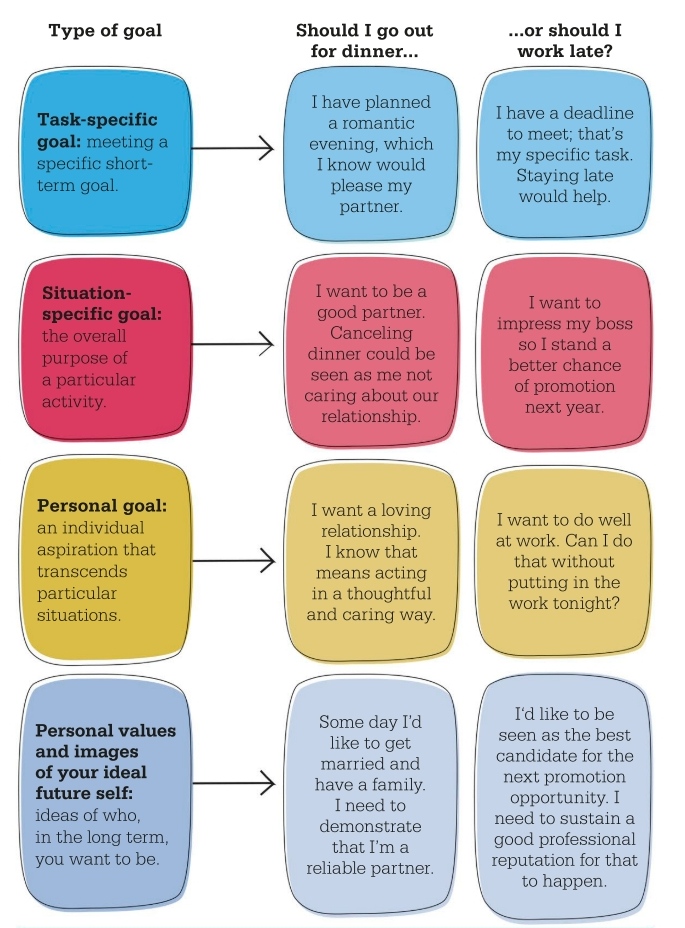
When you have to decide what to give up, it can be useful to think in terms of different types of goals. A 1997 study published in the Journal of Personality and Social Psychology suggests weighing four different types of goals when trying to make a decision. Suppose you’re trying to decide whether to cancel date night with your partner in order to get some extra work done. Assessing the situation in the context of the following types of goals may help you settle whether, in this instance, your partner or your work should take priority.
 Vnotes Education
Leave a comment