
Top-down leadership, in which managers give orders, is not always the best way to get results. A number of different leadership styles have been identified by business experts.
How it works
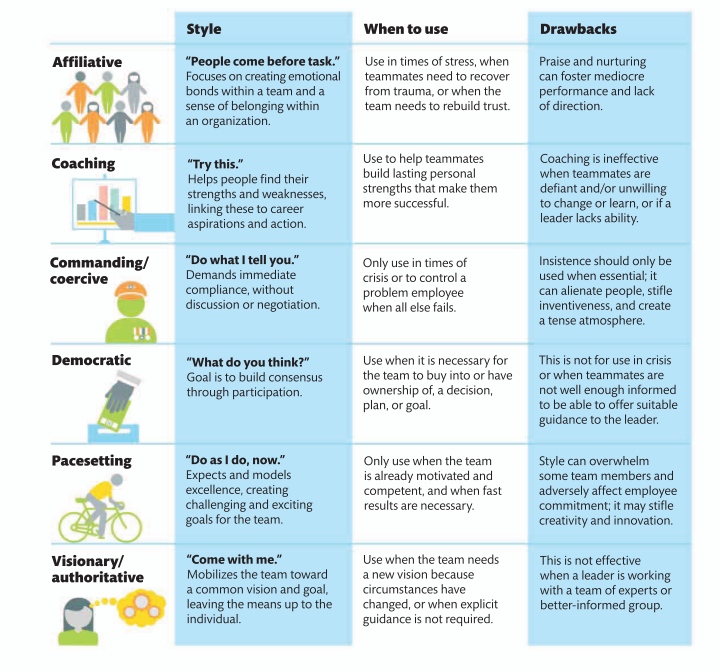
Every leader is an individual with his or her own approach. However, over the years, management gurus have identified key leadership styles that can be used to achieve different results, depending on the environment. Many frameworks are based on the ideas of psychologist Kurt Lewin, who developed his theories in the 1930s with three major styles: autocratic, democratic, and laissez-faire (non-interference).
In 2007, for example, business authors Eric Flamholtz and Yvonne Randle developed a leadership matrix based on Lewin’s theories, which shows the best style to use in any given situation, ranging from autocratic (one all-powerful leader) to consensus (decisions reached by general agreement. Truly inspirational leaders encourage people to believe in themselves so that they achieve results beyond even their own expectations.
“Outstanding leaders go out of their way to boost the selfesteem of their
personnel.” Sam Walton
TRANSFORMATIONAL LEADERSHIP
While different styles can suit different situations, transformational leadership, in which leaders and their followers raise one another to higher levels of integrity and motivation, was identified by guru James McGregor Burns as the most effective. This has been developed by others, including industrial psychologist Bernard Bass, who listed the qualities of a transformational leader.
- Is a model of integrity and fairness
- Sets clear goals
- Has high expectations
- Encourages others
- Provides
- support and recognition
- Stirs the emotions of people
- Gets people to look beyond their self-interest
- Stirs the emotions of people
When to use which leadership style
 Vnotes Education
Leave a comment