
People work for money, but they are also motivated by other factors such as doing a good job and being valued. Non-financial rewards drive day-to-day motivation more strongly than pay and benefits.
How it works
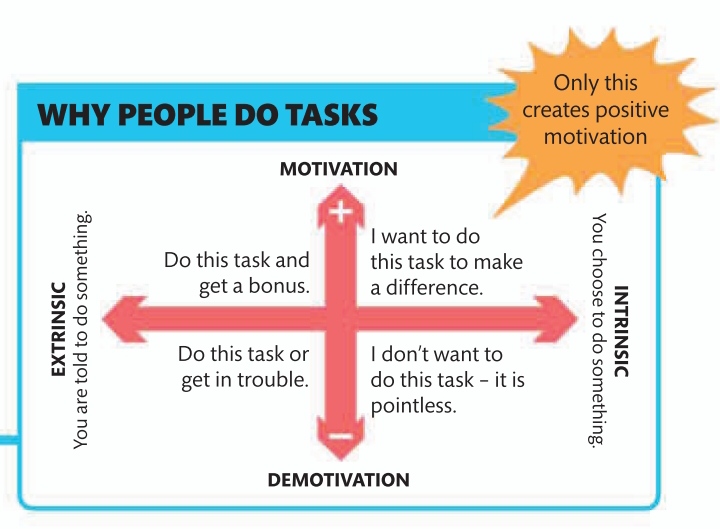
In the past, tangible pay and benefits were the key motivational tools for employees. These financial rewards are termed extrinsic because they areexternal to the actual work and others control the amount, distribution, and timing. Employers now recognize that while extrinsic incentives are clearly important, intrinsic (psychological) rewards are crucial.
Understanding motivation in the workplace
Happy staff work well, and job satisfaction comes from subtle feel-good factors as much as a paycheck. Employees who enjoy their work tend to stay—job satisfaction and turnover move in opposite directions.
Extrinsic
Financial rewards
- ❯ Base pay
- ❯ Bonus
- ❯ Incentives
Benefits
- ❯ Pension contributions
- ❯ Paid holidays/vacation
- ❯ Health care
Intrinsic Feelings that an individual has:
- ❯ Purpose A sense of being able to accomplish something of value
- ❯ Choice Clear ownership and feeling responsible for outcome
- ❯ Progress As an individual, feeling and seeing evidence of moving things forward
- ❯ Competence Pride and satisfaction in own work
Fostering intrinsic rewards
Businesses that are successful engender trust and have employees who are passionate about what they do. All these factors contribute:
Purpose for organization and individual
- ❯ Clear vision for organization❯ Understanding of where individual fits in to achieve that purpose
- ❯ Clear goals and expectations for individual
Recognition
- ❯ Continuous feedback
- ❯ Ongoing engagement
- ❯ Non-cash rewards such as praise
Career development
- ❯ Progression and promotion
- ❯ Mentoring and coaching
- ❯ Learning opportunities
Culture
- ❯ Strong teamwork and consistent behaviors
- ❯ Open communication
- ❯ Sharing of knowledge and information
WHY PEOPLE DO TASKS
13%
the percentage of employees who are fully committed to their jobs
 Vnotes Education
Leave a comment