
Environmental regulations force companies to consider the impact of their activities and to adopt corporate social responsibility (CSR) as they grapple with legislation, climate change, and public opinion.
How it works
Globally, there are reams of different environment acts spread across multiple jurisdictions that affect the companies operating within their borders in different ways. Areas protected by environment acts include the atmosphere, fresh water, the marine environment, nature conservation, nuclear safety, and noise pollution. International acts are usually ratified by each country individually before taking effect there. An example of a common global means of reducing greenhouse gas emissions is emissions trading (“cap and trade”), by which companies must buy a permit for each ton of CO2
they emit over a
certain level. Those emitting under the agreed level can sell their permits to other companies.
Environmental credentials
Most companies include a section on environmental accounting in their financial statement. Some details are required by law, but the statement also gives an opportunity to showcase environmental credentials to stakeholders.
Product responsibility
- ❯ Life-cycle stages in which the health-and-safety impact of products and services are assessed for improvement
- ❯ Adherence to laws, standards, and voluntary
- codes relating to marketing communications
Society
- ❯ Programs and practices that assess and manage the impact of operations on communities
- ❯ Fines and sanctions for noncompliance with regulations
Economic
- ❯ Financial implications, risks, and opportunities for the organization’s activities due to climate change
- ❯ Financial assistance received from the government
Human rights
- ❯ Investment agreements that include human right clauses or that have undergone human rights screening
- ❯ Suppliers and contractors that have undergone screening on human rights; actions taken to address any issues
Labor practices
- ❯ Workforce by employment type, contract, and region
- ❯ Average hours of training per year, per employee by employee category
- ❯ Ratio of basic salary of men to women by employment category
GREENHOUSE GAS EMISSIONS
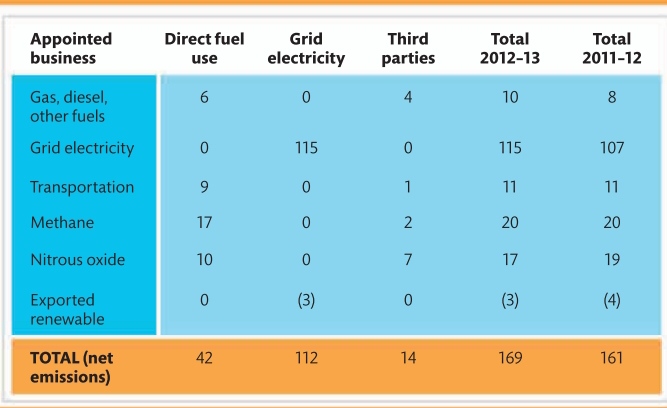
In some countries, companies are required by law to provide details of their greenhouse gas emissions. This is usually presented as a table in the environmental accounting section of the annual report. It includes direct and indirect emissions—by the company itself and by third parties—of gas, diesel, and other fuels; sulfur oxides and nitrous oxides; methane; and other ozonedepleting substances. In this table, from the Wessex Water utility company, emissions are shown as ktCO2
equivalents.
CASE STUDY
Cleaning up rivers
Wessex Water’s impressive record on pollution is mentioned several times in its statement, including in the chairman’s introduction. This prominence shows that the company believes acting in an environmentally conscious manner is important to its investors. The company illustrates several areas where it has acted with others to positively affect the environment:
- ❯ Work with the charity Surfers Against Sewage, which campaigns for clean seawater
- ❯ Its river strategy: collaborating with pressure groups and organizations to reduce pollutants and the impact of habitat alteration, and so increase the numbers of aquatic plants, invertebrates, and fish in local rivers
- ❯ Improving water quality at swimming beaches in the region, in compliance with mandatory standards
 Vnotes Education
Leave a comment