
The formal records of a business’s financial activities are presented as financial statements. Most jurisdictions require accurate information by law, and financial directors and auditors are liable for its contents.
How it works
Financial statements summarize a company’s commercial activities clearly and succinctly, with details of the business’s performance and changes to its financial position. They are aimed at several parties, so they need to be detailed but also comprehensible to the general public. The statements are usually presented together in the form of an annual report, with in-depth accounts and footnotes to give detail. Legal requirements vary, but accounts must be exact.
CONSOLIDATED FINANCIAL STATEMENTS
In an era of globalization, large corporations are now commonly made up of multiple companies. Companies owned by a parent company are known as subsidiaries, and continue to maintain their own accounting records, but the parent company produces a consolidated financial statement, which shows the financial operations of both companies. Depending on the jurisdiction’s reporting requirements, however, if a company owns a minority stake in a second company, then the latter will not be included in the former’s consolidated financial statement.
NEED TO KNOW
- ❯ Subsidiary One company that is controlled by another, usually a holding company
- ❯ Holding company A company set up to buy shares of other companies, then control them
- ❯ Globalization The process of businesses developing such large multinational presences that they transcend international borders
What’s in an annual report
The contents page shows where to find the big three statements—the balance sheet, cash-flow statement, and profit-and-loss statement—and softer information such as stories about staff and opinions of other stakeholders. The annual report provides an opportunity to impress shareholders and lenders as well as fulfill legal reporting obligations. It will contain all, or most, of the following.
Chair Instructions It is common for the chairman to write an introduction focusing on the positives and explaining any negative parts of an annual report for the benefit of shareholders.
Our environment These pages contain much of the company’s information on its environmental protocols, most of which are industryspecific.
Our performance indicators Performance indicators are common across all industries. They measure areas such as customer satisfaction and the quality of goods or services provided by the company.
Director report In the directors’ report, members of the board of directors give their professional opinions on how the business has performed over the last year.
Our customers and Community This section underlines a company’s social ethos, in particular its community involvement. Different types of companies may focus on different values.
Our customers A section on employees details areas such as staff development and training, health and safety, and key statistics on staff satisfaction.
Environmental accounting The environmental accounting section contains figures that pertain to the environment, often those stipulated by law—for example, greenhouse gas emissions.
Independent auditor’s report Auditors are independent and check the accuracy of companies’ accounts. This helps to eliminate mistakes and track fraud.
Our finance A brief overview summarizes the key areas of finance for the company, including overall performance, turnover, operating costs, capital investment, depreciation, interest charges, taxation, and dividends.
Our infrastructure The infrastructure pages of an annual report are a good place to supply more detail about the company’s fixed assets and explain why the company is an attractive investment for investors
Board of directors The board of directors, governance report, and statement of directors’ responsibilities sections indicate who is leading the company, showcases their credentials and roles, and reveals their pay.
Note to accountants Notes to the accounts are a key part of financial statements. They provide extra detail, insight, and explanation of the barebones figures supplied in earlier pages of the report.
Deconstructing a financial statement
The profit and loss account shows revenues, costs, and expenses— how much money the business makes—over an accounting period. The balance sheet shows what a business is worth at the time it is published, and is relevant to investors as it reveals assets, liabilities, and shareholders’ equity—all useful for gauging business health. The cash-flow statement shows the movement of cash within a business—its liquidity. However, along with the big three financial statements, an annual review contains a wealth of information about a company’s performance, of interest to its stakeholder groups. It is often the notes that bring statements to life.
TAXES
The percentage of business taxes taken by governments varies from country to country but the generic types remain similar:
- ❯ Direct taxes are levied directly on profits or income and include income taxes, inheritance taxes, and taxes relating to sales or purchase of property and other capital assets.
- ❯ Indirect taxes are paid on goods or services, such as sales taxes. Indirect taxes are often targeted to reduce consumption of harmful goods, a factor relevant to companies working in the alcohol and tobacco industries.
- ❯ Green taxes are increasingly common and are often indirect. They are generally used as a way of prohibitively increasing the price of goods or services harmful to the environment, such as air travel, landfill sites, or fuel, to diminish their use.
- ❯ Corporation tax is only paid by companies, not by sole proprietors or partnerships. It is levied as a percentage of the company’s total profit.
NEED TO KNOW
- ❯ Monopoly Situation in which there is just one supplier of a particular product or service; without government control, a company with a monopoly could make prices high and quality low, as consumers would have no alternative
- ❯ Oligopoly Industries that have a small number of suppliers. The competition is not as intense as in the free market, so governments often impose regulations on companies to ensure quality and fair prices
- ❯ Remuneration Money paid for work or a service provided— the financial term for pay; may include bonuses or share options
BOARD OF DIRECTORS
Much of what might be considered personal information about directors of public companies is in the public domain. It is usually a legal obligation to disclose:
- ❯ Names of executive directors
- ❯ Names of non-executive directors, and whether they are independent or shareholders
- ❯ Shareholding
- ❯ Board attendance record
- ❯ Dates of directors’ terms of office
- ❯ Remuneration, including bonus, share options, pension plans, and benefits
- ❯ Notice period
- ❯ Termination payment
- ❯ Potential conflicts of interest
Case study: the details
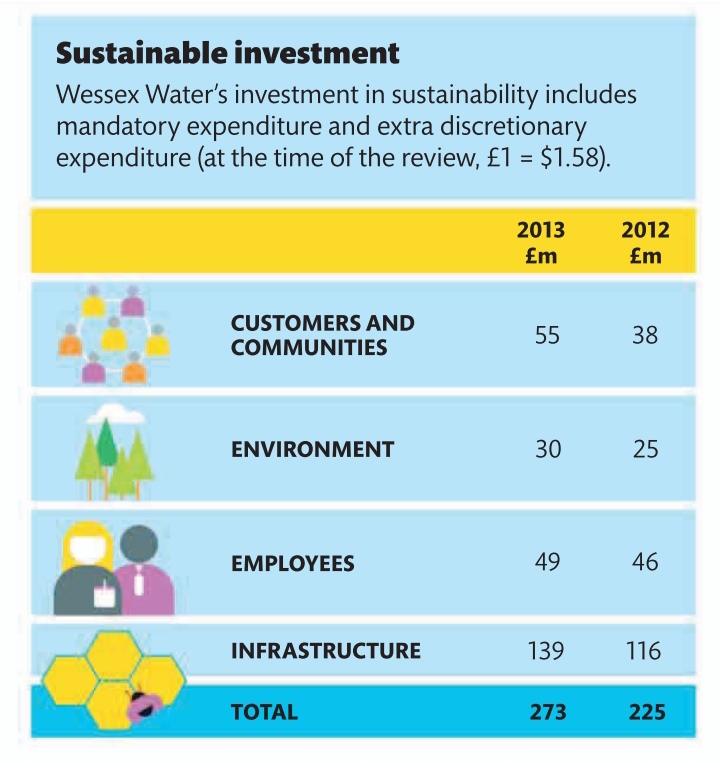
Financial statements are presented as part of the annual report, which also publishes case studies, quotations, statistics, and profiles of customers, suppliers, employees, and directors. The notes, often running to 20 pages or so, contain tables and text that flesh out the financial information. The following examples are taken from the 2013 annual review of UK utility company Wessex Water.
Our finance
This section contains the
headline financial figures of the business, such as profits, taxes paid, assets owned, liabilities, and dividends paid out, as well as some more detailed explanation of the figures.
Charitable donations
Companies vaunt their philanthropy in the annual report, detailing how much they have given away and how it has helped. They may support charities relevant to the nature of their business or let employees vote on recipients.
Customer satisfaction
Overall, this section shows how the company works with customers to improve service and support. In monopoly and oligopoly industries, customer satisfaction is particularly important, as governments often set high targets. Wessex Water’s annual review shows a customer satisfaction rating of 96 percent.
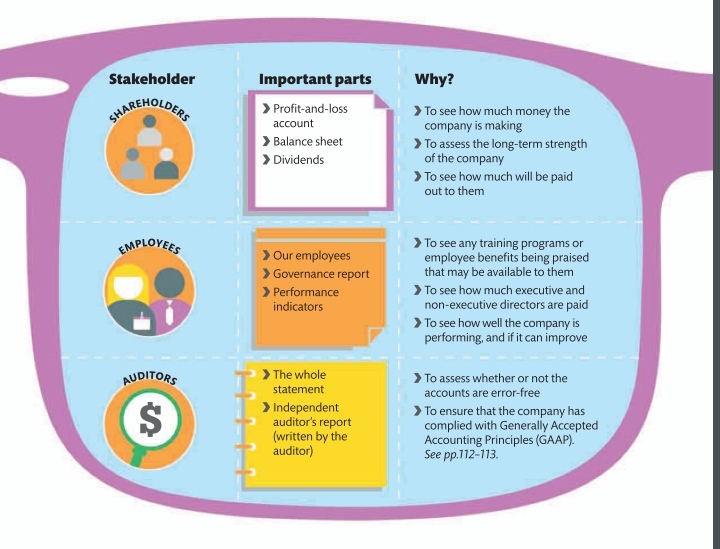
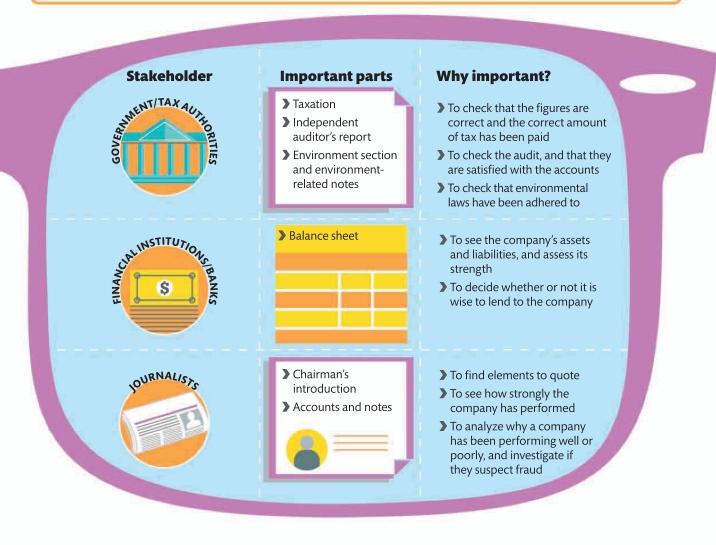
Financial statements for users
Different stakeholders are interested in different parts of the annual review. Customers of a service provider, for instance, may look at the section on customers and community while potential lenders go to the financial statements..
STATISTICS MADE EASY
Impressive statistics are often scattered through an annual report. These examples are from UK utility Wessex Water:
6% post-tax
return on capital
❯ This percentage is estimated by dividing income after tax by the amount of investment. It is useful for showing shareholders the kind of returns they can expect on their investments.
64% gearing
❯ For most industries, gearing is a company’s debt compared to its equity. In the water industry, it compares a company’s net debt to its regulatory capital value (the value of the business that earns a return on investment). Gearing is expressed as a percentage.
A3/A-/BBB+ credit rating
❯ Credit ratings assess the likelihood that loans will be repaid. A3 and A- fall at the bottom of “strong capacity to meet financial commitments,” while BBB+ is at the top of the adequate range. The major ratings companies in the US are Moody’s, Standard and Poor’s, and Fitch.
 Vnotes Education
Leave a comment