
We often hope other people will approve of our character, actions, and opinions. However, this can leave us with a dilemma: to what extent should we try to win respect by doing as others wish?
Feeling community gives us peace of mind: it is one of the best boosts for our confidence and our relationships with ourselves and others. But how do we present our most admirable self while being true to who we really are?
Presenting a respectable self
Social disapproval is a powerful deterrent, and all of us, to some extent, will want to maintain a public face that people accept. Psychologists refer to the process as “impression management” (IM). This can sound rather manipulative; and indeed studies confirm that individuals with a high IM score are more willing to be economical with the truth when their reputation is on the line. Recent research, though, has argued that such people are not truly confident— instead, they are defensive, and anxious about losing face. Israeli psychologist Liad Uziel argued in 2010 that a more accurate term would be “interpersonally oriented self-control,” a useful phrase that flags the difference between negative covering up and positive self-presentation. Showing yourself worthy of respect can be a skilled performance, but it needn’t be a cynical one. At times it may even increase your creativity (see “Not so shallow,” opposite).
Respect for
Laurence Sterne
ourselves guides our morals; respect for others guides our manners.
Irish novelist and clergyman
Respect and giving
While it’s good to be generous, it’s also common knowledge that people don’t usually respect a pushover. When considering this aspect of your standing with others, ask yourself a few questions:
- ■ Do I have a hard time refusing unreasonable requests?■ Do I often feel taken for granted? ■ Do I often put my own needs last?
■ Do I do more favors for others than they do for me?
■ Do I get the low-grade work no one else wants? - ■ Do I worry people will reject me if I say no?
As anthropologist David Graeber observes in Debt: The First 5,000 Years, nonreciprocal giving is a mark of hierarchy rather than equality—think of giving candy to a child or bringing a tribute to a king. In such imbalanced relationships, giving once creates the expectation that you’ll give again.
If you give too much, you may actually be indicating that you consider yourself lower-status. If so, finding ways to say no (see p.131) might actually raise your standing. Respect begins with respecting yourself, so work on showing your value and following your principles.
Maintaining respect
Respect, lost in a moment, may take great effort to restore—though at times a single great effort can win over others and recover your position. Don’t skimp on what’s needed to rebuild your standing: respect is worth striving for.
NOT SO SHALLOW
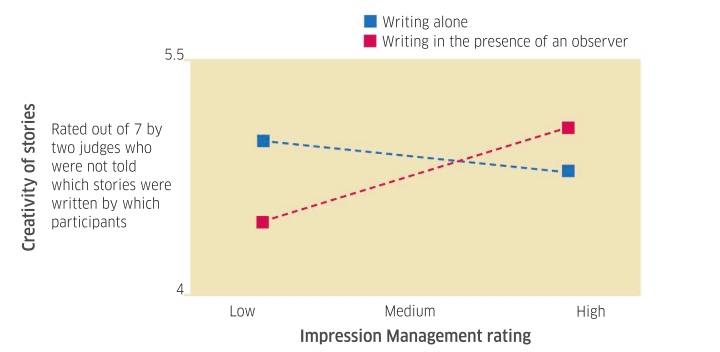
There’s a tendency to think of people who pay a lot of attention to their “impression management” (IM) as more superficial than those who don’t. A 2010 study by Israeli psychologist Liad Uziel, however, found that a desire for respect may increase creativity in front of an audience. Asked to create stories in a test setting, people rated as having low IM performed better when alone. However, given an audience, it was people with high IM who carried the day.
THE EFFECT OF “IM” ON CREATIVITY
STEPPING OFF THE GUILT TRACK
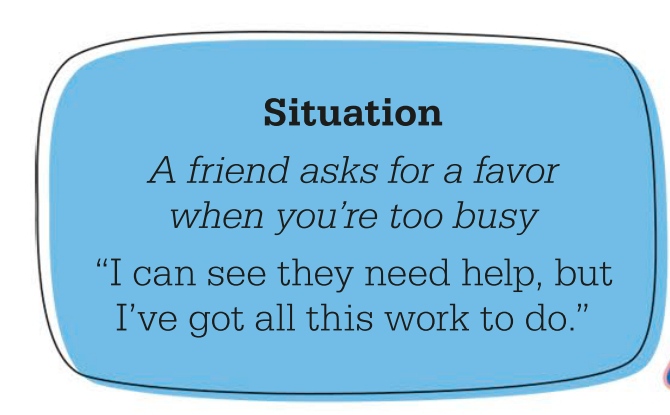
If you feel under pressure to accept every responsibility pushed your way, you’re probably a decent person— but you may gain more respect if you can draw some reasonable boundaries. This may mean letting go of guilt. Here is one example, showing a possible set of negative thoughts about a situation, alongside alternative, more positive responses.
Negative responses
- ■ “If I say no, that’ll make things worse for them”
- ■ “That’s selfish of me”
- ■ “People don’t like selfish people”
- ■ “Maybe I’ll lose my friendship”
- You feel guilt and anxiety
- ■ “OK, I guess I’ll make time” You do, and your work suffers
- ■ “Why am I so inadequate? Maybe people are right not to respect me.”
Positive responses
- ■ “This favor is something I just can’t manage right now”
- ■ “I don’t have to sabotage myself to be a good person”
■ “If I take care of myself, I can be more help to them another time”
■ “If they’re my friend, they’ll understand this”
You feel regret combined with confidence - ■ “I’ll make it up to them later.” You say no, and your own life stays under control
- ■ “If I ask for respect, I can expect to get it.”
 Vnotes Education
Leave a comment