
The emotions an individual feels on a daily basis dictate the type of person they feel they are. And yet it is a series of biological processes in the brain that generate every feeling a person has.
What is emotion?
Emotions impact hugely on people’s lives—they govern their behavior, give meaning to their existence, and are at the core of what it is to be considered human. Yet in reality emotions result from physiological responses in the brain triggered by different stimuli—the psychological significance read into emotions is an entirely human construct. Emotions evolved to promote human success and survival by initiating certain behaviors: for example, feelings of affection prompt the desire to find a mate, reproduce, and live in a group; fear generates a physiological response to avoid danger (fight-or-flight); reading emotions in others makes social bonding possible.
Processing emotion
The limbic system (p.26), located just under the cortex, generates all emotions. They are processed via two routes, conscious and unconscious (below). The primary receptor that “screens” the emotional content of all incoming stimuli is the amygdala, which signals to other areas of the brain to produce an appropriate emotional response. Connections between the limbic system and the cortex, in particular the frontal lobes, enable emotions to be processed consciously and experienced as valuable “feelings.” Each emotion is activated by a
specific pattern of brain activity— hatred, for example, stimulates the amygdala (which is linked to all negative emotion) and areas of the brain associated with disgust, rejection, action, and calculation. Positive emotion works by reducing activity in the amygdala and those cortical regions linked to anxiety.
Conscious and unconscious emotive routes
Humans experience their emotional responses through an unconscious route, which is designed to prepare the body for rapid action (fight-or-flight), or via a conscious route, which enables a more considered response to a situation. The amygdala responds to threat and can detect stimuli before the person is even aware of it, provoking an automatic, unconscious reaction. A simultaneous, but slower, transmission of sensory information to the cortex creates a conscious secondary route for the same stimulus, and can modify this initial reaction.
Conscious
Thalamus All sensory information comes to the thalamus for distribution to the amygdala for quick assessment and action, and to the cerebral cortex for slower processing to conscious awareness.
Sensory cortex All sensory information comes to the sensory cortex for recognition. It extracts more information along this path, but the process takes longer than the unconscious route.
Hippocampus Consciously processed information is encoded in the hippocampus to form memories. The hippocampus also feeds back stored information, confirming or modifying the initial response.
CONSCIOUS FACIAL EXPRESSIONS
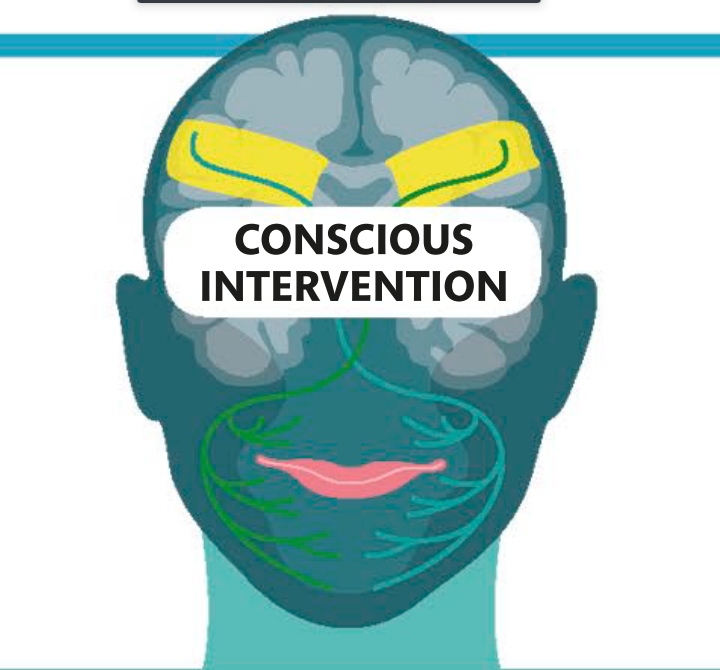
The motor cortex allows a person to control facial expression and so hide or express genuine emotion.
unconscious
Amygdala The amygdala instantly assesses incoming information for emotional content. It sends signals to other areas for immediate bodily action. It operates unconsciously and so is liable to make errors.
Hypothalamus Signals from the amygdala come to the hypothalamus, which triggers hormonal changes that make the body ready for “fight or flight” in response to emotional stimuli. The muscles contract and the heart rate increases.
REFLEX FACIAL EXPRESSIONS
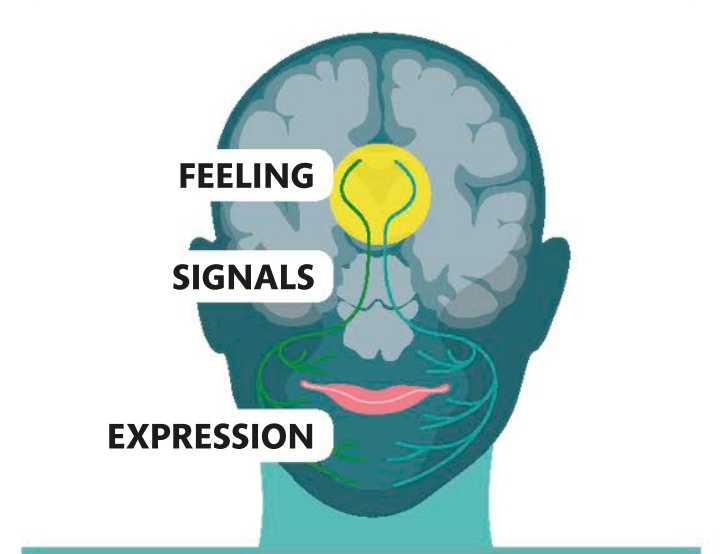
The emotional reaction caused by the amygdala sparks spontaneous, uncontrolled facial expressions.
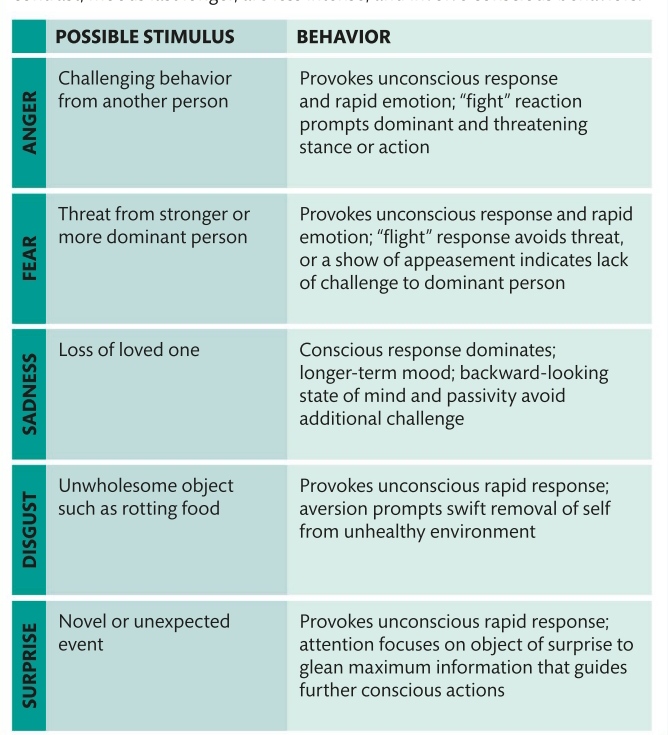
EMOTIVE BEHAVIORS AND RESPONSES
Typical behavioral patterns in response to emotion have evolved in order to neutralize any perceived threat, through either fight or appeasement. In contrast, moods last longer, are less intense, and involve conscious behaviors.
“Human behavior flows from … desire, emotion, knowledge.”
Plato, ancient Greek philosopher
 Vnotes Education
Leave a comment