
Studies of the brain have given valuable insight into the vital correlation between brain activity and human behavior, as well as revealing the complex process by which the brain itself is brought to life.
Connecting brain and behavior
Understanding the biology of the brain and how it works became vital with the rise of neuroscience in the 20th century. Studies in this field confirmed that the brain itself is fundamentally intertwined with human behavior, and prompted the emergence of specialist fields, such as neuropsychology. This relatively new branch of science combines cognitive psychology (the study of behavior and mental processes) with brain physiology, and examines how specific psychological processes relate to the brain’s physical structure. Investigating the brain in this light raises the age-old question of whether mind and body can be separated. The relationship between brain and mind has been debated
since the time of ancient Greece and Aristotle, when prevailing philosophical thought labeled the two entities as distinct. This theory, which René Descartes reiterated in the 17th century with his concept of dualism (right), permeated studies of the brain until well into the 20th century. Modern neurological research and advances in technology
have enabled scientists to trace certain behaviors to specific areas of the brain, and to study connections between the different regions. This has radically advanced knowledge of the brain and its effect on behavior, mental function, and disease.
Mind controlling brain
Dualism argues that the nonphysical mind and the physical brain exist as separate entities, but are able to interact. It considers that the mind controls the physical brain, but allows that the brain can at times influence the normally rational mind, for example, in a moment of rashness or passion.
Brain controlling mind
Monoism recognizes every living thing as material, and that the “mind” is therefore purely a function of the physical brain. All mental processes, even thoughts and emotions, correlate to precise physical processes in the brain. Cases of brain damage reinforce this: minds alter when the physical brain is altered.
“I think, therefore I am.”
René Descartes, French philosopher
Mind-body dualism
Humans are innately reluctant to reduce consciousness to pure biology. But the scientific evidence shows that the
physical firing of neurons generates our thoughts. Two schools of thought, monoism and dualism, dominate the question of whether the mind is part of the body, or the body part of the mind.
SPECIALIZATION OF THE CEREBRAL HEMISPHERES
CEREBRAL CORTEX
Nerve fibers cross over at the base of the brain, so each hemisphere controls the opposite side of the body.
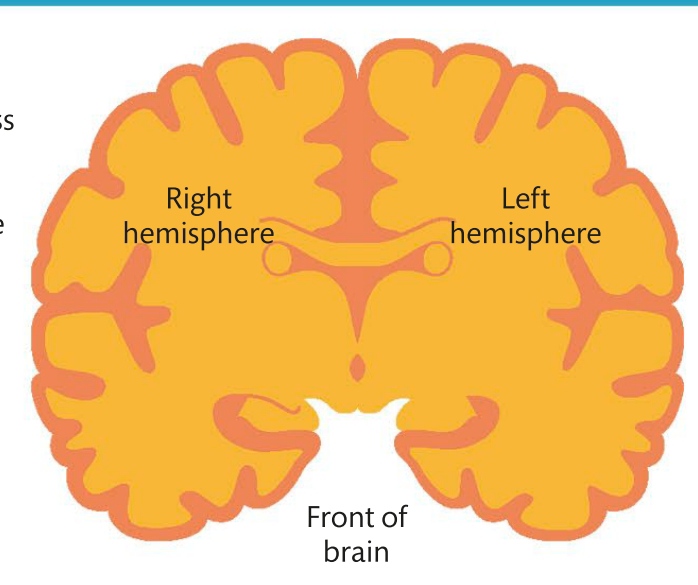
Left hemisphere
- ❯ This controls and coordinates the right side of the body.
- ❯ It is the analytical side of the brain.
- ❯ It is responsible for tasks relating to logic, reasoning, decision-making, and speech and language.
Right hemisphere
- ❯ This controls muscles on the left side of the body.
- ❯ It is the creative side of the brain.
- ❯ It deals with sensory inputs, such as visual and auditory awareness, creative and artistic abilities, and spatial perception.
Mapping the brain
One of the most complex systems in nature, the human brain controls and regulates all our mental processes and behaviors, both conscious and unconscious. It can be mapped according to its different neurological functions, each of which takes place in a specific area. The hierarchy of mental processing is loosely
reflected in the brain’s physical structure: high-level cognitive processes take place in the upper areas, while more basic functions occur lower down. The largest and uppermost region (the cerebral cortex) is responsible for the highest-level cognitive function, including abstract thought and reasoning. It is the capacity of their cerebral cortex that separates humans from other mammals. The central limbic areas (below) control instinctive and emotional behavior, while structures lower in the brain stem maintain vital bodily functions, such as breathing.
Functional divisions
The cerebral cortex (also called the cerebrum) divides into two separate but connected hemispheres, left and right. Each one controls a different aspect of cognition . Further divisions include four paired lobes (one pair on either hemisphere), each of which is associated with a specific type of brain function.The frontal lobe is the seat of high-level cognitive processing and motor performance; the temporal lobe is involved in short- and long-term memories; the occipital lobe is associated with visual processes; and the parietal lobe deals with sensory skills. Brain-imaging techniques, such as fMRI (functional
magnetic resonance imaging), measure activity in the different brain areas, yet their value to psychologists can be limited. Those studying fMRI results need to be aware, for example, of the issue of “reverse inference”: just because a particular part of the brain is shown to be active during one cognitive process does not mean it is active because of that process. The active area might simply be monitoring a different area, which is in fact in control of the process.
The limbic system
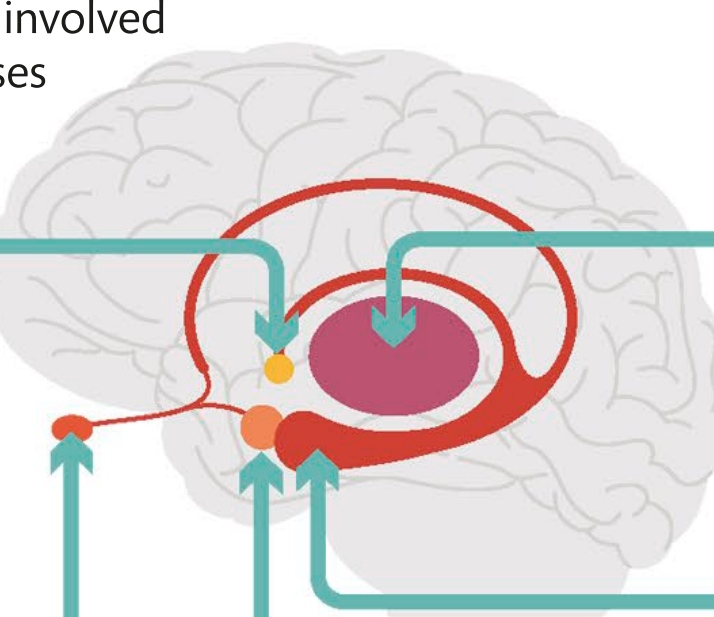
This complex set of structures is involved in processing emotional responses and the formation of memories.
Hypothalamus Involved in regulating body temperature and water levels and key behavioral responses.
Olfactory bulb Relays messages about smell to the central limbic areas for processing.
Amygdala Processes emotions; affects learning and memory.
Hippocampus Converts short-term memories into long-term ones.
Thalamus Processes and sends data to higher brain areas.
Locating brain function
Psychologists and neurologists can map neurological function when small areas of the brain are stimulated. Using brainscanning techniques, such as fMRI or CT, they study and record the sensation and movements this stimulation produces.
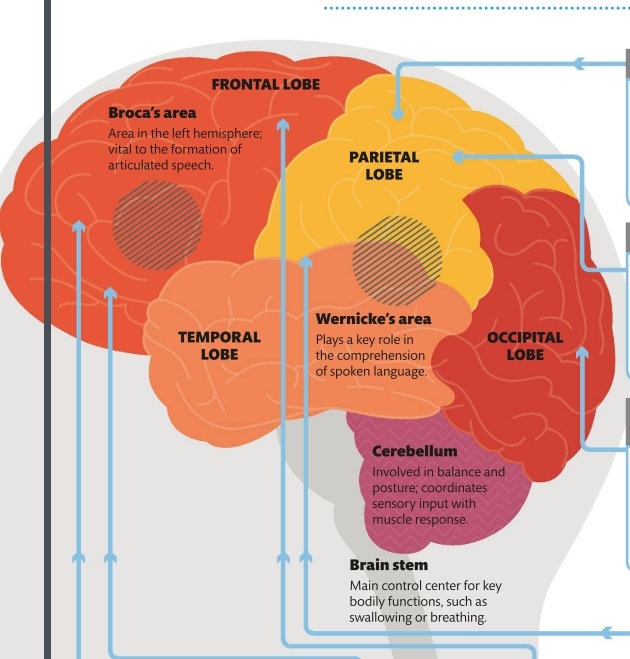
Broca’s area
Dorsolateral prefrontal cortex This area is linked to various high-level mental processes, including
“executive functions”— the processes involved in self-regulation or mental control.
OFC (orbital frontal cortex) Part of the prefrontal cortex, the OFC connects with the sensory and limbic areas; it plays a role in the emotional and reward aspect of decision-making.
FRONTAL LOBE
Supplementary motor cortex One of the secondary motor cortices, this area is involved in planning and coordinating any complex movements. It sends information to the
primary motor cortex.
Wernicke’s area
Plays a key role in the comprehension of spoken language.
Tempo-parietal junction Located between the temporal and parietal lobes, this area processes signals from limbic and sensory areas, and has been linked with the comprehension of “self.”
Cerebellum
Brain stem
Main control center for key bodily functions, such as swallowing or breathing.
OCCIPITAL LOBE
Primary visual cortex Visual stimuli are initially processed in this cortex, enabling recognition of color, movement, and shape. It sends signals on to other visual cortices to be processed further.
PARIETAL LOBE
Motor cortex This is the primary area of the cerebral cortex involved in motor function. It controls voluntary muscle movements, including planning and execution.
Sensory cortex Information gathered by all five senses is processed and interpreted here. Sensory receptors from around the body send neural signals to this cortex.
Lighting up the brain
The human brain contains around 86 billion specialized nerve cells (neurons) that “fire” chemical and electrical impulses to allow communication between them and the rest of the body. Neurons are the core building blocks of the brain, and connect to form complex pathways through the brain and central nervous system. Neurons separate at a narrow junction
called a synapse. In order to pass a signal on, the neuron must first release biochemical substances, known as neurotransmitters, which fill the synapse and activate the neighboring cell. The impulse can then flow across the synapse in a process known as synaptic transmission. In this way the brain sends messages to the body to activate the muscles, and the sensory organs are able to send messages to the brain.
Forming pathways
transmission indicate that pathways within this vast network link to specific mental functions. Every new thought or action creates a new brain connection, which strengthens if it is used repeatedly, and it is then more likely that the cells will communicate along that pathway in the future. The brain has “learned” the neural connections associated with that particular activity or mental function.
86
billion neurons exist in the brain
Acetylcholine The effects of this neurotransmitter are mostly excitatory, and activate the skeletal muscles; it is also linked to memory, learning, and sleep.
Glutamate The most common neurotransmitter, glutamate has an excitatory effect and links to memory and learning.
GABA The brain’s
main inhibitory neurotransmitter, GABA slows the firing of neurons and is calming.
Adrenaline Released in stress situations, adrenaline creates an energy surge that increases heart rate, blood pressure, and blood flow to the larger muscles.
Endorphins Released by the pituitary gland, endorphins have an inhibitory effect on the transmission of pain signals; they are associated with pain relief and feelings of pleasure.
Serotonin With an inhibitory effect, serotonin is linked to mood enhancement and calmness. It regulates appetite, temperature, and muscle movement.
Norepinephrine Similar to adrenaline, this excitatory neurotransmitter is mainly associated with the fight-or-flight mechanism; it is also linked to stress resilience.
Dopamine With either an inhibitory or an excitatory effect, dopamine plays a key role in rewardmotivated behavior and links to mood.
Neurotransmitters
Many different types of neurotransmitters are released at a synapse, and may have either an “excitatory” or an “inhibitory” effect on a target cell. Each type is linked with a specific brain function, such as regulating mood or appetite. Hormones have a similar effect but are transmitted by blood, whereas neurotransmitters are transmitted across the synaptic cleft.
CHEMICAL EFFECTS AND OVERLAPS
These three neurotransmitters have distinct yet interrelated roles.
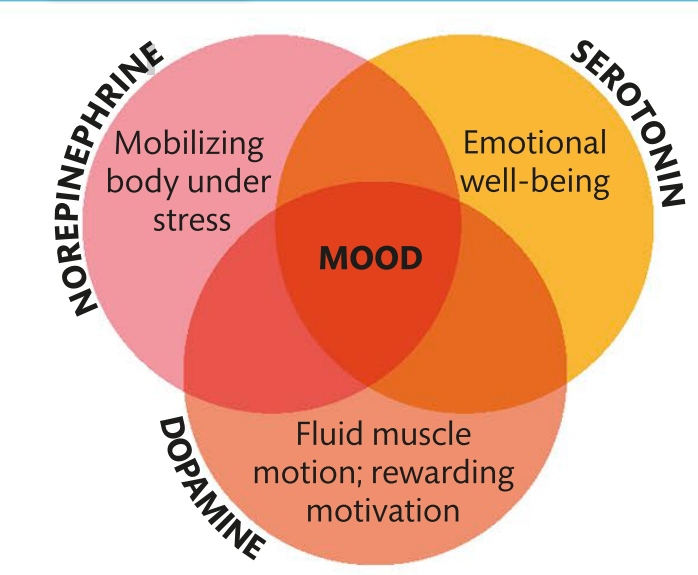
- ❯ All affect mood.
- ❯ Norepinephrine and dopamine are both released in stressful situations.
- ❯ Serotonin moderates a neuron’s response to the excitatory effects of dopamine and norepinephrine.
 Vnotes Education
Leave a comment