
Panic attacks are an exaggerated reaction to the body’s normal response to fear or excitement. With panic disorder, a person regularly experiences such attacks for no obvious reason.
What is it?
The normal reaction to fear or excitement causes the body to produce the hormone adrenaline to prepare for “fight or flight” from the source of fear. If a person has a panic attack, apparently normal thoughts or images trigger the brain’s fight-or-flight center, resulting in adrenaline racing around the body causing symptoms such as sweating, increased heart rate, and hyperventilation. Attacks last about 20 minutes and can be very uncomfortable. The individual may misinterpret
these symptoms, saying they feel as if they are having a heart attack or even dying. The fear can further activate the brain’s threat center so more adrenaline is produced, worsening symptoms. Individuals who have recurring
panic attacks can fear the next one so much that they live in a constant state of “fear of fear.” Attacks may, for example, be set off by fear of being in a crowd or a small space,but often they are triggered by internal sensations that have nothing to do with the outside world. As a result, everyday tasks can become difficult and social situations daunting. Those with panic disorder may avoid certain places or activities, so the problem persists because the person can never “disconfirm” their fear.
What are the causes?
One in 10 people suffer from occasional panic attacks; panic disorder is less common. Traumatic life experiences, such as a bereavement, can trigger the disorder. Having a close family member with panic disorder is thought to increase the risk of developing it. Environmental conditions such as high carbon dioxide levels may also cause attacks. Some illnesses, for example an overactive thyroid, can produce symptoms similar to panic disorder, and a doctor will rule out such illnesses before making a diagnosis.
2%
of people are affected by panic disorder
The panic cycle
Constant cycle of anxiety and fear
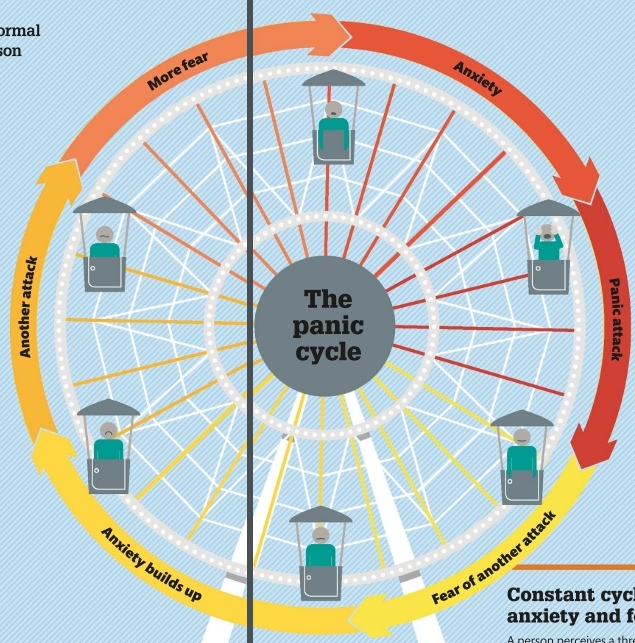
A person perceives a threat and starts to
panic. The physical symptoms develop, worsening the anxiety and therefore the symptoms, which in turn increase the likelihood of a repeat attack.
SYMPTOMS OF A PANIC ATTACK
The symptoms result from the action of the autonomic nervous system—the part not under conscious control
Increased heart rate Adrenaline causes the heart to pump faster to
move blood containing oxygen to where it is needed. This can result in chest pains.
Feeling faint Breathing is faster and shallower to increase The panic cycle
oxygen, causing hyperventilation and lightheadedness.
Sweating and pallor Sweating increases to cool the body. The
person may also become pale as blood is diverted to where it is needed most.
Choking sensation Faster breathing feels like choking—oxygen
level rises but not enough carbon dioxide is exhaled.
Dilated pupils The pupil (black part of the eye) becomes
dilated to let in more light, making it easier to see to escape.
Slowed digestion As digestion is not crucial for “flight,” it slows. The
sphincters (valves) relax, which makes the sufferer feel nauseous.
Dry mouth The mouth can feel very dry as body fluids are
concentrated in the parts of the body where they are most needed.
TREATMENT
❯ Cognitive behavioral therapy to identify triggers, prevent avoidance behavior, and learn to disprove feared outcomes.
❯ Support groups to meet others with the disorder and get advice.
❯ Selective serotonin reuptake inhibitors (SSRIs) .
 Vnotes Education
Leave a comment