
Public companies are required by law to appoint a board of directors to provide oversight.
How it works
All companies must have at least one director. If a company goes public and issues shares, it is legally required to have a board of directors. The board is made up of experienced business advisers who provide independent oversight of the company for shareholders and are mandated by law to govern the company responsibly. Board members may come from within
the company or be independent outsiders, and should cover a range of expertise— such as legal, financial and marketing— or have specialized industry knowledge. Networkers are also highly prized for their ability to build connections with influential figures in the corporate and governmental spheres. From within their ranks, the board elects a chairman, vice-chairman, secretary, and treasurer.
Shareholders evaluate
Any person or institution that has bought shares in a publicly listed company is a shareholder. The board works for the shareholders, who effectively own the company.
Board of directors
The board of directors of a publicly listed company sits between the company and its shareholders.
Secretary
Appointed by The board Responsible for
❯ Publicly representing the company’s policies and leading board meetings
Treasurer
Appointed by The board Responsible for
- ❯ Presenting yearly accounts
- ❯ Leading audit committee
Chairman
Appointed by The board Responsible for
- ❯ Publicly representing the company’s policies
- ❯ Leading the board, conducting board meetings
- ❯ Determining the composition of the board
- ❯ Mentoring and monitoring the CEO or managing director (MD)
- ❯ Communicating with shareholders
Vice-chairman
Appointed by The board Responsible for
- ❯ Standing in for chairman
- ❯ Undertaking special projects for chairman
- ❯ Assisting chairman in balancing experience, personality, and age of directors on board
Directors
Appointed by The board Responsible for
- ❯ Determining strategy
- ❯Monitoring achievement of implemented policies
- ❯ Appointing managers
- ❯ Accounting for company’s activities to shareholders and other stakeholders
Company
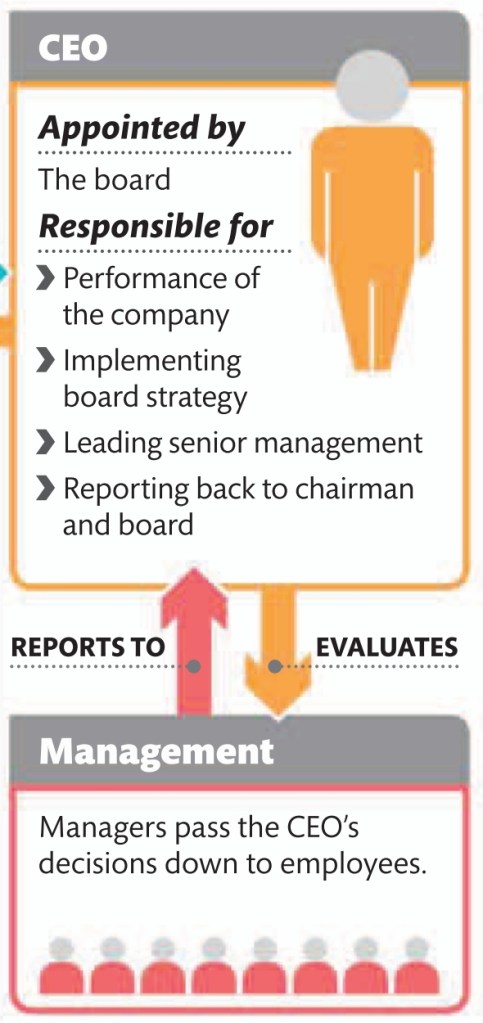
Responsible for day-to-day production, sales and marketing operations, and finance. The company reports to the board via its chief executive officer (CEO), who executes the board’s decisions.
CEO
Balancing the board
The board has three clear areas of responsibility: developing business strategy, advising the company, and overseeing how the firm is run. Selecting the right mix of directors to fulfill these functions is crucial. Board members may come from
inside or outside the company. Those who work for the company (executive or internal directors) have more expertise in running the business, but independent members (non-executive or external directors) are better placed to offer perspective, scrutinize the actions of company executives, and call them to account. When potential conflicts of interest arise between management and shareholders, independent directors can weigh decision-making in favor of acting in the company’s best interests. The ideal balance is a hot topic
in corporate governance. In US companies, CEO and chairman roles have traditionally been combined, but following a spate of corporate scandals, the roles are now more often vested in two individuals. In Europe, keeping the roles separate has long been seen as best practice.
NEED TO KNOW
❯ NEDs Non-executive directors, also known as independent, external, or outside directors
❯ Executive directors Board members who also work for the company—not to be confused with the term executive director when used as a title for the CEO
❯ Model Business Corporation Act Developed by the American Bar Association, this model is used as the basis for corporate governance in the US
PROS AND CONS OF CEO AS CHAIRMAN
Pros
❯ Strong, central leadership Decisions hold fewer conflicts.
❯ Efficiency CEO/chairman can implement board decisions swiftly.
❯ Expertise CEO has company and industry knowledge (a CEO may become chairman after retirement).
❯ Balance of power Established hierarchy between CEO/chairman and other directors reduces risk of conflict on the board.
Cons
❯ Lack of transparency Conflicts of interest/corruption are more likely.
❯ Reduced objectivity Board headed by CEO is unable to monitor CEO’s work objectively.
❯ Higher remuneration Combined role generally commands higher pay than two separate individuals.
❯ Mentoring Chairman who is also CEO cannot offer independent mentoring and support for the role.
Board structure variations
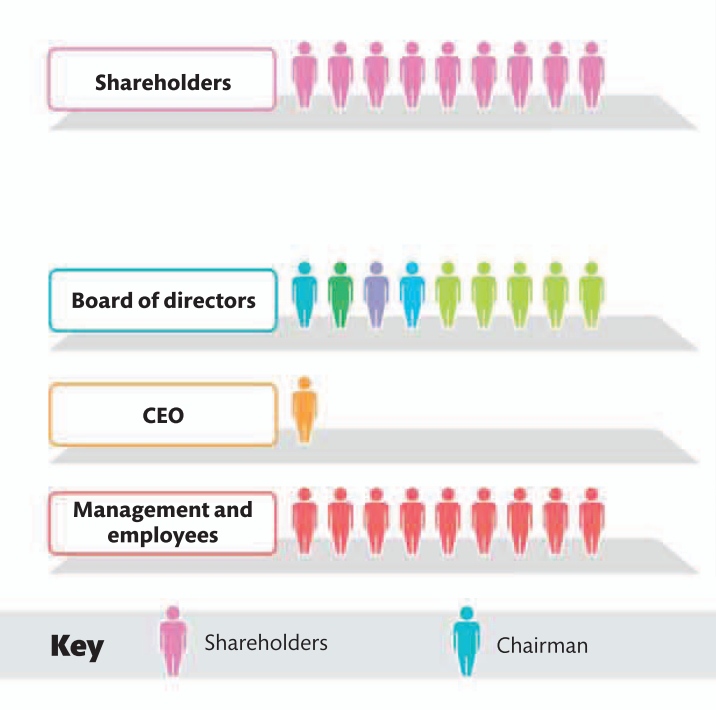
Independent board of directors
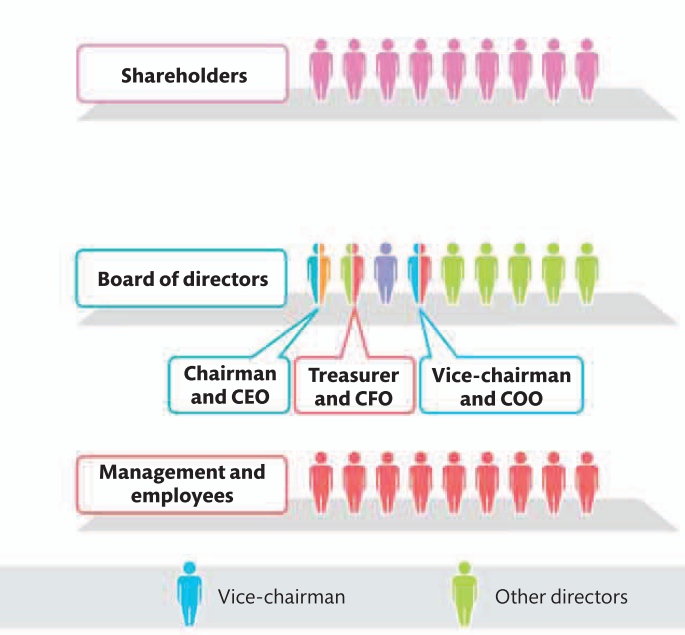
The board sits between shareholders and company. The CEO is the main channel of communication between board and company, while the chairman is the principal conduit between shareholders and board. This structure gives the board most independence.
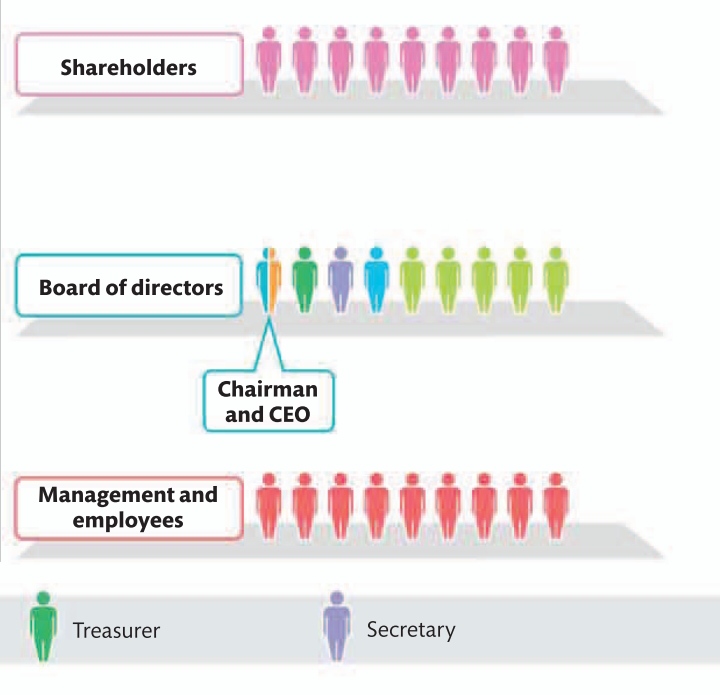
CEO as chairman
A setup in which the company’s CEO serves as the board’s chairman. While this offers less independent scrutiny of finances, strategy, performance, and pay, it avoids duplication of roles. This setup is found in US corporations and in many small- and medium-sized companies in other countries.
Senior management as directors
A structure in which senior managers also sit on the board. The chief financial officer (CFO) is appointed board treasurer and the chief operations officer (COO) is vice-chairman. In some countries (Germany, for example), employees must be included on the board by law.
Two-tier board
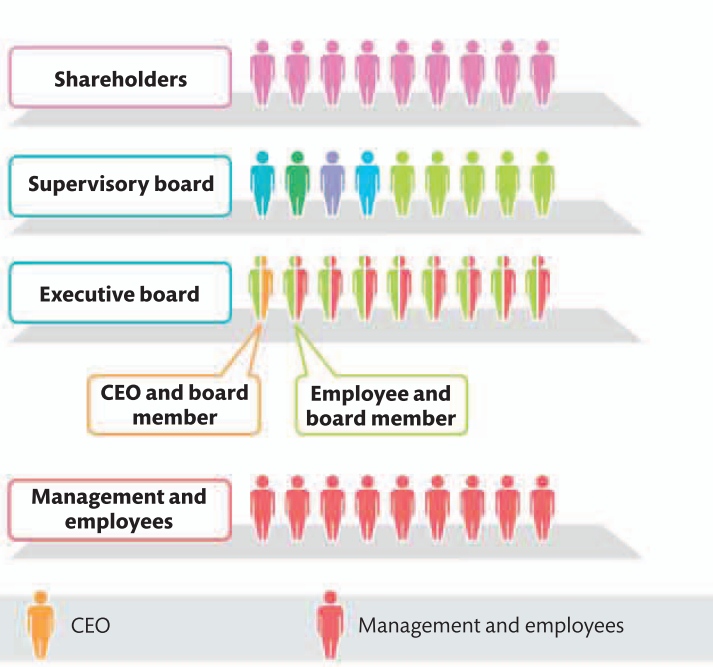
An arrangement that is made up of separate supervisory and executive boards. The supervisory board is composed of outside directors, led by a chairman. The executive board comprises senior managers, including the CEO. The two boards always meet separately.
 Vnotes Education
Leave a comment