
Almost every organization has a structured arrangement of levels for members, from the board of directors at the top to junior employees at the bottom. There is a trend toward reducing the number of levels.
How it works
There are five levels in the conventional corporate structure with a line of authority from top to bottom. The chief executive officer (CEO) is the highest-ranking person in the company, reporting to the board of directors and sometimes also sitting on the board. Reporting to the CEO are a number of highlevel executives, known as C-level executives—their job titles begin with a “C” and end with an “O.” Below the C-level is management, in tiers that differ from company to company, with employees forming the bottom level. As well as skilled and unskilled employees, there may be staff on fixed-term contracts, taken on for the duration of a project or for a set length of time, and casual temporary workers.
C-LEVEL VARIATIONS
The range of C-level positions varies for each company. In addition to the three top posts, there may be:
- CAO Chief Administrative Officer
- CIO Chief Information Officer
- CTO Chief Technology Officer
- CPO Chief Product/Production Officer, responsible for overseeing product development and production
- CMO Chief Marketing Officer, responsible for marketing strategy and business development C-level positions are evolving, adapting to market conditions and business priorities. New roles are emerging while some traditional roles are disappearing. The role of COO, for example, is less popular in modern organizations. Some of the new roles include:
- CPO Chief Privacy Officer
- CSO Chief Sustainability Officer
- CDO Chief Digital Officer
- CKO Chief Knowledge Officer
- CCO Chief Customer Officer
C-suite executives
These are the most senior jobs in the company, with the CEO at the top, the COO and CFO traditionally on the next level down, and other C-positions below that. In many companies, the C-level positions have equal authority and all report directly to the CEO.
CHIEF OPERATING OFFICER (COO) Responsible for day-to-day operations; reports to CEO and acts as second in command
CHIEF EXECUTIVE OFFICER (CEO) Decides on corporate policy and strategy
CHIEF FINANCIAL OFFICER (CFO) Manages company’s financial risk; reports to CEO
Mid-level management
Responsible for overseeing specific functions in the organization, the most senior managers at this level head up different departments or divisions. These managers are often called directors (not to be confused with the board of directors) or, in the US, vice-presidents. The exact job titles, and the number of midlevel managers, vary depending on the company.
MARKETING MANAGER Directs marketing department day to day
OPERATIONS MANAGER Oversees operations division; may also direct production department
R AND D MANAGER Heads up research and development (R and D) of new products
FINANCE MANAGER Puts CFO’s plans or directions into action, instructing junior managers
Junior management and other employees
Team leaders, such as supervisors and assistant managers, implement management plans. They also coordinate teams of skilled and unskilled workers in, for example, production, customer service, and sales to carry out the core tasks needed for the company to function efficiently and profitably.
SUPERVISORS AND TEAM LEADERS
NON-MANAGEMENT EMPLOYEES
Flattening hierarchies
The trend in management over the past few decades has been to eliminate layers from company hierarchies, which means they are becoming flatter—in other words, there are not as many levels to go through in order to reach the top. One example is the role of chief
operating officer (COO), which has been disappearing in recent years. Between 2000 and 2012, there was a 10 percent decline in the number of Fortune 500 (an annual list of the top US corporations compiled by Fortune magazine) companies with COOs. Only 38 percent of the
500 have a COO position now. CEOs have also eliminated layers of middle management, and in the US there was a 300 percent increase between 1986 and 2003 in the number of division heads reporting directly to the CEO. Sometimes companies decide
restructure the other way round instead —from flat to tall—by eliminating a number of senior management posts and replacing them with a greater number of junior supervisory roles. 500 have a COO position now. CEOs have also eliminated layers of middle management, and in the US there was a 300 percent increase between 1986 and 2003 in the number of division heads reporting directly to the CEO. Sometimes companies decide
restructure the other way round instead —from flat to tall—by eliminating a number of senior management posts and replacing them with a greater number of junior supervisory roles.
NEED TO KNOW
❯ Span of control Number of employees reporting to a manager or other senior level; the greater the span of control, the more workers reporting to an individual above
❯ Line position Job role with responsibility for achieving the goals of the organization
❯ Staff position Job role providing expertise to assist someone in a line position
Tall vs. flat hierarchies
There are pros and cons for both types of hierarchy, and each company has to find the number of levels, and positions within each level, that suits the nature of its business.
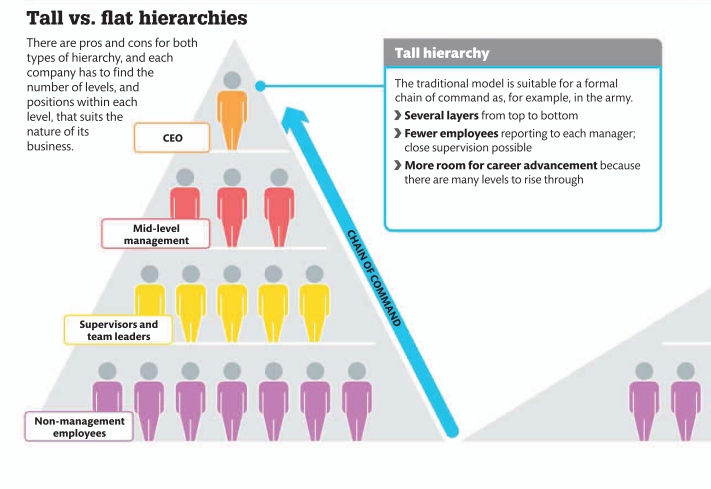
Tall hierarchy
The traditional model is suitable for a formal chain of command as, for example, in the army.
❯ Several layers from top to bottom
❯ Fewer employees reporting to each manager; close supervision possible
❯ More room for career advancement because there are many levels to rise through
Flat hierarchy
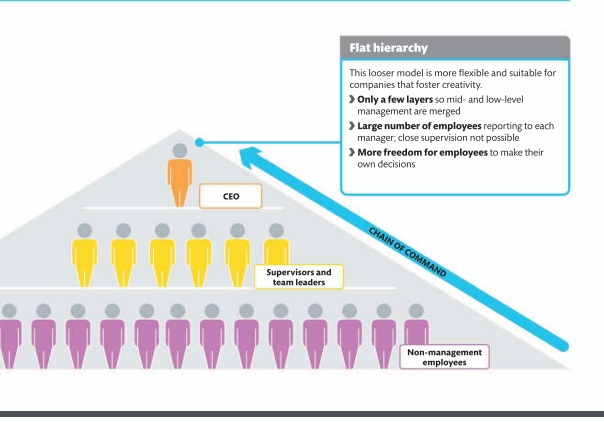
This looser model is more flexible and suitable for companies that foster creativity.
❯ Only a few layers so mid- and low-level management are merged
❯ Large number of employees reporting to each manager; close supervision not possible
❯ More freedom for employees to make their own decisions
 Vnotes Education
Leave a comment