
This is an (as yet) incurable, degenerative disorder, also known as mild or major neurocognitive impairment. It is characterized by memory disorders, personality changes, and impaired reasoning.
What is it?
The term dementia describes a set of symptoms that affect the brain and gradually become more severe. Symptoms include difficulties with concentration, problem solving, carrying out a sequence of tasks, planning, or organizing, as well as general confusion. A person with dementia may lose
track of days or dates, and find it hard to follow a conversation or recall the right word for something. They may also be unable to judge distances or see objects in three dimensions. Dementia may cause people to feel insecure and lose their self-confidence and can result in depression. Many different conditions, such
as Alzheimer’s, cardiovascular disease, Lewy bodies, and disorders of the front and side lobes of the brain, cause the symptoms.Dementia is mainly seen in older adults, but can occur in people in their 50s (known as early onset), and sometimes even younger. There is no single assessment for
dementia. The GP uses memory and thinking tests and may order a scan to confirm which areas of the brain are damaged. Treatment aims to alleviate symptoms and slow their progression.
CAUSES
❯ Alzheimer’s disease causes abnormal proteins to build up around brain cells and damage their structure. This disrupts the chemical messages that pass between the cells so the cells gradually die. Symptoms progress as more parts of the brain are affected.
❯ Vascular dementia can result from cardiovascular disease. It occurs when blood flow to the brain is impaired (for example, by a stroke), causing problems with reasoning, planning, judgment, and memory.
❯ Mixed dementia results when Alzheimer’s and vascular dementia occur at the same time.
❯ Dementia with Lewy bodies has similar symptoms to Alzheimer’s and Parkinson’s disease. Also known as Pick’s disease, it occurs when protein bodies form in nerve cells and often causes hallucinations and delusions.
❯ Frontotemporal dementia is a rarer form that affects the temporal (side) and frontal lobes of the brain. It alters personality and behavior, and makes use of language difficult.
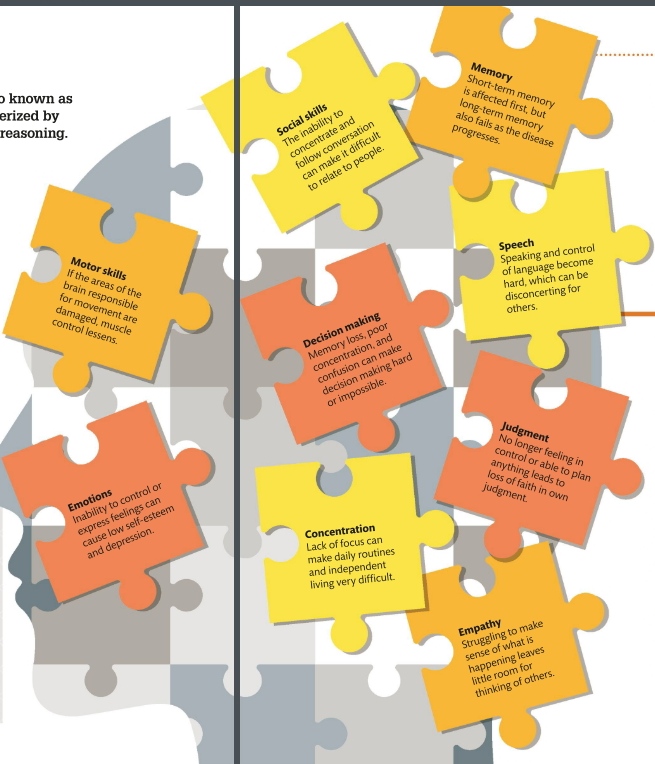
How it affects a person
Because every person is different, their experience of dementia is, too. The diagnosis is based on a person’s history and how the symptoms affect their ability to cope day to day.

TREATMENT
❯ Cognitive stimulation and reality orientation therapy for short-term memory.
❯ Behavioral therapy to help carry out daily routines.
❯ Validation therapy—the main caregiver reading out loud, respectful statements.
❯ Cholinesterase inhibitors
to boost memory and judgment.
More than 30%
of people over 65 develop dementia
 Vnotes Education
Leave a comment