
A person with pyromania sets fires purposely. This very rare impulse-control disorder is triggered by stress, and the action provides relief from tension or distress.
What is it?
Also known as firesetting, pyromania is an obsessive desire to light fires. It can be a chronic (long-term) problem, or restricted to several occurrences during a period of unusual stress. A person with pyromania is excessively fascinated with making fires and situations involving fire, as well as witnessing or assisting in the fire’s aftermath. Individual factors that contribute
to pyromania may include antisocial behaviors and attitudes, sensation and/or attention seeking, lack of social skills, and inability to cope with stress. Parental neglect or emotional detachment, parental psychological disorders, peer pressure, and stressful life events can all be triggers in both children and adults. Interviews with affected children and teens often identify a chaotic household, in which case a whole-family approach to treatment is required .
PYROMANIA IN CHILDREN, TEENS, AND ADULTS
❯ In children and teens firesetting may be a cry for help, or part of a larger pattern of aggression. Teens may be influenced by antisocial adults in their community. Some are diagnosed with psychotic or paranoid disorders , and others may be cognitively impaired.
❯ In adults pyromania has been linked to symptoms that include depressed mood, thoughts of suicide, and poor interpersonal relationships. It is often associated with psychological problems such as OCD .
Destructive cycle
The cycle of obsession and gratification is difficult to break.
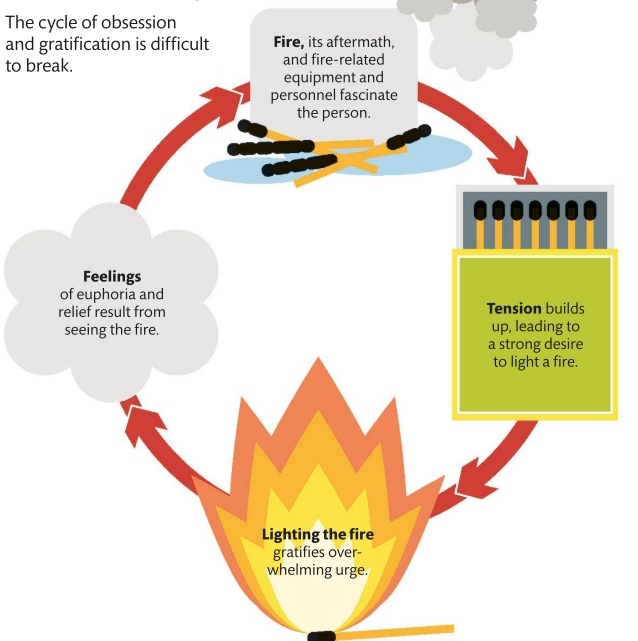
Fire, its aftermath, and fire-related equipment and
personnel fascinate the person.
Tension builds up, leading to
a strong desire to light a fire.
Lighting the fire gratifies overwhelming urge.
Feelings of euphoria and
relief result from seeing the fire.
TREATMENT
❯ Cognitive and behavioral therapies tailored to children to include problemsolving and communication skills, anger management, aggression replacement training, and cognitive restructuring; long-term, insight-oriented psychotherapy for adults.
 Vnotes Education
Leave a comment