
This disorder can result in children who do not bond with a caregiver in infancy. Unidentified reactive attachment disorder can be a precursor to lifelong impaired personal development.
What is it?
Attachment theory states that developing a strong emotional and physical bond with a primary caregiver is key to a child’s healthy personal development. Without such a bond a child can become increasingly detached, withdrawn, and distressed, and the physical symptoms relating to stress become obvious. Persistent disregard of a child’s
basic physical needs, frequent changes of primary caregivers, and childhood abuse can disrupt a child’s ability to form social and emotional bonds. The child can develop markedly disturbed ways of relating socially, and may be unable to initiate or respond to social interactions. Disinhibited responses,
such as a disregard for convention and impulsive behavior, used to be included in the assessment of this disorder, but these are now considered as a separate diagnosis of disinhibited social engagement disorder.
Long-term impact
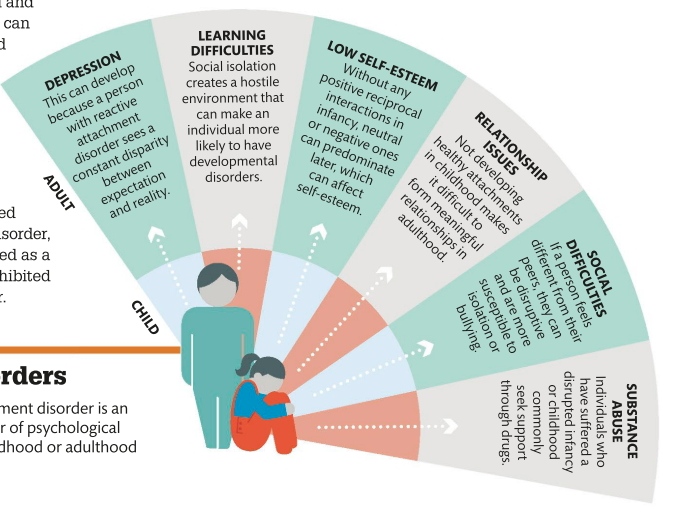
Early neutral, negative, or even hostile environments are likely to have a long-term negative impact and affect a person right through to adulthood. An individual’s ability to make and maintain healthy relationships in later life is seriously compromised. Reactive attachment disorder can develop in early infancy, and the vulnerability it creates is associated with a wide range of disorders that affect both children and adults (below).
Associated disorders
Undiagnosed reactive attachment disorder is an underlying factor in a number of psychological problems that emerge in childhood or adulthood under clinical assessment.
TREATMENT
❯ Cognitive and behavioral therapies including cognitive behavioral therapy to examine habitual appraisals, dialectical behavior therapy to help severely affected adults, family therapy to promote good communication, anxiety management, and positive behavior support.
 Vnotes Education
Leave a comment