
Companies that want to expand through a merger or acquisition may decide on a strategy of either horizontal or vertical integration, combining businesses involved in similar or dissimilar activities.
How it works
Companies can choose from several strategies when they merge or are part of an acquisition. Two of the most common are horizontal and vertical integration. Horizontal deals are always done
between competitors that produce similar types of products, such as cars or mobile phones, and often share—or compete for—the same suppliers and clients. As a result of merger or acquisition, the newly formed company can make cost savings in production, distribution, sales, and marketing. Vertical deals are usually between businesses involved in the same industry but at different stages—for example, a computer maker and a component manufacturer. These deals can be upstream (toward the market) or downstream (in the direction of operations and production).
Integration models in practice
In these hypothetical examples, a cluster of printers, publishers, and bookstores merge or acquire each other in horizontal or vertical deals that aim to strengthen their market position, take advantage of economies of scale, and exploit synergy.
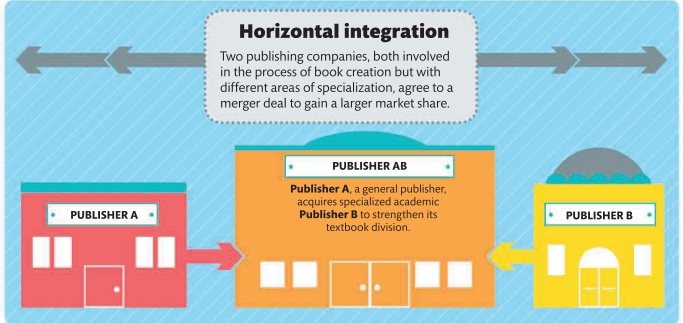
Horizontal integration
Two publishing companies, both involved in the process of book creation but with different areas of specialization, agree to a merger deal to gain a larger market share.
PUBLISHER AB
Publisher A, a general publisher, acquires specialized academic Publisher B to strengthen its textbook division.
PUBLISHER A
PUBLISHER B
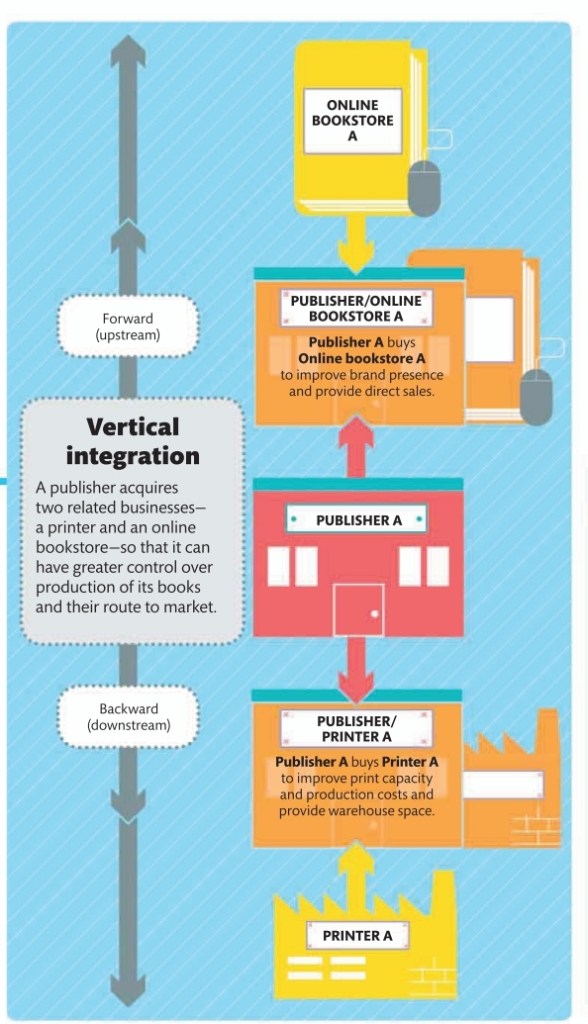
Vertical integration
A publisher acquires two related businesses—
a printer and an online bookstore—so that it can have greater control over production of its books and their route to market.
MERGER AND ACQUISITION TYPES
Conglomerate Combining two companies with nothing in common: for example, in 1985, tobacco-producer Philip Morris purchased General Foods, a new line of business unconnected to legal wrangles around smoking.
Market extension Combining two companies that sell the same products but in different markets: for example, in 1996, the Union Pacific Railroad Company acquired the Southern Pacific Rail Corporation to link railroads in adjacent US regions.
Product extension Combining two companies that sell different but related products in the same market: for example, in 2014, Microsoft bought Nokia’s mobile-phone unit to address flagging PC sales and its weakness in the mobile device market.

 Vnotes Education
Leave a comment