
Capital gearing is the balance between the capital a company owns and its funding by short- or long-term loans. Investors and lenders use it to assess risk.
How it works
Most businesses operate on some form of gearing (also called financial leverage). They partly fund their operations by borrowing money, via loans and bonds, on the condition that they make regular repayments of a fixed amount to the lender. If the level of gearing is high (in other words, the business has taken on large debt), some investors will be concerned about its ability to repay and see this as an insolvency risk. However, if the amount of operating profit is more than enough to repay interest, high gearing can provide better returns to shareholders. The optimum level of gearing for a company also depends on how risky its business sector is, how heavily geared its competitors are, and what stage of its life cycle it is at.
Low gearing
Company has less debt
Company has more equity Low proportion of debt to equity, also described as a low degree of financial leverage. Equity comes from:
- ❯ Reserves (retained profits)
- ❯ Share capital
Equity finance (shares)
Pros
- ❯ Does not have to be repaid
- ❯ Shareholders absorb loss
- ❯ Good for start-ups, which may take a while to become profitable
- ❯ Angel investors share expertise
- ❯ Low gearing seen as a measure of financial strength
- ❯ Low risk attracts more investors and boosts credit rating
Cons
- ❯ Shared ownership, so company has limited control of decisions
- ❯ Shared profit in return for investors risking their funds
❯ Legal obligation to act in the interests of shareholders - ❯ Heavy administrative load
- ❯Complex to set up
High gearing
Company has more debt
High proportion of debt to equity, also described as a high degree of financial leverage. Typical examples of debt are:
- ❯ Loans
- ❯ Bonds
Company has less equity
Debt finance (loans)
Pros
- ❯ If the company makes a profit, it can reap a larger proportion
- ❯ Paying interest is tax deductible
- ❯ Does not dilute ownership
- ❯ Company retains control of decisions
- ❯ Repayment is a known amount that can be planned for
- ❯ Quicker and simpler to set up
- ❯ Small business loans at favorable rates may be available to start-ups
Cons
- ❯ Loan must be repaid
- ❯ Interest must be paid, even if operating profit shrinks
- ❯ Debt may be secured on fixed assets of company
- ❯ Unpaid lender can seize assets and force bankruptcy
- ❯ Lenders first to be paid in the event of insolvency
- ❯ High gearing considered a measure of financial weakness
- ❯ High risk may put off investors and adversely affect credit rating
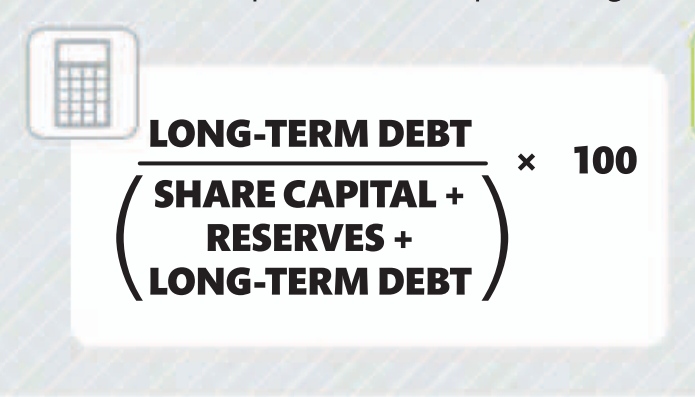
Gearing ratio calculation Analysts and potential investors assess the financial risk of a company with this calculation, presented as a percentage.
Low gearing A software company is going public. Its ratio of 21.2 percent tells investors that it has relatively low gearing and is well positioned to weather economic downturns.
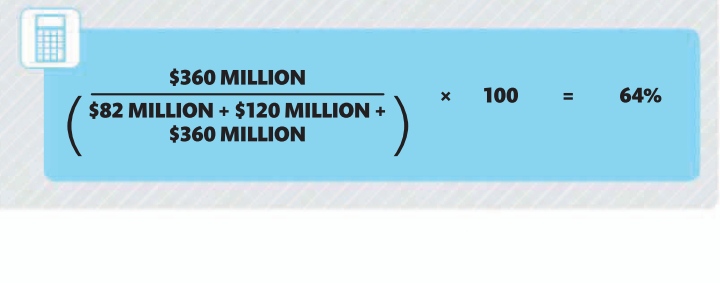
High gearing A water utility is the only water provider in the area, with several million customers. The ratio of 64 percent is acceptable for a utility company with a regional monopoly and a good reputation.
NEED TO KNOW
❯ Interest cover ratio An alternative method of calculating gearing—operating profit divided by interest payable
❯ Overleveraged A situation in which a business has too much debt to meet interest payments on loans
❯ Deleverage Immediate payment of any existing debt in order to reduce gearing
 Vnotes Education
Leave a comment