
There are two main ways of measuring a company’s performance: financial and non-financial. To assess financial performance, a company calculates financial ratios. To assess other areas of the business, a company examines its key performance indicators (KPIs), which help management and staff evaluate performance and how it can improve. KPIs also enable interested outsiders, such as investors, lenders, or analysts, to decide whether to invest in the business.
Financial and nonfinancial categories
Any company that publishes a financial report will be required to set out key figures on the revenue generated and the expenses incurred during the course of its activities. These figures can be compared using mathematical calculations called financial ratios. However, financial ratios alone may not give an accurate vision of the company’s future prospects. Non-financial ratios, or key performance indicators, do not measure financial performance, but they do reveal other important characteristics of a company that will ultimately affect its profitability, such as customer loyalty and research and development (R and D) productivity.
Tracking for forecasting
Financial and nonfinancial measures can be used forecasts company Performance and track fraud.
Financial measures
Financial ratios
- ❯ Used by investors and lenders to gauge financial health of an organization: if it’s likely to survive economic slump, and what prospects it has for future growth
- ❯ Standard set of ratios used by the financial industry
- ❯ Calculated based on figures provided in financial reports
Non financial measures
Key performance
- ❯ Used internally and by investors, as they appear in financial statement
- ❯ May be calculated daily or even more frequently for internal use
- ❯Companies can set diverse KPIs to reflect future goals
- ❯ Unique to each company
TREND ANALYSIS USING PERFORMANCE MEASUREMENTS
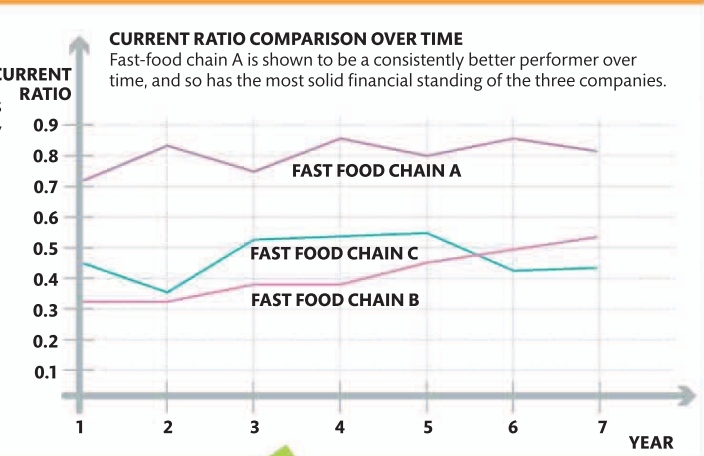
A comparison of either financial ratios or KPIs between companies in the same industry and across time is often used to track a company’s performance. Current ratios are calculated by dividing current assets by current liabilities: the higher the ratio, the more liquidity a company has.
CURRENT RATIO COMPARISON OVER TIME Fast-food chain A is shown to be a consistently better performer over time, and so has the most solid financial standing of the three companies.
THE BIGGER PICTURE
Some professional services companies, such as multinational PwC, undertake quarterly surveys, interviewing senior executives to find out how optimistic they are about their sector and the wider economy. Such surveys help companies measure their own performance objectively.
69%
of multinationals link performance measures to future financial results
 Vnotes Education
Leave a comment