
Two fundamental choices traditionally face marketers: whether to try to sell a product with broad appeal to as many people as possible, or to focus on selling a tailored product to a defined group.
How it works
Both niche and mass marketing strategies offer businesses the potential to make a high return on investment. A niche approach generally works on the basis of lowvolume sales at a premium price to a specific group of consumers, while a mass approach tends to use heavy promotion to a wider audience and aims to achieve high-volume sales. In reality, businesses tend to mix
up both approaches, launching a niche product and then expanding it to a mass market. Marketers also use internet channels to promote the same product to different groups of customers within a mass audience.
Niche market
❯ Business targets a select group of consumers with specific need and wants.
❯ Customers often prepared to pay a premium price for an uncommon product.
❯ Sales volume of niche product low, so does not benefit from production economies of scale (manufacturing large quantities to decrease the unit cost of production).
Mass market
Who and how
❯ Business targeting a large group of consumers with generalized wants and needs.
❯ Requires high marketing spend to promote products, which must be widely distributed.
❯ Marketplace often crowded with other competitors selling a similar product.
HYBRID APPROACHES
Using social media to identify and reach more than one target market, marketers have developed hybrid approaches that are more flexible than conventional niche or massmarket positioning of products.
Mass market An unfocused strategy that aims at the broadest customer base.
Large segment Channels marketing resources to one large segment of the mass market.
Adjacent segment Once large segment is fully penetrated, product expands into related segment.
Multi segment Markets to several segments at once, with a customized strategy for each.
Small segment Markets to a small segment with few competitors, if resources are limited.
Niche segment Focuses marketing resources on a specific group of customers.
Mass customization Customizes a strategy for each sub-segment within the mass market.
NEED TO KNOW
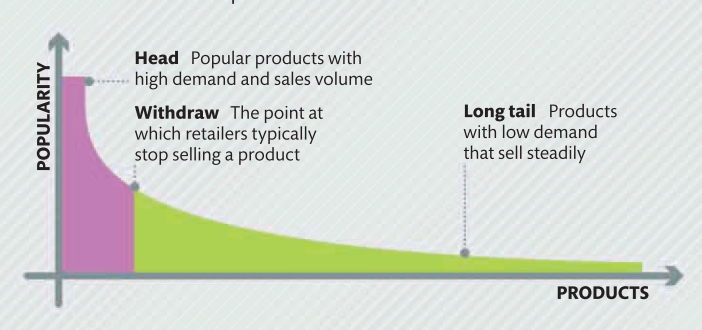
Coined by Wired magazine editor Chris Anderson, the term “long-tail marketing” takes its name from a demand curve (see below) depicting products with low demand or sales volume—niche products—that continue to sell and make profit over time.
20%
of sales can make up to 80% of profit
 Vnotes Education
Leave a comment