
The goods and services a company sells are its product. A product can be defined in terms of features, design, size, packaging, service type, return policies, and warranties, together intended to meet the customer’s needs.
How it works
Consumers can be said to buy benefits rather than products. For the marketer, the product itself is that benefit to the consumer, as packaged and presented.Marketers identify the goods and services they sell in three or five product levels, with the benefit at the core. The marketer’s job is to translate and communicate each product level as an offer to the consumer.
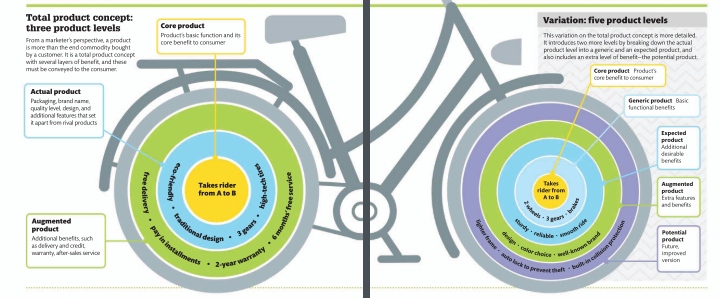
Total product concept: three product levels
From a marketer’s perspective, a product is more than the end commodity bought by a customer. It is a total product concept with several layers of benefit, and these must be conveyed to the consumer.
Actual product Packaging, brand name, quality level, design, and additional features that set it apart from rival products
Augmented product Additional benefits, such as delivery and credit, warranty, after-sales service
Core product Product’s basic function and its core benefit to consumer
Variation: five product levels
This variation on the total product concept is more detailed. It introduces two more levels by breaking down the actual product level into a generic and an expected product, and also includes an extra level of benefit—the potential product.
Core product Product’s core benefit to consumer
Generic product Basic functional benefits
Expected product Additional desirable benefits
Augmented product Extra features and benefits
Potential product Future, improved version
NEED TO KNOW
❯ Personal branding Promoting oneself as a product with a distinct brand personality
❯ Fast-moving consumer goods (FMCGs) Sold quickly and at relatively low unit cost, such as food and household products
42%
of new product launches can be
expected to fail
 Vnotes Education
Leave a comment