
Every successful product launched on the market experiences growth followed by decline. To maximize profitability, business managers must recognize and manage each stage of the product’s life span.
How it works
There are typically six identifiable stages in a product life cycle, with the product’s rate of growth measured by time and revenue. Most businesses have more than one product on the market at any time, and strategic manipulation of the portfolio of products at their different stages in the cycle is crucial to maintaining business growth. The life of older products may be prolonged by extension strategies, but if they are no longer grabbing new market share, the business must consider launching new products in order to continue generating revenue.
Introduction Sales are typically low and cost per customer is high as the market takes time to accept the new product.
Launch Business outlay is high due to product development costs and marketing budget. There is no return on investment.
Growth Sales increase and the cost per customer falls as profits rise. There are more customers—and more competitors.
Saturation Sales peak and the cost per customer is at its lowest. Profits are now high and competition is intense.
Withdrawal The product is phased out as sales stall or continue to fall. The business introduces a replacement product before the old one is withdrawn.
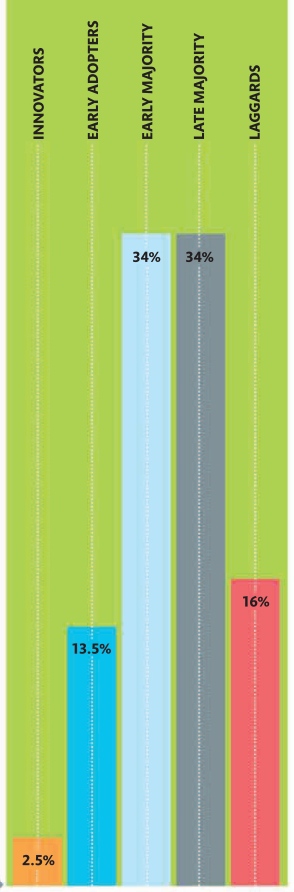
Diffusion of innovation (consumer uptake) %
Marketers identify five distinct customer types according to how quickly they pick up on a new product.
PORTFOLIO ANALYSIS
Rising stars Products with a high market share in a
high-growth market; they require a big marketing spend to keep them growing.
Cash cows Products with a high market share in a
low-growth market; they generate money to support rising stars.
Problem children Products with a low market share in a
high-growth market; they need a big marketing spend.
Dogs Products with low market share and low growth; they may stay in portfolio to keep customers happy.
NEED TO KNOW
❯ Extension strategy Revival of a product by rebranding, or repackaging, repricing it, or finding new markets
❯ Portfolio analysis Each of a company’s products measured by growth rate and market share to determine marketing spend
❯ Product life cycle management (PLM) Tracking of product data from inception to withdrawal
6 months
the length of time a product can be labelled as “new
 Vnotes Education
Leave a comment