
The process of turning a customer’s interest into a sale is called lead conversion. The task requires not only a sales pitch to promote the product or service, but also an approach tailored to the customer.
How it works
Sales and marketing departments are responsible for generating sales income for a company. The first step is to locate or identify potential customers—lead generation. The second step is to make contact with those potential customers and entice or persuade them to buy—lead conversion. A sales pitch is used to convert
leads into customers. However, nowadays the stereotypical spiel delivered by an overzealous salesperson has been largely replaced by more sophisticated tactics, such as live chat on shopping websites, which inform customers and invite them to participate in a dialogue, rather than simply pestering them.
Raw lead Potential customer—
perhaps a website visitor, or a suitable person who can be approached by cold-callingq
Suspect Raw leads show their interest by remaining on website or by not ending phone conversation with cold-caller.
Prospect One step away from becoming a customer, prospects need a final enticement to convince them to buy the product.
Inactive Prospect isn’t ready to buy immediately, but shows enough interest to suggest they might buy in the future.
Customer Raw lead has committed to buy; focus is now on retaining the customer and enticing them to make repeat purchases.
Dead lead Lead will not convert, but may be worth trying to revive in future.
Online lead conversion
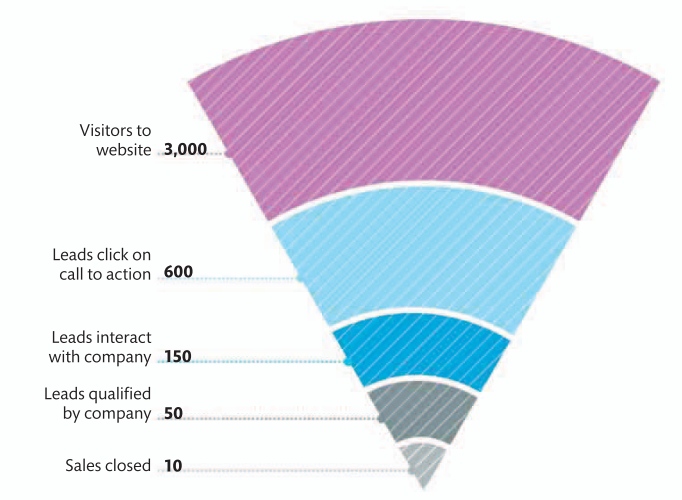
A strategy is required for steering website visitors through every step of the lead-converting process. It is often presented as a funnel. Once visitors have arrived at a website, they are enticed to click on a “call to action” (CTA) button, which takes them farther into the funnel.
THREE CLASSIC SALES PITCHES
High concept Catchy introduction that captures the vision or key idea of a product or business; intended to grab attention and interest
Elevator Short summary (under a minute long) that explains the why, what, and how of a business or product
20-minute deck Presentation that explains the product or business in detail; how it can serve the need a prospective customer may have
NEED TO KNOW
❯ Lead scoring System used to measure the readiness of leads for conversion
❯ Sales pipeline Visual tracking of the number of leads, suspects, and prospects at each stage in order to monitor sales process
❯ Lead nurturing Informal contact with a lead designed to gradually win them over as a customer
❯ Cost per touch Measurement of the cost of sales labor each time a lead is “touched” (contacted)
 Vnotes Education
Leave a comment