
This range of conditions affects a person’s ability to receive, send, process, and/or understand verbal, nonverbal, and visual concepts and may be apparent in hearing, language, and/or speech.
What are they?
The four main conditions are language, childhood fluency, speech-sound, and SCD (social communication disorders). They are often complex. Some are apparent in babies and toddlers, whereas others may not become obvious until a child is at school. The causes are wide-ranging.
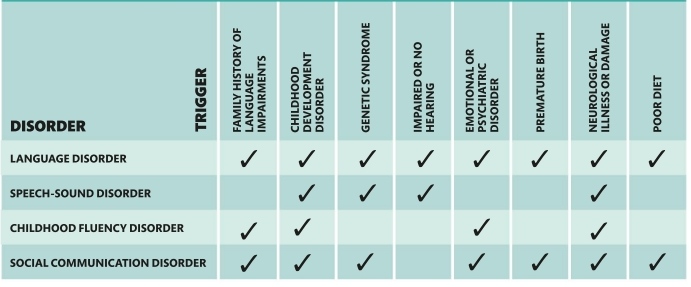
Communication disorders may develop of their own accord or stem from a neurological illness. They can be genetic—20–40 percent of children with a family history of speech and/or language impairment have communication disorders. Prenatal nutrition may be involved. Psychiatric disorders, ASD , Down syndrome, cerebral palsy, and physical problems including cleft lip or palate and deafness may limit a person’s ability to communicate.
How are they diagnosed?
To maximize a child’s development potential, early intervention is important; some conditions require lifelong management. A speech and language specialist takes a case history, including information about family background, medical conditions, and information from teachers and caregivers, to prepare a treatment plan.
CAUSES OF COMMUNICATION DISORDERS
More than one causal factor may be involved and the effects can range from mild to profound.
LANGUAGE DISORDER
The child does not understand others (receptive disorder) or cannot communicate thoughts (expressive disorder) or both (receptive-expressive disorder).
❯ Baby does not smile or babble in response to parents, and only has a few words by 18 months.
❯ Child does not play with others and prefers to be alone. May become shy and distant.
❯ Child has difficulty swallowing, affecting ability to speak.
CHILDHOOD FLUENCY
The child stammers or stutters, repeating words or parts of words, and prolonging speech sounds.
❯ Speech can become blocked as if child is out of breath.
❯ Child uses distracting sounds such as throat clearing or head and body movements to disguise their problem.
❯ Anxiety is increasingly evident as child tries to hide disorder.
❯ Child avoids public speaking as anxiety worsens the stutter.
SPEECH–SOUND DISORDER
The child has difficulty articulating sound patterns and mispronounces words beyond expected age range.
❯ Unclear speech, common in young children, continues beyond the age of eight.
❯ Child unable to produce correct sound patterns even though they can understand speech, so cannot make themselves understood by others.
❯ Limited understanding of rules of speech sounds is apparent.
SCD
The child cannot process
verbal and visual information simultaneously.
❯ Child cannot adapt language to suit situation, so can be dogmatic, dominating, and inappropriate when talking to adults or peers.
❯ Child lacks nonverbal communication skills such as taking turns in conversation or other group activities.
❯ Child cannot greet people as they have little or no interest in social interaction.
IMPACT ON THE CHILD
Errors of thinking and communication affect daily
interactions. Children become anxious, with low self-confidence.
❯ Developmental milestones are delayed as children learn through communication.
❯ Social isolation occurs because child does not initiate interaction and cannot make friends. May become target of bullies.
❯ Behavioral issues arise as child adopts avoidance techniques and may become aggressive if they cannot resolve speech difficulties.
SOCIAL COMMUNICATION DISORDER OR AUTISM SPECTRUM DISORDER?
SCD (social communication disorder) has many symptoms in common with ASD (autism spectrum disorder). Assessment must rule out ASD before doctors diagnose the child with SCD and establish a treatment plan.
Social communication disorder
Children with SCD find it difficult to learn the basic rules
of conversation: how to start one, listen, phrase questions, stay on topic, and know when it is over. SCD can occur alongside other developmental issues such as language impairment, learning disabilities, speech-sound disorder, and ADHD
Autism spectrum disorder
Children with ASD find it hard to relate to people, emotions, and feelings. As with SCD, this can result in communication difficulties, impaired social skills, and altered sensory and visual perception. But ASD has an additional defining characteristic of restricted or repetitive behaviors.
TREATMENT
❯ Speech and language therapy essential to help language skills, speech-sound production and rules, fluency, and nonverbal gestures; for stutterers, support to control and/or monitor rate of speech and breathing.
❯ Positive behavior therapies to improve the relationship between behavior and communication.
❯ Family therapy, special educational support, and environmental adaptations to support language development.
 Vnotes Education
Leave a comment