
Carl Jung expanded Freud’s ideas—he thought the unconscious mind went far deeper than the merely personal and was at the core of behavior patterns.
What is it?
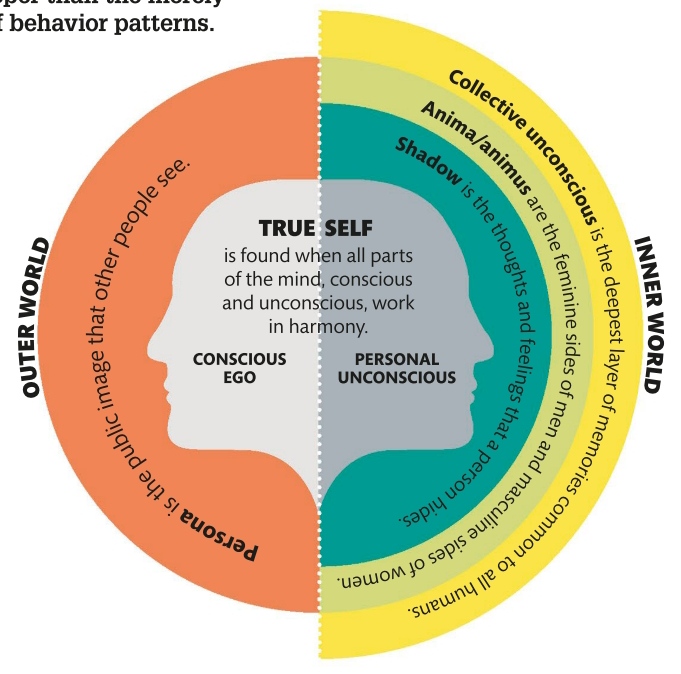
Like his colleague Sigmund Freud, Jung considered that psychological distress occurs when the conscious and unconscious parts of the mind are unbalanced. But Jung thought that personal memories were part of a much larger whole. Jung noticed that the same myths
and symbols occur across the world, whatever the culture. He thought these must be the result of shared experience and knowledge of the human species, remembered by everyone as what he called the collective unconscious. These memories, in the deepest layer of the unconscious mind, take the form of archetypes—instantly recognizable symbols that shape behavioral patterns. The conscious ego is the public image that a person presents to the world. Its archetype is the persona, identifiable as a person being on their best behavior. The darker aspects of the mind that most people hide Jung called the shadow. Further archetypes are the anima (female traits in men) and the animus (male traits in women), which often clash with the conscious ego and the shadow. To find the true self, all the layers of a person’s personality need to work in harmony. Whereas psychoanalysis delves
into the top layer of the client’s unconscious, Jungian therapists explore all the layers. Their role is to help the client use the archetypes to understand and change their own behavior. Jungian therapists use
techniques such as dream analysis and word association to reveal where the inner archetypes collide with outer-world experiences. This process of analysis enables the client to understand which layers of their mind are in conflict, and then make positive changes to restore the balance. Like psychoanalysis, this therapy is a fascinating journey into the mind and can take years.
NEED TO KNOW
❯ Word association The client says whatever comes into their mind when the therapist presents them with a word.
❯ Extrovert Someone whose attention is directed toward the outside world and other people; outgoing, responsive, active (even reckless), decisive.
❯ Introvert Someone whose attention is directed inward to their own thoughts and feelings; shy, contemplative, reserved, self-absorbed, indecisive.
 Vnotes Education
Leave a comment