
Tics are sudden, painless, nonrhythmic behaviors that are either motor (related to movement) or vocal. A disorder may be diagnosed when tics occur repeatedly and are apparently unconnected to the environment or situation.
What are they?
Tics—small, uncontrollable movements or sounds— are not usually serious and normally improve over time. However, if they persist they can be frustrating and interfere with everyday activities—especially if the person has more than one tic. Changes in the parts of the brain that control
movement are thought to cause tics. There is probably a genetic predisposition, too. Taking drugs such as amphetamines or cocaine can trigger tics, as can medical conditions, including cerebral palsy and Huntington’s disease, or psychological disorders such as ADHD and OCD . Tics are more common in children, but they can
begin in adulthood. Statistics vary regarding the prevalence, with 0.3–3.8 percent of children described as having severe tics. Treatment may not be needed if a tic is mild; lifestyle management, such as avoiding stress or tiredness, is often all that is required.
Simple and complex tics
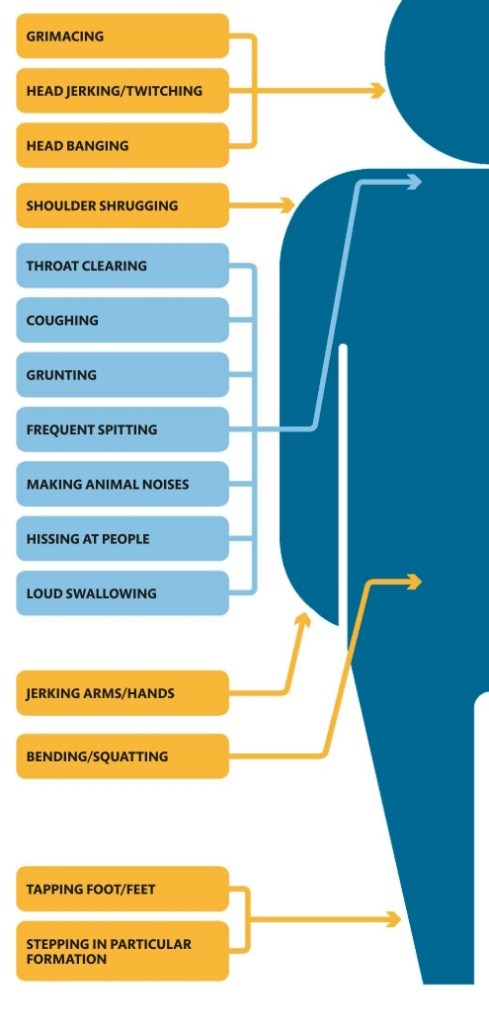
Tics take many forms. Some affect body movement and others are verbal. They may be simple or complex. A simple tic affects a small number of muscle groups, for example, blinking or clearing the throat. A complex tic involves coordinated patterns of several muscle groups, such as blinking in combination with a shoulder shrug, facial grimace, and spontaneous shouting.
Key
- GRIMACING
- HEAD JERKING/TWITCHING
- HEAD BANGING
SHOULDER SHRUGGING
- THROAT CLEARING
- COUGHING
- GRUNTING
- FREQUENT SPITTING
- MAKING ANIMAL NOISES
- HISSING AT PEOPLE
- LOUD SWALLOWING
JERKING ARMS/HANDS
BENDING/SQUATTING
- TAPPING FOOT/FEET
- STEPPING IN PARTICULAR FORMATION
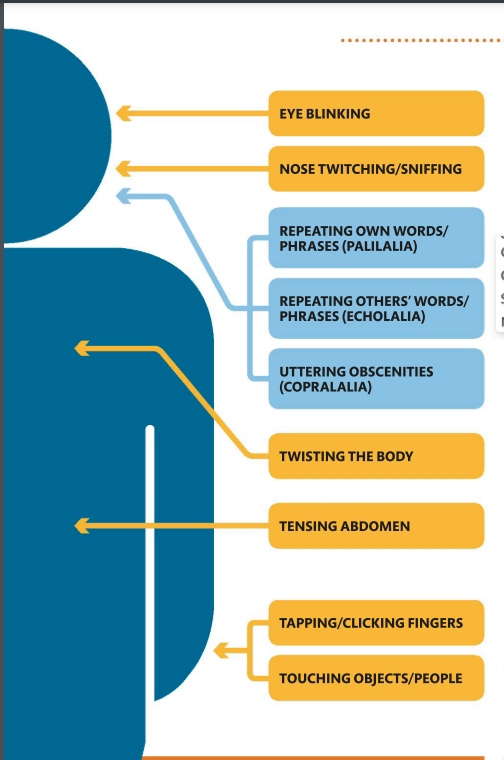
EYE BLINKING
NOSE TWITCHING/SNIFFING
- REPEATING OWN WORDS/ PHRASES (PALILALIA)
- REPEATING OTHERS’ WORDS/ PHRASES (ECHOLALIA)
- UTTERING OBSCENITIES (COPRALALIA)
TWISTING THE BODY
TENSING ABDOMEN
- TAPPING/CLICKING FINGERS
- TOUCHING OBJECTS/PEOPLE
TOURETTE’S SYNDROME
This is a condition characterized by multiple tics, named after George de la Tourette, who first described it in 1884. For a condition to be classified as Tourette’s syndrome, the tics must last for at least a year and at least one must be vocal. Most individuals have a combination of motor and vocal tics, which can be both simple and complex. The syndrome often runs in families. Tourette’s syndrome is thought to be linked to
TWISTING THE BODY
problems with a part of the brain called the basal ganglia, or possibly to a childhood throat infection caused by a streptococcal bacteria. The first stage of diagnosis is to check other possible causes of the symptoms such as allergies or poor eyesight. A neurologist or psychiatrist then rules out conditions such as ASD before referring the person for psychotherapy. In a third of cases, the tics reduce, become less troublesome, or disappear over a 10-year period.
ADVANCE WARNINGS
Most people have an unusual or uncomfortable feeling before the tic occurs. Individuals often describe this as a rising tension that only the tic itself can release. Some people can suppress their tics for a short period, until the urge to do it becomes too strong, which may result in a more severe tic.
WARNING URGE
- Burning sensation behind eyes
- Tension in a particular muscle
- Dry throat
- Itching
NEED TO RELEASE TENSION
TIC
- Blinking
- Twitching individual muscle
- Grunting
- Twitching body
TREATMENT
❯ Behavioral therapies widely used for Tourette’s to expose the unpleasant feelings that precede the tic and encourage a response that stops it.
❯ Habit reversal training to teach use of incompatible behaviors in place of the tic, so planned intentional movements compete with the tic and prevent it.
❯ Lifestyle management such as relaxation techniques and listening to music to reduce frequency of tics.
❯ Antidepressants or anti-anxiety medication to support behavioral interventions if needed.
“The rhythm of music is very, very important for … patients with Tourette’s.”
Oliver Sacks, British neurologist
 Vnotes Education
Leave a comment