
Unlike other psychological approaches, humanism places central
importance on the individual’s viewpoint, encouraging the question “How do I see myself?” rather than “How do others see me?”
What is it?
Whereas behavioral psychology is concerned with observing external actions and psychoanalysis delves into the subconscious, humanism is holistic, focusing on how a person perceives their own behavior and interprets events. It centers on a person’s subjective view of themselves and who they would like to be, rather than the objective view of an observer. Pioneered by Carl Rogers and
Abraham Maslow in the 1950s, humanism offers an alternative way of trying to fathom human nature. It assumes that personal growth and fulfillment are primary goals in life, and that emotional and mental well-being comes from achieving this. The principle of free will, exercised in the choices a person makes, is also key.
“The good life is a process, not a state of being.”
Carl Rogers, American humanist psychologist
Evaluation
Rogers and other humanist psychologists suggested a number of new methods of investigation, such as open-ended questionnaires in which there were no “right” answers, casual interviews, and the use of diaries to record feelings and thoughts. They reasoned that the only way to really get to know someone was to talk to them. Humanism is the theory that
underpins person-centered therapy (p.132)—one of the most common therapies for depression. The humanistic approach is also used in education to encourage children to exercise free will and make choices for themselves, and in researching and understanding motivation. However, humanism ignores
other aspects of the individual such as their biology, the subconscious mind, and the powerful influence of hormones. Critics also say that the approach is unscientific, because its goal of self-realization cannot be accurately measured.
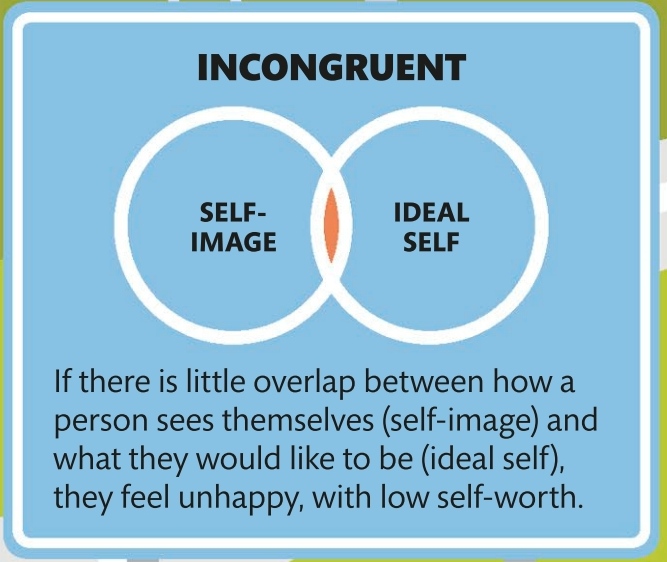
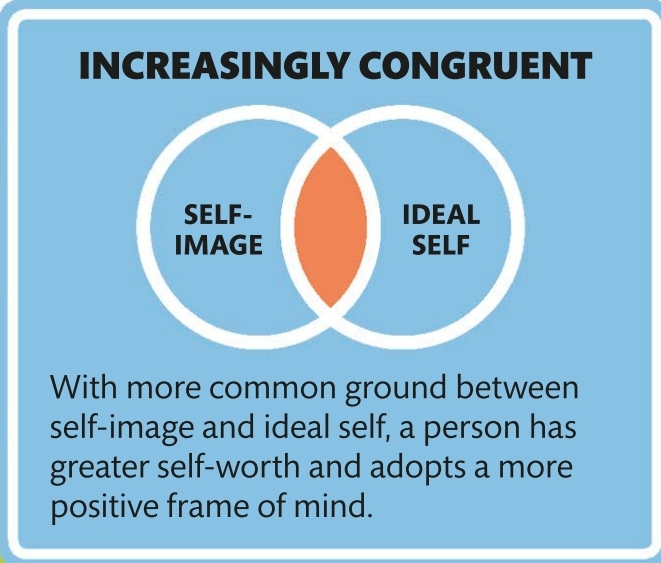
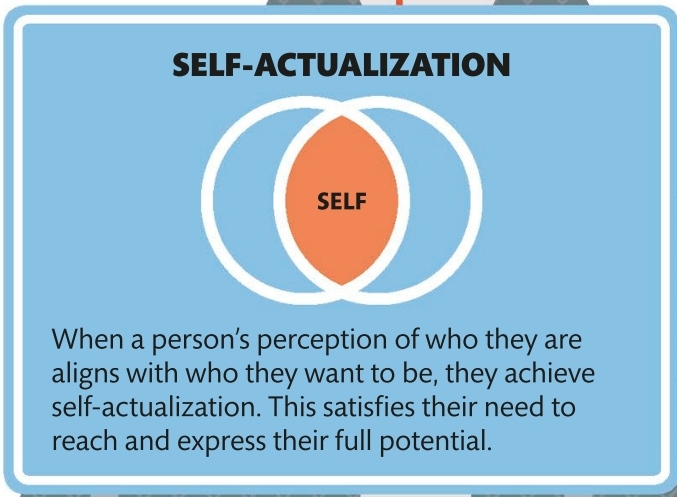
Road to fulfillment
INCONGRUENT
INCREASINGLY CONGRUENT
SELF-ACTUALIZATION
GESTALT PSYCHOLOGY
Influenced by humanism, gestalt psychology examines in detail how the mind takes small pieces of information and builds them into a meaningful whole. It emphasizes the importance of perception—the laws that govern how each person perceives the world. Part of gestalt assessment
involves showing clients a series of images to discover how their eye perceives each one. The Rubin Vase illusion is the best known
of these, and illustrates the law of “figure” and “ground”: a person’s mind always works to distinguish a figure (words, for example) from its background (a white page), and in doing so, makes a decision about priority and what to focus on.

INDIVIDUAL OR GROUP?
Humanism is rooted in Western ideas of personal identity and achievement, sometimes called individualism. In contrast, collectivism subordinates the person to the group.
Individualism
- ❯ Identity defined in terms of personal attributes— such as outgoing, kind, or generous
- ❯ Own goals take priority over those of the group
Collectivism
- ❯ Identity defined by which group someone belongs to❯ Family, then workplace, are most important groups
- ❯ Goals of group take priority over individual’s
 Vnotes Education
Leave a comment