
This psychological theory proposes that the unconscious struggles of the mind determine how personality develops and dictates behavior.
What is it?
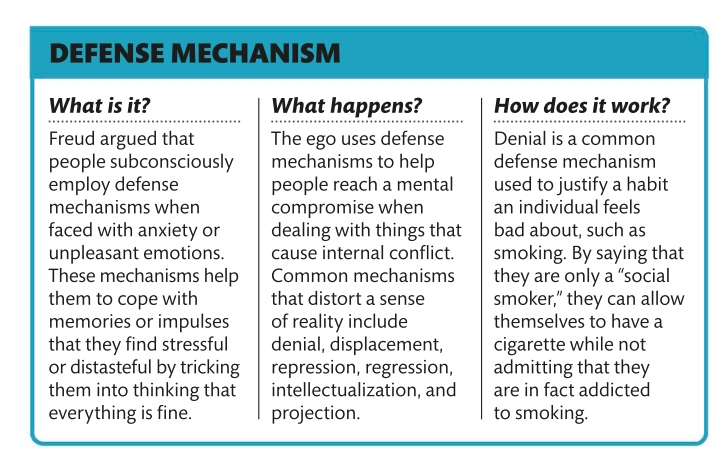
What is it? Founded by Austrian neurologist Sigmund Freud in the early 20th century, psychoanalytical theory proposed that personality and behavior are the outcome of continual conflicts in the mind. The individual is not usually aware
of the discord because it takes place at a subconscious level. Freud suggested conflict occurs between three parts of the mind: the id, superego, and ego (below, right). Freud believed that personality
develops from birth in five stages, which he called psychosexual
because they involve both sexuality and mental processes. At each stage a person’s mind focuses on a different aspect of sexuality, such as oral pleasure when they suck their thumb as a baby. Freud believed that the psychosexual stages trigger a battle between biology and social expectations, and the mind must resolve this conflict before a person can move on to healthy mental development.
Evaluation
Although Freud’s model has been hugely influential in highlighting the role of the subconscious , it has proved controversial because it focuses on sexuality as the driver of personality. Many critics view his model as too subjective and too simplistic to explain the complex nature of the mind and behavior.
Topographical model
Freud divided the mind into three levels of consciousness.
The conscious mind forms only a small part of the whole. Although it is completely unaware of the thoughts in the unconscious mind, the latter still affect behavior.
Psychoanalysis In this therapy ,
the client tells the analyst about their childhood memories and dreams in order to unlock the
unconscious mind and
reveal how it is controlling or triggering undesirable behavior.
Conscious mind This contains the ideas and emotions that people are aware of.
Preconscious mind This stores information such as childhood memories, which can be accessed through psychoanalysis.
Unconscious mind This hides most of
a person’s impulses, desires, and thoughts.
Dreams Dreams are seen as a channel for unconscious thoughts that people cannot usually access
because many of them are too disturbing for the conscious mind to cope with.
Structural model
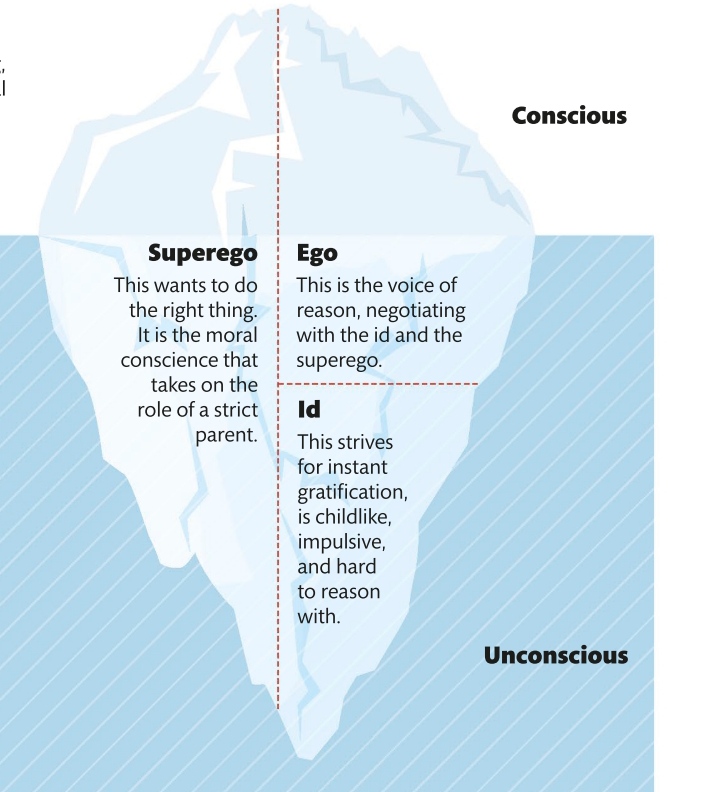
The conscious mind is just the tip of the iceberg, a small part of a hidden whole. Psychoanalytical theory is based on the concept that the unconscious mind is structured in three
parts—the id, ego, and superego—which
“talk” to one another to try to resolve conflicting emotions and impulses.
NEED TO KNOW
- ❯ Inferiority complex When self-esteem is so low that a person cannot function normally. The idea was developed by neo-Freudian Alfred Adler.
- ❯ Pleasure principle What drives the id—the desire to obtain pleasure and avoid pain.
- ❯ Neo-Freudians Theorists who built on Freud’s psychoanalytic theories, such as Carl Jung, Erik Erikson, and Alfred Adler.
 Vnotes Education
Leave a comment