
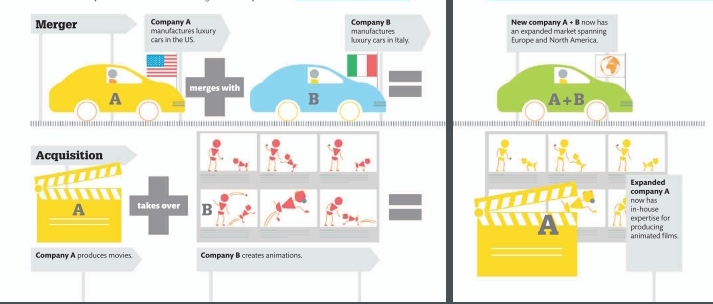
Two of the quickest ways to accelerate expansion are for a business to buy out another—an acquisition—or to amalgamate with another business in a merger.
How it works
Mergers and acquisitions (M and A) is a general term used to describe the ways in which companies are bought, sold, and recombined. In the case of either a merger or an acquisition, two separate legal entities are unified into a single legal entity. While a merger combines two companies on a reasonably equal footing to create a new company, which will make both parties better off, an acquisition is usually a purchase of a smaller company by a larger one. This benefits the company making the purchase but may not necessarily benefit the target company. M and A can be friendly or hostile—agreed to or imposed.
REASONS TO PURSUE M AND A
❯ Improved economies of scale Wider operations streamline production and sales.
❯ Bigger market share Combining the existing markets expands share of the total market.
❯ Diversification A different
product lineup gives the chance to cross-sell or create more efficient operations if the products are complementary.
FRIENDLY AND HOSTILE
- ❯ The target company’s board of directors and management agree to be bought out.
- ❯ The acquiring company makes an offer of cash or stock to the target company’s board and management.
❯ The stock or cash offer is set at a premium level. - ❯ Because the offer is above actual market level, shareholders usually agree to it.
- ❯ The acquiring company bypasses management and goes straight to the target company’s shareholders.
- ❯ The target company’s management fight the deal.
- ❯ The buying company convinces shareholders to vote out the management (a proxy fight) or it makes an offer to shareholders to buy shares at an above-market price (a tender offer).
NEED TO KNOW
❯ Pacman strategy The target company tries to take over the very company attempting the hostile buyout
❯ Swap ratio An exchange rate between the value of the shares of two companies when merging
❯ Defensive merger Undertaken to anticipate a merger or takeover attempt that threatens a company
❯ Economies of scale Benefit to company of M and A expansion


Leave a Reply