
When a company changes from private to public, it offers shares for sale to members of the public. This process is known as going public and enables the company to raise money for growth.
How it works
The process by which an organization goes public (also known as flotation) marks the end of its life as a private company, after which it is no longer owned by a small number of shareholders or company members. A company may choose to go public when it needs capital to finance growth. Going public usually happens over several months; the company makes legal and financial preparations before the final stage, when it releases company shares for sale, either to selected investors or to the general public, or to a combination of both. Each share represents a “stake” in the company, and the money that the company receives from the sale of shares becomes capital, or wealth, which it now owns.
Ways to list on a stock exchange
There are three primary ways to take a company public, each of which has different associated costs. The type of public offering that a company chooses will be determined by its size and how much capital it needs to raise.
Introduction A company joins a new stock exchange without raising capital, but by trading its existing shares. To do this, over 25 percent of the shares must already be in public hands (on other stock exchanges) and no one shareholder can own a majority of shares.
Placing Select groups of institutional investors are invited to buy shares. This involves fewer costs than undertaking a full public share offering (see below) but the amount of capital that can potentially be raised is limited since
there are fewer shareholders.
Initial Public Offering(IPO) Institutional and private investors are invited to subscribe to or buy from the first round of shares that the
company issues. This is the most expensive way to go public, but allows for a company to raise large amounts of capital.
Stock exchange A financial market in which company securities (stocks and shares) are bought and sold according to current market rates.
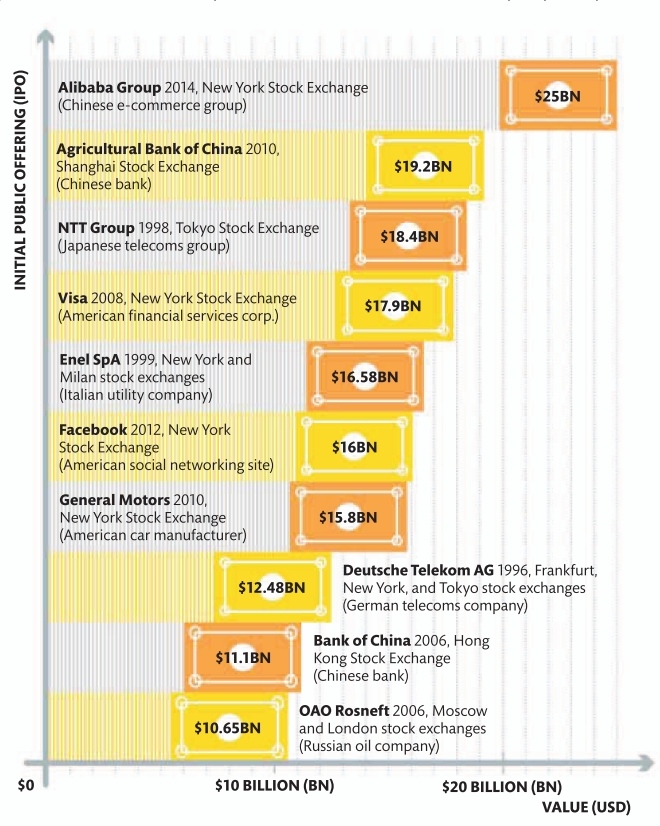
TEN LARGEST IPOS IN HISTORY
When a well-known private company undertakes an IPO, there is fierce competition between investors to buy its shares, and record-breaking activity can ensue. This graph shows the largest IPOs until 2014, based on proceeds from shares sold on the first day they went public.
WARNING
❯ Underestimation If the initial valuation of shares by the underwriters is too cautious, then the company will fail to realize the true value of its stock
❯ Overestimation If underwriters overestimate the value of shares newly on the market (new issue), it may flop due to lack of demand
❯ Volatility Share prices in the first few days of an IPO may fluctuate dramatically due to political or economic events
20%the typical minimum annual growth potential of public companies in the US
A closer look at IPOs
An Initial Public Offering (IPO) is the first time that shares in the company are offered for public sale. It is the most common way for a private company to go public if it needs a large injection of capital to fund major expansion. There are other reasons for going public—for example if a government wants to privatize a state-owned company, such as a national railroad, or if the members of a large family-owned enterprise want to sell their stake.
The IPO process
Before a company can issue shares, it has to be listed on a stock exchange where trading (the buying and selling of shares) can take place. The company must then fulfill the criteria necessary to secure investors. This process is lengthy, subject to strict financial regulations, and is extremely expensive to undertake. Only once all stages of the process are complete can the share offering be officially declared on a stock exchange.
1 Meet the qualifications The specific requirements are set by the stock exchange where the company plans to list. Listing conditions vary between exchanges, but typically demand:
- Pretax earnings above a certain level
- Three years of audited financial statements
- Ability to pay the annual listing fee
1 Appoint underwriters These financial professionals will be responsible for buying and selling the shares to the public.
3 File a prospectus This document contains information about the offering, the business, and its financial history, and proposed plans. Details are still subject to change.
4 Promote the share offering Company representatives, as well as the underwriters, visit national and international destinations to pitch to potential investors.
5 Set the final offer price After ascertaining market conditions and the anticipated demand, the company decides the price and the number of shares to issue. It is then ready to launch the offering.
6 Sell on the stock market The IPO is officially declared a few days after potential investors receive the final prospectus. The declaration is made on a set day after the exchange has closed, and the shares are available for trading the following day.
NEED TO KNOW
❯ Large cap Listed company with market capitalization of more than $10 billion
❯ Mid cap Listed company with market capitalization of between $2 billion and $10 billion
❯ Small cap Listed company with market capitalization of between $250 million and $2 billion
$16.6 trillion
the total market capitalization of companies listed on the New York Stock Exchange*
 Vnotes Education
Leave a comment