
Most companies prefer to secure funding from their own internal resources, rather than either take on debt through borrowing or give up a stake in the company by issuing shares, both of which cost more.
How it works
When a business needs funds, or capital, to pay for expansion or investment in order to maintain its current operations, it is faced with two choices: either find the money from outside sources, or find the money from within the organization itself. Since there are costs attached to bringing in funds from external sources, such as interest that has to be paid on a bank loan, the business managers must weigh up the opportunity cost of using its own funds—the profit it could earn by investing those funds—against the cost of financing.
Company
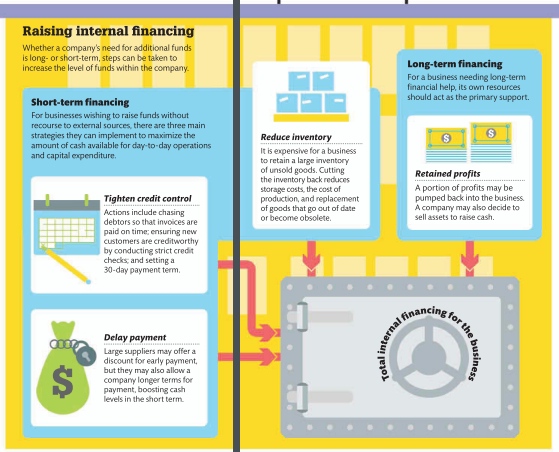
Raising internal financing
Whether a company’s need for additional funds
is long- or short-term, steps can be taken to increase the level of funds within the company.
Short-term financing
For businesses wishing to raise funds without recourse to external sources, there are three main strategies they can implement to maximize the amount of cash available for day-to-day operations and capital expenditure.
Tighten credit control Actions include chasing debtors so that invoices are
paid on time; ensuring new customers are creditworthy by conducting strict credit checks; and setting a 30-day payment term
Delay payment Large suppliers may offer a discount for early payment, but they may also allow a company longer terms for payment, boosting cash levels in the short term.
Reduce inventory It is expensive for a business to retain a large inventory of unsold goods. Cutting the inventory back reduces storage costs, the cost of production, and replacement of goods that go out of date or become obsolete.
Long-term financing
For a business needing long-term financial help, its own resources should act as the primary support.
Retained profits A portion of profits may be
pumped back into the business. A company may also decide to sell assets to raise cash.
USING PROFITS TO FUND EXPANSION
A company seeking to grow may choose to fund the expansion with its profits. This option offers both advantages and disadvantages.
Pros
❯ The use of profits means that no interest payment has to be made, unlike on money that is borrowed
❯ Existing owners and directors are able to retain full control over the business, rather than sharing it with new investors
❯ The company is able to keep a low debt profile, which will appeal to future investors and lenders
Cons
❯ Profits can take time to build up sufficiently to fund expansion
❯ Withholding dividends may upset some shareholders who prefer to receive the profit as dividends
❯ Lost opportunity to earn funds from investing profit rather than spending it
THE RECENCY BIAS
When a company receives timely payments for its invoices, this helps maintain its levels of funds. Interestingly, invoices issued right after completion of work tend to get paid sooner than those invoices that are sent later. A theory called recency bias explains this phenomenon: the brain prioritizes recent events over those that occurred longer ago.

44
the average number of days it takes a limited
company in the UK to pay a 30-day invoice
 Vnotes Education
Leave a comment